Laser-driven magnetic state defies equilibrium rules
Researchers used laser pulses and neutron scattering to reveal a long‑lived nonequilibrium magnetic state that breaks detailed‑balance rules.
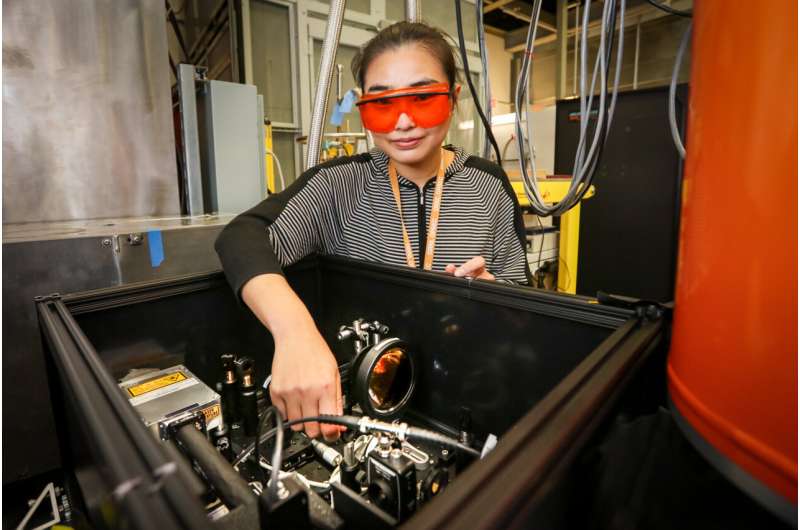
Laser‑driven magnons break detailed‑balance, opening a new window on nonequilibrium magnetism
A team at Oak Ridge National Laboratory (ORNL) has demonstrated that rapid laser pulses can push a magnetic material into a steady, nonequilibrium state that defies the classic “detailed‑balance” rule of statistical mechanics. By pairing ultrafast optics with the Spallation Neutron Source, the researchers directly observed an excess of low‑energy magnons that persisted far longer than a simple heating effect would allow. The work, published in Nature Communications, provides a fresh experimental platform for studying driven quantum systems in real time.
From laser excitation to neutron probing
The experiment began with femtosecond laser pulses striking a crystalline magnet. The light deposits energy on a sub‑picosecond timescale, displacing the system from its ground state. Rather than allowing the material to relax, the team applied a periodic train of pulses, creating a continuous drive that kept the system out of equilibrium.
To capture what happened inside the crystal, the sample was placed in the beamline of ORNL’s Spallation Neutron Source. Inelastic neutron scattering measured the energy and momentum of magnons—collective spin excitations that act as carriers of magnetic information. The neutron data revealed a striking asymmetry: extra scattering intensity appeared only on the energy‑gain side of the spectrum, a clear signature that the detailed‑balance relation had been broken.
Why breaking detailed‑balance matters
In a system at thermal equilibrium, detailed balance guarantees that the rates of energy‑absorbing and energy‑releasing processes are linked by a simple Boltzmann factor. Violating this rule means the system can sustain a net flow of excitations without external bias, a hallmark of genuine nonequilibrium steady states. The observed excess of low‑energy magnons persisted for many pulse cycles, indicating that the driven state is not a fleeting thermal spike but a robust, laser‑stabilized configuration.
This discovery has two immediate implications:
- Benchmark for nonequilibrium probes – It shows that neutron scattering, traditionally used on static samples, can resolve dynamic, driven phenomena with high precision.
- Platform for quantum‑information research – Magnons are being explored as carriers of quantum information because of their long coherence times. A controllable nonequilibrium magnon population could enable new schemes for low‑loss data transport or memory devices.
Looking ahead: from magnons to quantum technologies
The authors stress that the methodology is broadly applicable. By swapping the material or adjusting the laser drive, researchers could explore a variety of nonequilibrium phases, from Floquet‑engineered topological states to transient superconductivity. Moreover, the ability to generate and monitor a steady magnon excess may inform future efforts to interface magnetic materials with quantum processors, where coherent spin excitations could serve as interconnects.
While the current study focuses on a specific compound, the underlying principle—using synchronized light and neutron probes to capture driven quantum matter—opens a versatile experimental frontier. As the community builds on this proof‑of‑concept, we can expect deeper insights into how far‑from‑equilibrium dynamics shape the emergent properties of quantum materials.
--- The findings are detailed in Chengyun Hua et al., “Violation of detailed balance in non‑equilibrium magnons observed by inelastic neutron scattering,” Nature Communications (2026).
Hype check
RealThe paper in Nature Communications provides peer‑reviewed evidence of a detailed‑balance violation observed with neutron scattering; the claim matches the reported results.
- Peer-reviewed paper, or press release only?Paper — Published in Nature Communications
- Error-corrected (logical) qubits, or physical qubits only?Logical / not a qubit claim — Not a qubit‑count claim
- A new milestone, or a rebrand / restatement?New — First direct observation of detailed‑balance violation in a solid
- Independent confirmation?Not yet — No external replication mentioned
- Does the headline claim match what the source shows?Matches — Headline accurately reflects detailed‑balance violation
An editorial assessment of the claim as reported, not a judgment of the company or researchers. Checked against: phys.org. How we rate hype →
Source
Read original sourceWhy we picked this
Accepted from curated QuantumUnzipped source (relevance scoring disabled).