Leiden University and Riverlane Research Reveals Distance-Losing Flaw in Correlated Decoding Below Threshold
Leiden University and Riverlane discovered that standard two‑pass correlated decoders lose one unit of surface‑code distance below the error‑threshold, but a simple error‑rate‑dependent regularization restores the expected scaling without extra runtime cost.
Introduction
A joint study by researchers at Leiden University’s Instituut‑Lorentz and Applied Quantum Algorithms group and the quantum error‑correction company Riverlane has identified a subtle yet important flaw in the widely used two‑pass correlated decoding protocol for surface codes. Under realistic circuit‑level noise, the standard re‑weighting step can reduce the effective code distance by one unit deep in the sub‑threshold regime (physical error rates \(p < 10^{-3}\)). The authors propose a lightweight regularization that restores the nominal distance scaling while preserving the performance gains of correlated decoding, and it incurs no additional classical latency.
How Standard Correlated Decoding Breaks Down
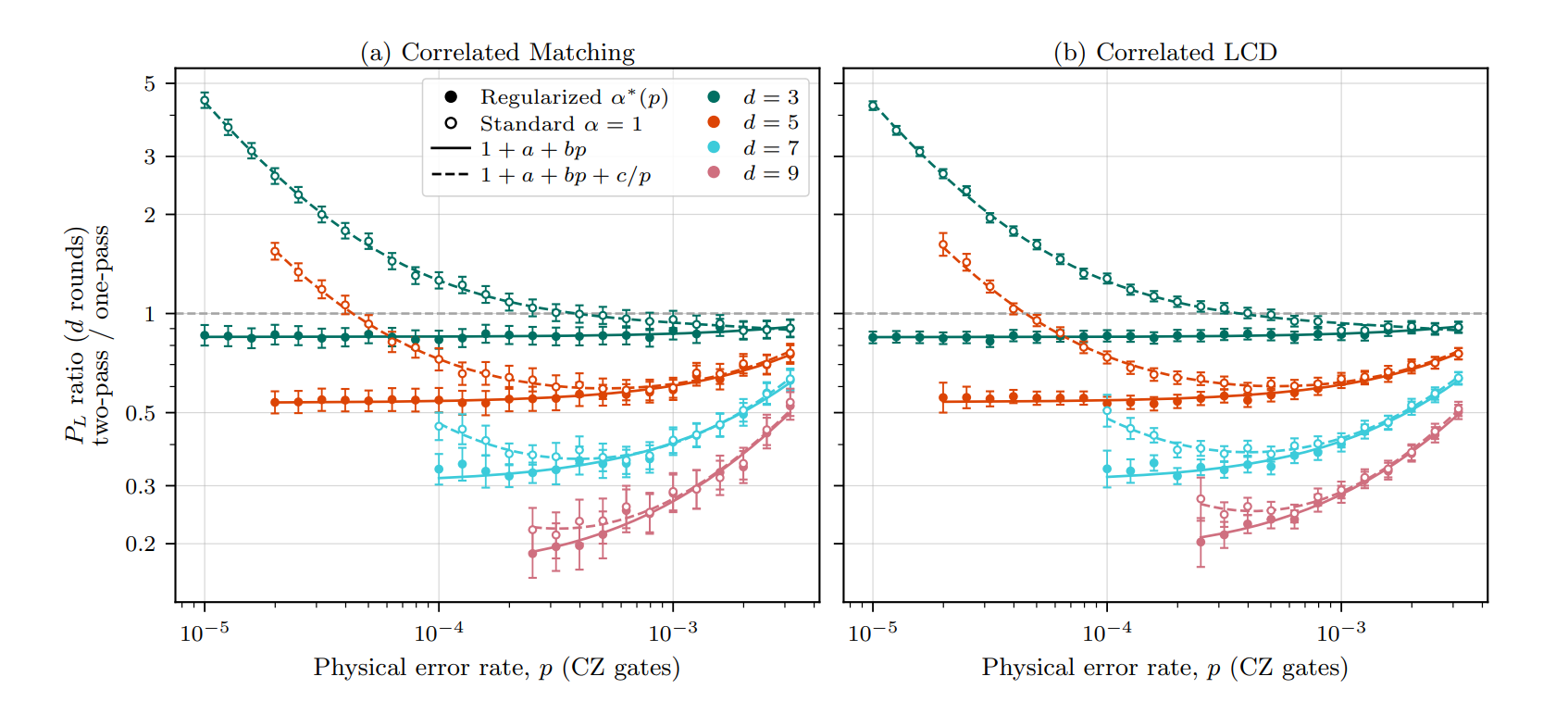
Correlated decoding improves upon basic minimum‑weight perfect matching (MWPM) or Union‑Find (UF) decoders by using the outcome of an initial pass (e.g., X‑type errors) to discount edge weights in the second pass (e.g., Z‑type errors). In the standard implementation, the re‑weighting rule applies a full discount to all edges that share a common error syndrome. When circuit‑level noise creates a single physical fault that can propagate to multiple independent hyperedges, this aggressive discount makes long, logically incorrect error chains appear artificially cheap. Consequently, error configurations of size \((d-1)/2\) – which a distance‑\(d\) surface code should correct – can trigger logical failures, effectively reducing the code’s distance to \(d-1\).
The Regularization Fix
The researchers introduce an error‑rate‑dependent scaling factor \(\alpha^{*}(p)\) that tempers the re‑weighting strength:
``` α*(p) = α0 / [1 + (p0 / p)^k] ```
For physical error rates near the threshold (\(p \approx 10^{-2}\)), \(\alpha^{}\) stays close to 1, so the decoder retains its usual advantage. As the error rate drops (\(p \le 10^{-4}\)), \(α^{}\) smoothly reduces, preventing over‑discounting of cross‑subgraph edges. The modified edge probability becomes \(p'{\nu}=α^{*}(p)\,P(e{\nu}\mid e_{\mu})\). Crucially, the optimal \(α^{}(p)\) can be pre‑computed during decoder initialization, meaning the regularized decoder adds zero runtime overhead* during the two decoding passes.
Performance Impact
| Decoder Variant | Effective Distance Scaling | Logical Error Ratio (\(p=10^{-5}\)) | Runtime Overhead | |-----------------|----------------------------|-----------------------------------|-------------------| | Uncorrelated (MWPM/UF) | \(p^{(d+1)/2}\) (baseline) | 1.0× | Baseline 1‑pass speed | | Standard Correlated | \(p^{(d-1)/2}\) (distance loss) | ~4.4× higher than baseline | Constant 2‑pass re‑weighting | | Regularized Correlated | \(p^{(d+1)/2}\) (distance restored) | ~0.55× lower than baseline | Zero extra latency |
The regularized decoder not only recovers the expected distance scaling but also delivers a lower logical failure rate than the uncorrelated baseline, all while keeping the classical processing cost unchanged.
Practical Implications
- Real‑time decoding architectures can adopt the regularization without redesigning hardware pipelines, since the weight tables are computed once offline.
- Belief‑matching and qLDPC decoders that rely on correlated re‑weighting can apply the same principle to avoid distance loss in other code families.
- As gate fidelities improve and physical error rates move further below threshold, the regularized approach ensures that error suppression continues to scale predictably, protecting the long‑term viability of fault‑tolerant quantum processors.
Closing Thoughts
The Leiden‑Riverlane analysis highlights that even well‑established decoding heuristics can harbor hidden scaling issues when confronted with realistic noise models. By introducing a simple, pre‑computable regularization parameter, the community gains a decoder that retains the speed and accuracy benefits of correlated decoding without sacrificing the surface code’s theoretical distance advantage. This insight will be valuable for anyone designing low‑latency QEC stacks for near‑term quantum hardware and for future fault‑tolerant architectures.
Source
Read original sourceWhy we picked this
Accepted from curated QuantumUnzipped source (relevance scoring disabled).