LeWorldModel plans up to 48x faster than foundation-model-based world models and run on a single GPU.
LeWorldModel claims up to 48× faster planning than foundation‑model world models while running on a single GPU.
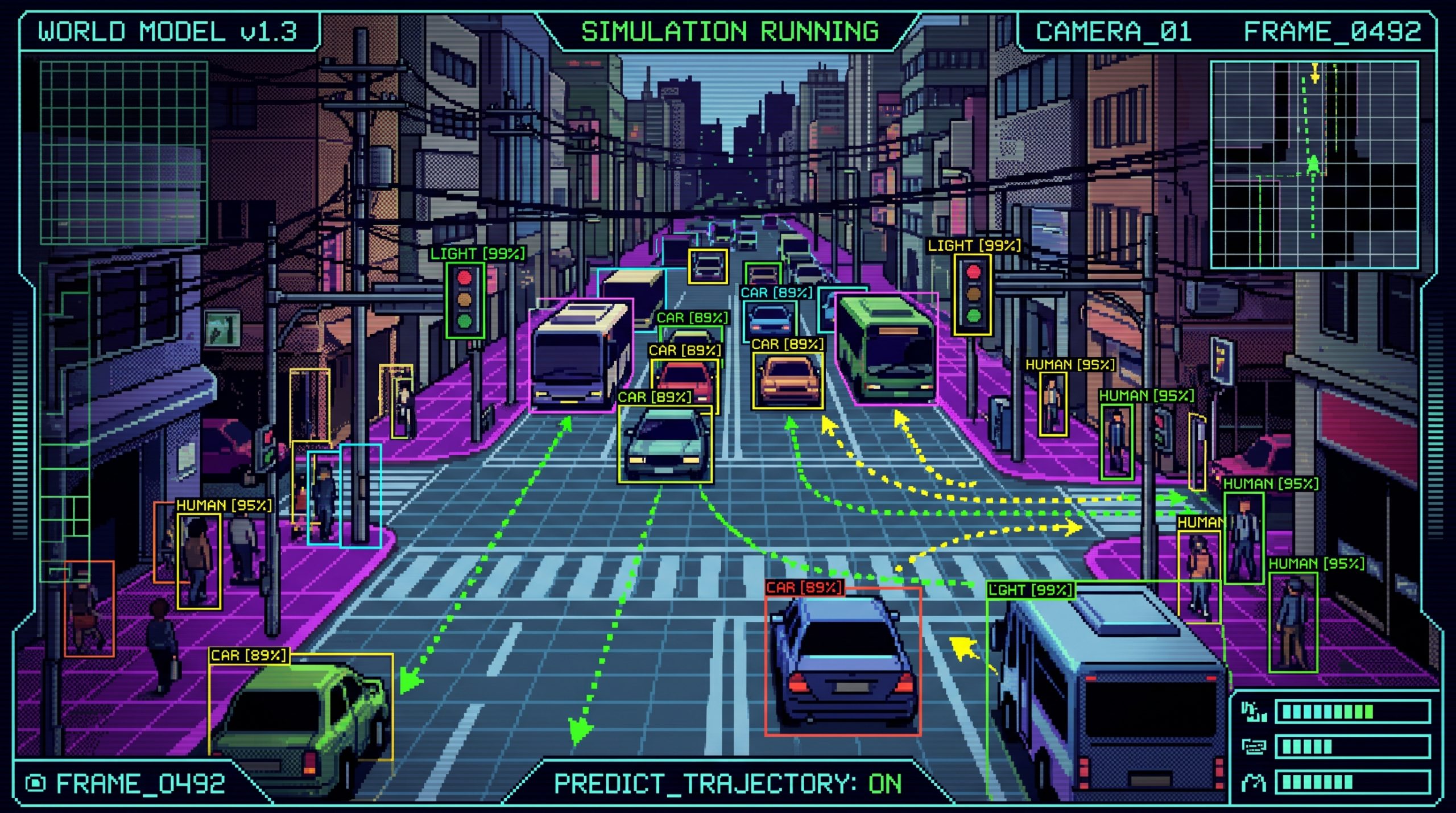
LeWorldModel: Faster Planning on a Single GPU
LeWorldModel (LeWM) is a new AI architecture that promises dramatic speed gains for planning tasks. Developed by a team that includes Yann LeCun, the model uses a Joint Embedding Predictive Architecture (JEPA) trained directly from raw pixels with only two loss terms. With 15 million parameters, LeWM can be trained on a single GPU in a few hours and reportedly plans up to 48 times faster than world models built on large foundation models.
Simpler Training, Stable Representations
Traditional end‑to‑end world models often require a suite of loss terms and careful hyper‑parameter tuning to avoid “representation collapse,” where the network maps all inputs to the same latent code. LeWM sidesteps this by enforcing a Gaussian distribution on its latent embeddings and pairing a prediction loss with a regularizer. The result is a training objective that needs only one adjustable hyper‑parameter, making the process more robust and easier to reproduce.
Speed Gains Through Latent‑Space Planning
LeWM’s planning pipeline works in a low‑dimensional latent space rather than raw pixel space. After encoding an observation, the model predicts the next latent state given an action, then uses Model Predictive Control to roll out a sequence of actions that reaches a goal. Because the latent representation is compact, each rollout is cheap, allowing the system to evaluate many candidate plans quickly. Benchmarks on 2‑D and 3‑D control tasks show planning times comparable to the PLDM baseline and far faster than the DINO‑WM architecture, which processes many more tokens per observation.
Physical Understanding and Plausibility Checks
Beyond speed, the authors highlight that LeWM’s latent space captures meaningful physical structure. Probing experiments reveal that the model encodes quantities such as object velocity and can flag scenarios that violate basic physics. This suggests the network is learning a more abstract, generalizable model of the world rather than merely memorizing successful action sequences.
Practical Implications
If the reported 48× speedup holds across a broader set of environments, LeWM could make high‑quality planning accessible to researchers without large compute clusters. Training on a single GPU in hours lowers the barrier to entry and may accelerate experimentation in robotics, simulation, and reinforcement learning. The open‑source release of the code further encourages community validation and extension.
Cautions and Next Steps
The performance claims are based on the authors’ internal benchmarks; independent replication has not yet been reported. Moreover, the speed advantage is measured under fixed computational budgets, and it is unclear how the model scales to more complex, high‑dimensional tasks. Future work should test LeWM on diverse real‑world datasets, compare it against additional baselines, and explore how the latent‑space physics encoding can be leveraged for safety‑critical applications.
In summary, LeWorldModel introduces a streamlined JEPA that appears to deliver substantial planning speedups on modest hardware while preserving a rich, physically grounded latent representation. The community will need to verify these results, but the approach points toward more efficient, accessible AI planning systems.
--- The article is based solely on the supplied editorial brief.
Hype check
PartlyThe 48× speed claim is backed by internal benchmarks only; no peer‑reviewed paper or independent verification is provided.
- Peer-reviewed paper, or press release only?Press release only — Only a press‑release style description, no paper cited
- Error-corrected (logical) qubits, or physical qubits only?Logical / not a qubit claim — Not a qubit‑count claim
- A new milestone, or a rebrand / restatement?New — Introduces a new JEPA architecture and speed claim
- Independent confirmation?Not yet — No external replication mentioned
- Does the headline claim match what the source shows?Matches — Headline reflects the 48× speed claim in the brief
An editorial assessment of the claim as reported, not a judgment of the company or researchers. How we rate hype →
Source
Read original sourceWhy we picked this
Accepted from curated QuantumUnzipped source (relevance scoring disabled).