LG CNS and D-Wave Partner to Evaluate Quantum Annealing for Enterprise Combinatorial Optimization
LG CNS and D‑Wave have signed a non‑binding MOU to explore quantum‑annealing solutions for enterprise‑scale combinatorial optimization across industries in South Korea and Asia.
Introduction
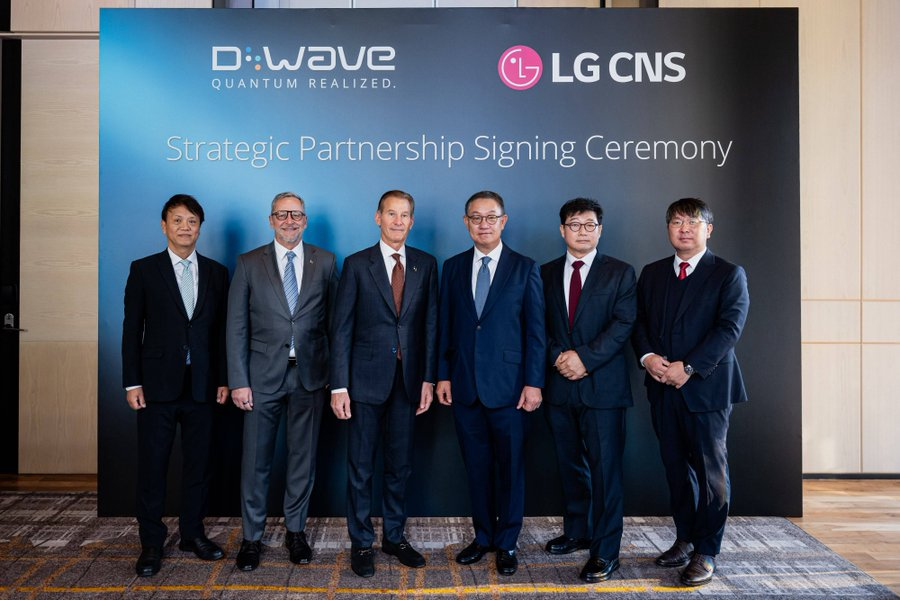
LG CNS, a leading South Korean IT systems integrator, and D‑Wave Quantum Inc., a pioneer of quantum‑annealing hardware and cloud services, announced a partnership to evaluate quantum‑annealing workflows for enterprise optimization. Unveiled at the Qubits Asia conference in Seoul, the collaboration aims to integrate D‑Wave’s Leap cloud platform with LG CNS’s optimization pipelines to tackle large‑scale combinatorial problems such as scheduling, routing, and anomaly detection.
Why Quantum Annealing?
Quantum annealing is designed for solving discrete optimization problems that grow exponentially in complexity as variables increase. Classical solvers—linear programming, mixed‑integer programming, and heuristic methods—often hit performance ceilings when faced with thousands of interdependent variables. By mapping these problems onto a quantum‑annealing processor, D‑Wave promises faster convergence to high‑quality solutions, especially for:
- Industrial scheduling – allocating machines, labor, and materials in factories.
- Logistics and routing – optimizing delivery routes for fleets and supply‑chain networks.
- Telecommunications – dynamic routing of data traffic to minimize latency.
- Anomaly detection – identifying outliers in visual‑inspection images or subsurface sensor data.
How the Partnership Will Work
The non‑binding memorandum of understanding outlines a joint development framework rather than a commercial contract. Key responsibilities include:
- Problem formulation – LG CNS will translate real‑world business challenges into quadratic unconstrained binary optimization (QUBO) models suitable for quantum annealing.
- Algorithm validation – Both parties will run hybrid quantum‑classical solvers on D‑Wave’s Leap cloud, comparing results against state‑of‑the‑art classical algorithms.
- Integration testing – LG CNS will embed the quantum‑annealing workflow into its existing enterprise software stacks, ensuring seamless data flow and security compliance.
- Performance benchmarking – Joint studies will quantify speed‑up, solution quality, and cost‑effectiveness, providing a data‑driven basis for any future commercial rollout.
Potential Impact and Challenges
If successful, the collaboration could give LG CNS a differentiated offering in the competitive Korean and broader Asian markets, where enterprises are increasingly seeking AI‑enhanced optimization tools. For D‑Wave, the partnership opens a direct channel to a major systems integrator, expanding its footprint beyond North America. However, several hurdles remain:
- Scalability – Current quantum‑annealing hardware supports problems up to a few thousand variables; larger enterprise use cases may still require hybrid approaches.
- Economic viability – Without disclosed hardware purchases or cloud‑compute commitments, the business case hinges on demonstrable performance gains over classical solvers.
- Regulatory and security concerns – Enterprise data must be protected when processed in a cloud environment, especially for sectors like telecommunications and logistics.
Looking Ahead
The MOU sets the stage for a series of pilot projects that will test quantum‑annealing’s practical benefits in real‑world settings. Stakeholders should watch for forthcoming benchmark reports, which will reveal whether quantum annealing can move from a promising research tool to a production‑grade optimization engine.
--- This article provides an overview of the LG CNS–D‑Wave partnership based on publicly available information and does not contain proprietary data or undisclosed agreements.
Source
Read original sourceWhy we picked this
Accepted from curated QuantumUnzipped source (relevance scoring disabled).