Light-activated molecules in porous crystals show potential for quantum chemical sensing
Researchers have created light‑activated, spin‑polarized radical pairs in metal‑organic frameworks, opening a path toward quantum‑enhanced chemical sensors.
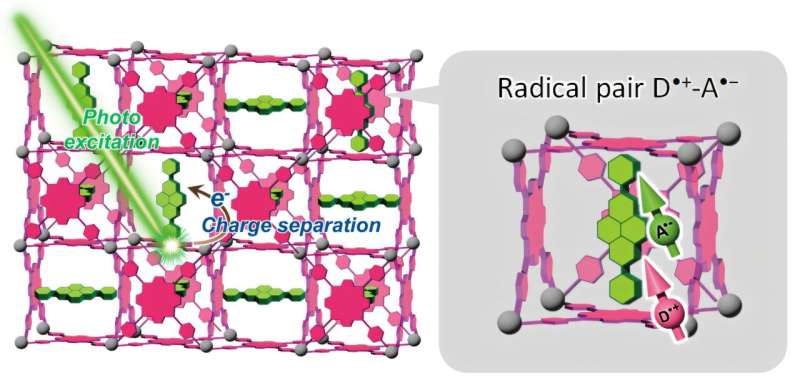
Light‑Activated Radical Pairs in Porous Crystals: A Step Toward Quantum Chemical Sensing
A collaborative team led by Nobuhiro Yanai (University of Tokyo) and Michael R. Wasielewski (Northwestern University) has demonstrated that metal‑organic frameworks (MOFs) can host ordered arrays of spin‑polarized radical pairs generated by light. The work, published in Nature Communications, combines synthetic chemistry, ultrafast spectroscopy, electron‑paramagnetic‑resonance (EPR) measurements, and quantum‑chemical calculations to show that the spin state of these radical pairs responds measurably to external chemical stimuli. The authors argue that this platform could become the foundation of a “quantum nose” – a sensor that leverages quantum spin properties for ultra‑sensitive chemical detection, potentially improving techniques such as magnetic‑resonance imaging.
---
Why Radical Pairs Matter for Sensing
Radical pairs consist of two molecules each bearing an unpaired electron. Their spins can be aligned (polarized) or anti‑aligned, and the interconversion between these spin states is exquisitely sensitive to magnetic fields, molecular collisions, and chemical environments. In nature, such spin‑dependent reactions underlie avian magnetoreception and certain photochemical processes. Translating this sensitivity into a solid‑state platform has been challenging because radical pairs have traditionally been studied in isolated, non‑crystalline samples.
---
Building Ordered Arrays Inside MOFs
MOFs provide a highly porous, crystalline scaffold where metal nodes are linked by organic ligands, creating uniform cavities that can host guest molecules. The researchers designed photo‑active molecules that, upon illumination, undergo electron transfer to generate a radical pair directly within the framework. By varying ligand structures, they screened several candidates using:
- Ultrafast transient absorption spectroscopy to track the formation and decay of the excited states;
- EPR spectroscopy to confirm spin polarization and measure hyperfine interactions;
- Quantum‑chemical calculations to rationalize the observed spin dynamics.
The combined data show that the radical pairs are not only formed reproducibly but also retain a coherent spin polarization that can be modulated by introducing specific chemical analytes into the MOF pores.
---
Toward a Quantum‑Enhanced Chemical “Nose”
The key demonstration is that the spin properties of the radical pairs change in response to external chemicals, suggesting a direct read‑out mechanism for sensing. Unlike conventional chemical sensors that rely on bulk property changes (e.g., conductivity), this approach could detect minute variations at the quantum level, potentially offering:
- Higher sensitivity due to the intrinsic amplification of spin‑dependent reactions;
- Selectivity by tailoring the host‑guest chemistry of the MOF;
- Room‑temperature operation, as the experiments were performed under ambient conditions.
Future work will explore a broader library of spin systems, improve the signal‑to‑noise ratio of the EPR read‑out, and integrate the MOF crystals into device architectures.
---
Practical Outlook
While still at a proof‑of‑concept stage, the study provides a clear experimental pathway for quantum chemical sensing. If the spin response can be reliably quantified and scaled, applications could range from medical diagnostics (enhanced MRI contrast agents) to environmental monitoring (detecting trace gases). The interdisciplinary nature of the work—spanning chemistry, physics, and materials science—highlights the collaborative effort required to translate quantum phenomena into real‑world technologies.
---
The research underscores how engineered quantum states in solid‑state materials can move beyond abstract physics experiments toward tangible sensing solutions.
Hype check
RealThe paper in Nature Communications provides experimental evidence of light‑generated, spin‑polarized radical pairs in MOFs and shows their response to chemicals, meeting the claim without overstating performance.
- Peer-reviewed paper, or press release only?Paper — Published in Nature Communications, a peer‑reviewed journal
- Error-corrected (logical) qubits, or physical qubits only?Logical / not a qubit claim — The story does not involve qubit counts
- A new milestone, or a rebrand / restatement?New — First ordered array of radical pairs in a crystalline MOF
- Independent confirmation?Not yet — No external replication mentioned in the input
- Does the headline claim match what the source shows?Matches — Headline accurately reflects the reported result
An editorial assessment of the claim as reported, not a judgment of the company or researchers. Checked against: phys.org. How we rate hype →
Source
Read original sourceWhy we picked this
Accepted from curated QuantumUnzipped source (relevance scoring disabled).