LMU’s quantum Rydberg atom experiment shows interaction over micrometers
LMU Munich has demonstrated micrometer‑scale interactions between Rydberg‑excited rubidium atoms using a combined optical‑tweezer, cavity, and Rydberg platform.
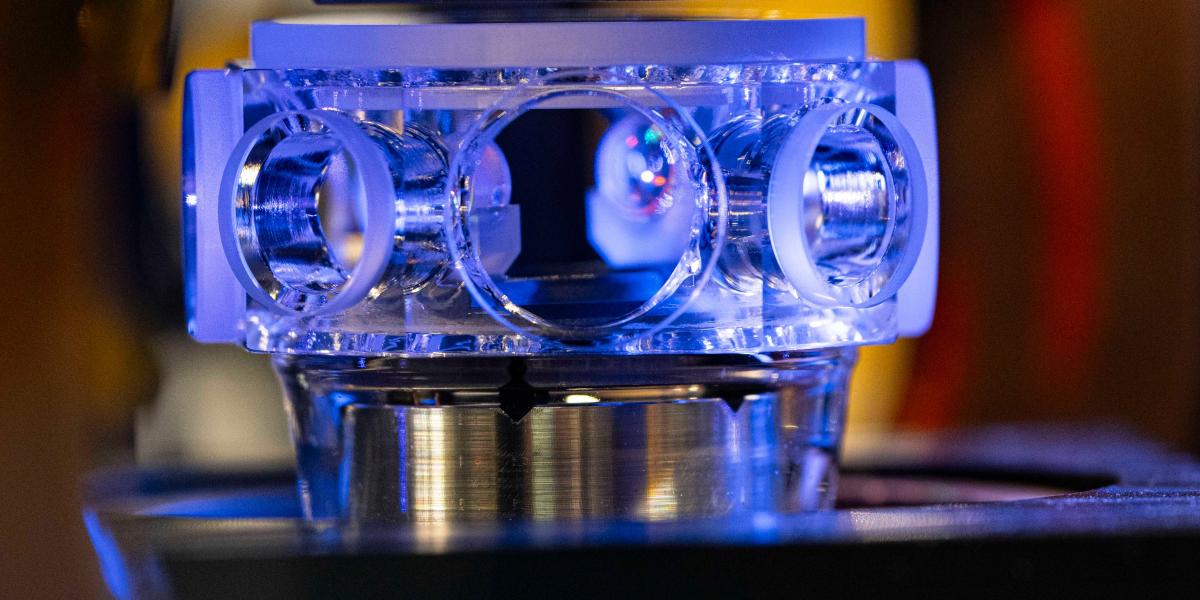
A New Interaction Range for Rydberg Atom Arrays
Researchers at Ludwig‑Maximilians‑Universität (LMU) Munich have reported a laboratory‑scale breakthrough that could help link quantum processors with light. By integrating optical tweezers, a high‑cooperativity optical cavity, and Rydberg excitation of rubidium atoms, the team observed strong atom‑photon coupling and Rydberg blockade over distances of several micrometers – a scale far larger than the typical sub‑nanometer spacing of atoms in most neutral‑atom platforms.
Combining Three Technologies
The experiment brings together three well‑established tools in quantum optics:
- Optical tweezers – tightly focused laser beams that trap individual atoms and allow precise positioning.
- Optical cavity – two highly reflective mirrors form a resonator where a photon bounces thousands of times, amplifying its interaction with any atom inside.
- Rydberg excitation – promoting an atom to a high‑energy Rydberg state gives it a huge electric dipole moment, enabling strong, long‑range interactions with neighboring atoms.
Individually, each component has driven progress in quantum simulation and computation. The novelty here is the seamless integration of all three, which previously proved difficult because Rydberg atoms are extremely sensitive to stray electric fields that can destabilise a cavity.
Micrometer‑Scale Coupling Demonstrated
In the LMU setup, rubidium atoms were spaced by several micrometers – a distance that is thousands of times larger than the atomic size. Two key observations confirmed the platform’s capabilities:
- Cavity shift – the presence of one or more atoms altered the resonance frequency of the cavity, showing that each atom couples strongly to the light field.
- Rydberg blockade – groups of up to four atoms exhibited the classic blockade effect, where excitation of one atom prevents its neighbors from being excited, a hallmark of collective, entangled behavior.
These measurements prove that both atom‑light and atom‑atom interactions can coexist in the same array, a prerequisite for photonic links between separate quantum processors.
Toward Light‑Linked Quantum Networks
The authors frame the result as a “building block” for quantum networks. By first entangling atoms within a cavity and then mapping that entanglement onto photons, distant nodes could exchange quantum information without moving the atoms themselves. The next experimental steps outlined include deterministic entanglement of selected atom configurations and read‑out of their states via the cavity – both essential for implementing error‑correction protocols and scaling up to larger, networked quantum computers.
Why This Matters
Current neutral‑atom platforms typically rely on nearest‑neighbor interactions, limiting the geometry of quantum gates. Extending the interaction range to micrometers opens new possibilities for non‑local gate operations, more flexible qubit layouts, and hybrid architectures that combine matter‑based processors with photonic communication channels. While the work is still at the proof‑of‑concept stage, it demonstrates that the technical hurdles of merging cavities and Rydberg arrays can be overcome.
---
The experiment is described in a press release from LMU Munich. No peer‑reviewed paper has been cited yet, and independent verification is pending.
Hype check
PartlyThe press release reports a novel experimental capability, but lacks a peer‑reviewed paper or external confirmation, so the claim is plausible yet not fully validated.
- Peer-reviewed paper, or press release only?Press release only — Only a press release is cited, no paper or preprint mentioned
- Error-corrected (logical) qubits, or physical qubits only?Logical / not a qubit claim — The story does not involve qubit‑count claims
- A new milestone, or a rebrand / restatement?New — Demonstrates micrometer‑scale interactions, a new experimental result
- Independent confirmation?Not yet — No external replication or third‑party confirmation reported
- Does the headline claim match what the source shows?Matches — Headline accurately reflects the reported micrometer‑scale interaction
An editorial assessment of the claim as reported, not a judgment of the company or researchers. Checked against: lmu.de. How we rate hype →
Source
Read original sourceWhy we picked this
Accepted from curated QuantumUnzipped source (relevance scoring disabled).