Local measurements reveal global quantum properties in a constant number of experimental runs
A new protocol certifies global quantum properties with a constant number of measurement runs, regardless of system size.
Constant‑Sample Certification of Quantum States
A recent study in Physical Review X demonstrates that key global properties of many‑qubit quantum systems—such as fidelity to a target state, multipartite entanglement, circuit complexity, and quantum "magic"—can be verified using only local measurements on a small subsystem. Remarkably, the number of experimental repetitions required does not grow with the total number of qubits, breaking the scaling barrier that has limited verification of larger devices.
How the Protocol Works
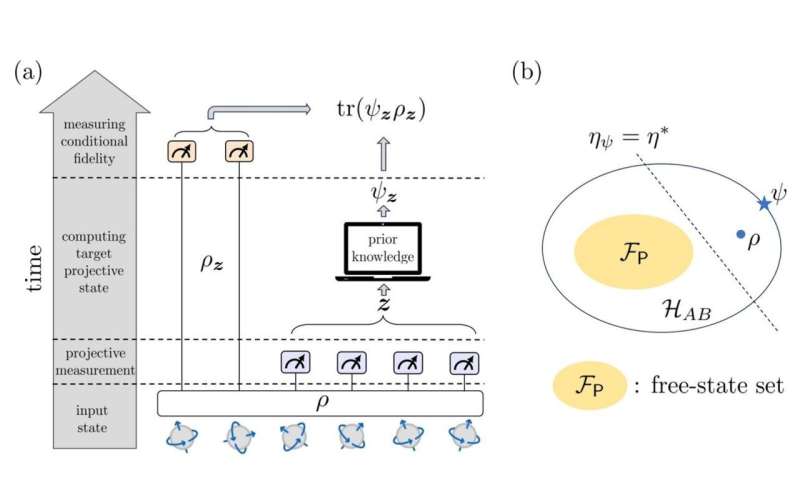
- Partition the system into a tiny subsystem A and a large complement B.
- Measure B in the computational basis, recording each outcome.
- Measure A in randomly chosen single‑qubit Pauli bases.
- Combine the two data streams into a conditional fidelity score.
- Compare the score to a preset threshold; passing the threshold certifies the desired property.
All measurement settings are fixed beforehand—no adaptive feedback or post‑selection is needed. The method works for both pure and mixed (noisy) states, making it directly applicable to real‑world devices.
Why Constant Sample Complexity Matters
Traditional state‑tomography or fixed‑local‑measurement protocols require sample numbers that scale as \(n^4\) or at best linearly with the qubit count \(n\). As a result, doubling the number of qubits can increase experimental cost dramatically. The new protocol’s sample complexity remains constant, meaning the same amount of data suffices whether the device has 10 qubits or 512. This flattening of the cost curve enables practical certification of the large‑scale machines that are emerging in labs worldwide.
Extending Beyond Fidelity
The authors show that the same framework can certify:
- Multipartite entanglement, reducing the sample requirement from \(O(n)\) to \(O(\log n)\).
- Circuit complexity, by detecting non‑trivial computational structure in the subsystem.
- Quantum magic, the resource needed for fault‑tolerant quantum computing, using only a three‑qubit subsystem even as the full system scales to hundreds of qubits.
These extensions illustrate that a small local “fingerprint” can reveal a wide range of global quantum resources.
Practical Outlook
As quantum hardware moves from proof‑of‑concept experiments toward scalable processors, reliable and inexpensive verification becomes a prerequisite. By eliminating the need for exhaustive tomography and tolerating realistic noise, this protocol offers experimenters a ready‑to‑use tool for benchmarking and quality control. Its simplicity—fixed measurement bases and no adaptive steps—makes it compatible with existing control electronics and measurement pipelines.
Bottom line: The constant‑sample certification method provides a scalable, noise‑robust pathway to validate the essential quantum properties that underpin future quantum technologies.
--- For the full technical details, see Z. Du et al., “Certifying Localizable Quantum Properties with Constant Sample Complexity,” Physical Review X (2026).
Hype check
RealThe paper provides a concrete protocol with constant sample complexity, backed by a peer‑reviewed PRX article; no external replication is mentioned but the claim matches the evidence.
- Peer-reviewed paper, or press release only?Paper — Published in Physical Review X (2026) with DOI provided
- Error-corrected (logical) qubits, or physical qubits only?Logical / not a qubit claim — Not a qubit‑count claim; focuses on certification method
- A new milestone, or a rebrand / restatement?New — Introduces constant‑sample complexity, a novel result
- Independent confirmation?Not yet — No external confirmation or replication cited
- Does the headline claim match what the source shows?Matches — Headline accurately reflects the constant‑sample certification result
An editorial assessment of the claim as reported, not a judgment of the company or researchers. Checked against: phys.org. How we rate hype →
Source
Read original sourceWhy we picked this
Accepted from curated QuantumUnzipped source (relevance scoring disabled).