Los Alamos and QC Ware Model Correlated Iron Oxides Using Sample-Based Quantum Diagonalization on IBM Hardware
Los Alamos National Laboratory and QC Ware demonstrate that sample‑based quantum diagonalization on IBM’s ibm_miami hardware can achieve chemical accuracy for correlated iron‑oxide models where conventional VQE struggles.
Introduction
A recent preprint from Los Alamos National Laboratory (LANL) and QC Ware showcases a hybrid quantum‑classical workflow that tackles the notoriously difficult electronic structure of strongly correlated iron oxides. By coupling tight‑binding Hamiltonians derived from density‑functional theory with a Sample‑Based Quantum Diagonalization (SQD) protocol executed on IBM’s ibm_miami quantum processor, the team reaches chemical accuracy for FeO and Fe₂O₂ systems—benchmarks that have previously stalled variational quantum eigensolver (VQE) approaches.
---
From Tight‑Binding Models to Quantum Sampling
The researchers start with non‑spin‑polarized DFT calculations, extracting localized Wannier functions to construct multi‑orbital d‑p Hamiltonians for the target materials. These Hamiltonians capture the essential electron‑electron interactions that give bulk FeO its Mott‑insulating character, a regime where standard DFT incorrectly predicts metallic behavior.
To keep the quantum circuits shallow and compatible with near‑term hardware, a one‑layer Local Unitary Cluster Jastrow (LUCJ) ansatz is employed. The ansatz restricts two‑mode Givens rotations to nearest‑neighbor qubit connectivity, eliminating the need for costly SWAP operations. Circuit parameters are first optimized in classical state‑vector simulations, avoiding barren‑plateau issues on the actual quantum processor.
---
Sample‑Based Quantum Diagonalization on ibm_miami
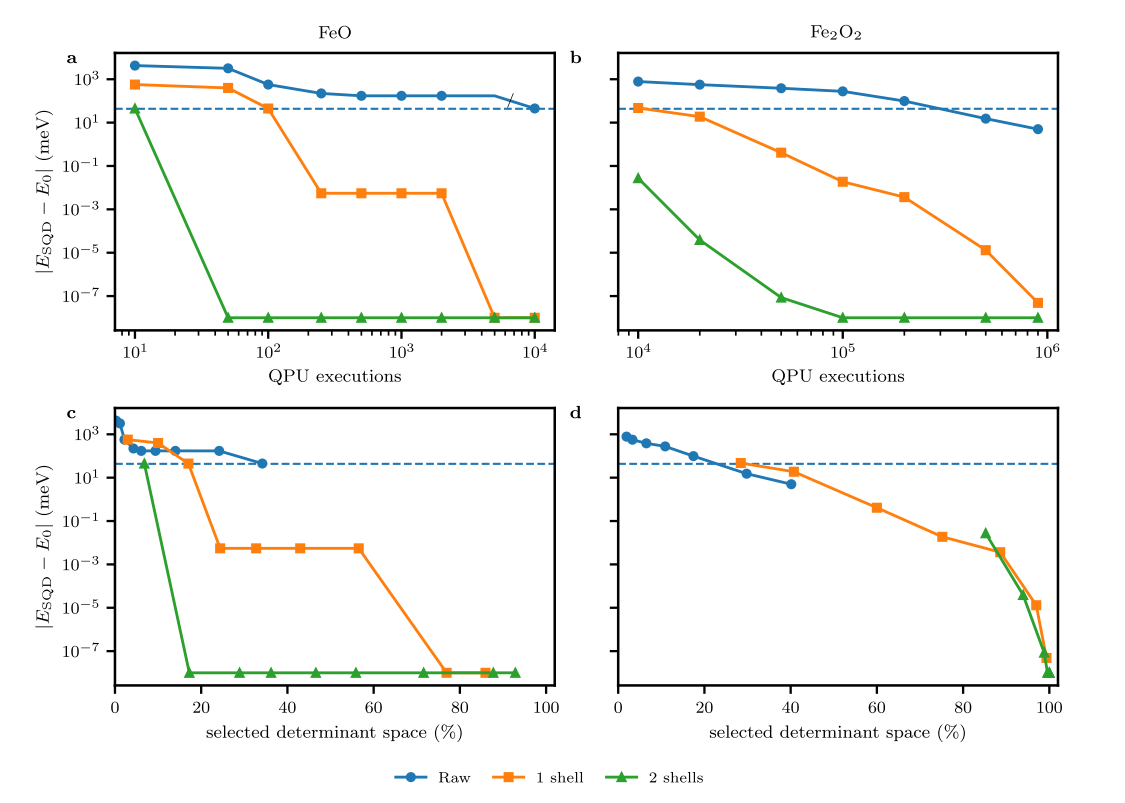
Instead of using the quantum device for full‑scale energy minimization, the ibm_miami system serves purely as a Fock‑space sampler. Measured bitstrings are post‑selected to enforce particle‑number conservation and then expanded into one‑ and two‑shell Fock‑space graphs based on non‑zero Hamiltonian matrix elements. Classical exact diagonalization of this projected Hamiltonian converges rapidly:
- FeO (diatomic) – 12 electrons in 16 spin orbitals (16 qubits) sampled across six parallel instances. SQD recovers the ground doublet using only 184 determinants, achieving an excitation energy of ~2,167 cm⁻¹ and staying within the 43 meV chemical‑accuracy threshold.
- Fe₂O₂ (rhombic dimer) – 24 electrons in 32 spin orbitals (32 qubits) sampled across three parallel instances. A similar reduction in determinant space yields accurate magnetic ground‑state predictions.
In contrast, a raw VQE run on the same hardware leaves a residual error of ~173 meV, far above the chemical‑accuracy limit, and becomes trapped in a non‑linear variational parameter manifold.
---
Implications and Future Directions
The success of SQD demonstrates a practical pathway for leveraging noisy intermediate‑scale quantum (NISQ) devices as high‑throughput samplers rather than full optimizers. By off‑loading the heavy lifting of parameter optimization to classical simulations and using the quantum hardware to generate statistically rich configuration samples, the workflow sidesteps many of the scaling bottlenecks that have limited prior quantum chemistry efforts.
The authors outline a roadmap for extending the approach to bulk periodic FeO. By distributing SQD sub‑blocks across Brillouin‑zone k‑points, the method could capture long‑range electronic correlations in realistic solid‑state environments while keeping quantum resource demands manageable.
---
Practical Takeaway
For practitioners interested in quantum chemistry on NISQ hardware, the LANL‑QC Ware study offers a concrete template:
- Derive a compact, physically motivated Hamiltonian (e.g., via Wannier‑function tight‑binding) to limit qubit count.
- Use a shallow, connectivity‑aware ansatz such as LUCJ to reduce circuit depth.
- Perform classical optimization of parameters and reserve the quantum processor for sampling measurement outcomes.
- Post‑process sampled bitstrings into a reduced determinant space and apply classical diagonalization to retrieve accurate energies.
By following these steps, research groups can achieve chemically accurate results for challenging correlated materials without waiting for fully fault‑tolerant quantum computers.
---
The preprint, titled “Towards Quantum Computation of Bulk FeO,” is available on arXiv for readers seeking the full technical details.
Source
Read original sourceWhy we picked this
Accepted from curated QuantumUnzipped source (relevance scoring disabled).