MoS2 flake creates bright, tunable N00N states for quantum sensing
A sub‑wavelength 3R‑MoS₂ flake directly generates bright, pump‑tunable two‑photon N00N states for quantum‑enhanced sensing.
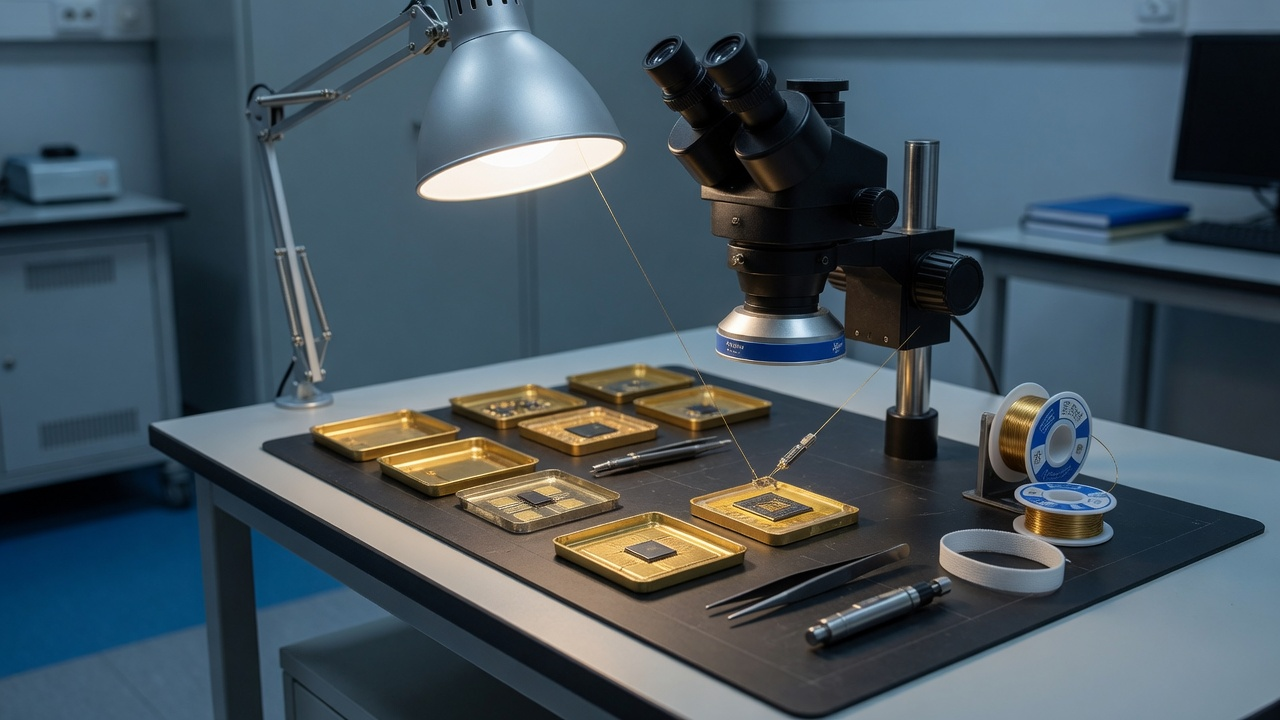
Compact, tunable N00N‑state source
Researchers at the University of Vienna and Columbia University have shown that a few‑layer 3R‑MoS₂ crystal can emit polarization‑entangled photon pairs in a N00N state without any external interferometer. By focusing a continuous‑wave 426 nm pump onto a sub‑micrometer‑thick flake, spontaneous parametric down‑conversion occurs across all symmetry‑allowed pathways, producing a bright, single‑spatial‑mode source.
Pump‑controlled state basis
The crystal’s C3v symmetry links the pump polarization directly to the N00N basis. Rotating the pump rotates the Wigner function of the emitted state, and a downstream half‑wave plate shifts the interference fringe by four times the plate angle—twice the rate of classical or single‑photon fringes. Polarization‑resolved tomography confirms that the density matrix follows the pump angle, while fringe visibilities stay above 95 % across the full range.
Brightness and quality
Coincidence‑to‑accidental ratios reach ~10³ at 25 µW pump power, falling to ~5 at 2.5 mW due to photoluminescence. The biphotons are centered at 852 nm, collected in transmission, and exhibit near‑perfect time correlation. Compared with traditional bulk‑crystal schemes that discard half the pairs at a beam splitter, this monolithic source retains essentially all generated photons.
Outlook: higher‑order Holland‑Burnett states
The authors’ theory shows that the same χ^(2) interaction could generate multi‑photon Holland‑Burnett (twin‑Fock) states, opening a path toward more complex entangled resources for Heisenberg‑limited interferometry. Because the process relies on crystal symmetry rather than phase‑matching, it can be integrated with silicon photonics and other on‑chip platforms.
Practical take‑away: A thin 3R‑MoS₂ flake offers a compact, pump‑programmable source of high‑fidelity N00N states, potentially simplifying quantum‑sensing hardware and enabling scalable integration with photonic circuits.
Hype check
PartlyThe arXiv preprint reports a novel source, but it is not yet peer‑reviewed and lacks independent replication, so the claim is promising but not fully validated.
- Peer-reviewed paper, or press release only?Press release only — Only an arXiv preprint is cited
- Error-corrected (logical) qubits, or physical qubits only?Logical / not a qubit claim — No qubit count is involved
- A new milestone, or a rebrand / restatement?New — First direct generation of tunable N00N states from a 2D flake
- Independent confirmation?Not yet — No external confirmation mentioned
- Does the headline claim match what the source shows?Matches — Headline accurately reflects the reported result
An editorial assessment of the claim as reported, not a judgment of the company or researchers. Checked against: arxiv.org. How we rate hype →
Source
Read original sourceWhy we picked this
Accepted from curated QuantumUnzipped source (relevance scoring disabled).