Moth Demonstrates Topology-Aware Quantum Data Encoding Across 120 Qubits Without SWAP Overhead
Moth Quantum’s Tessa scheme encodes thousands of parameters on 120 physical qubits without using SWAP routing gates, setting a new hardware record for quantum data encoding.
Moth Quantum’s Tessa pushes quantum data encoding past the SWAP barrier
Moth Quantum has unveiled Tessa (Tessellated QPIXL), a hardware‑native state‑preparation method that can embed up to 1,568 real‑valued parameters across every qubit of a 120‑qubit IBM superconducting processor. The key claim is that the encoding proceeds without any SWAP routing gates, a long‑standing bottleneck for nearest‑neighbor devices.
---
How Tessa sidesteps SWAP overhead
Conventional angle‑encoding approaches such as QPIXL or QCrank rely on a star‑connected graph: a small set of address qubits controls many data qubits. On chips with only nearest‑neighbor couplings, this forces deep SWAP chains that inflate circuit depth and error rates. Tessa tackles the problem by 2‑coloring the device graph. The processor’s bipartite coupling graph is split into interleaved address and data registers, ensuring each data qubit is driven only by its immediate address neighbours. The resulting circuit depth scales with the local vertex degree rather than the total qubit count, eliminating the need for SWAPs entirely.
---
Benchmark highlights
The preprint reports several concrete experiments on IBM’s Nighthawk r2 (120‑qubit square‑lattice) and Heron r2 (156‑qubit heavy‑hex) devices:
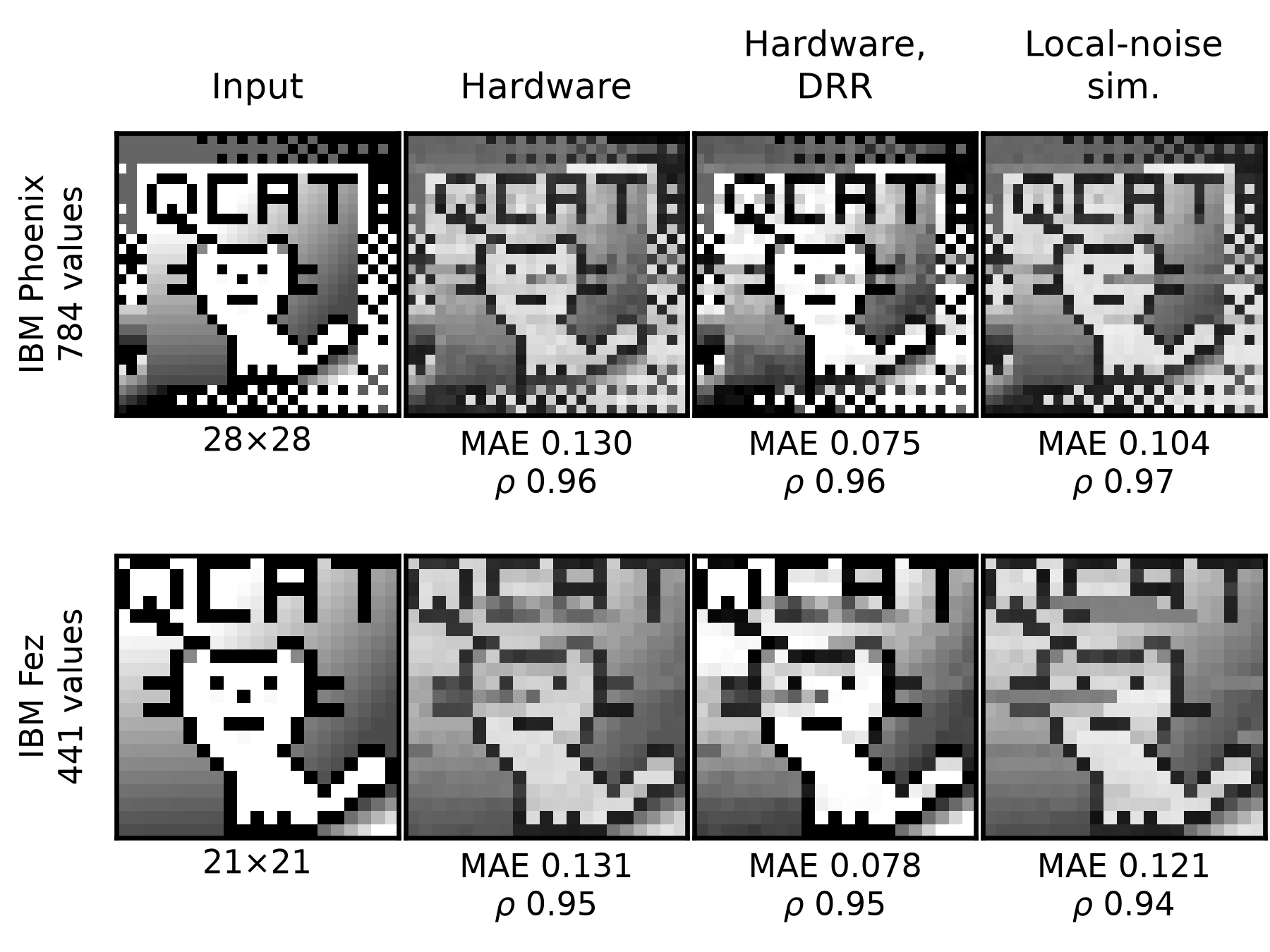
- Square‑lattice, Z‑basis – 784 values encoded with 728 CZ gates (depth 23), achieving 0.075 MAE and 0.96 correlation after contrast recovery.
- Square‑lattice, Z & X bases – 1,568 values encoded with 1,456 CZ gates (depth 43), yielding 0.154 value MAE and 0.092 hue MAE at 8,192 shots per basis.
- Heavy‑hex – 441 values (428 CZ gates) with 0.95 correlation in Z mode; 882 values (852 CZ gates) in the paired mode.
- Biological sequence reconstruction – 92.3 % of a 784‑nt mitochondrial DNA fragment and 71.5 % of a 393‑aa p53 protein sequence were recovered using Bloch‑sphere constellation encoding.
These results surpass the previous 128‑value hardware record set by QCrank, demonstrating that Tessa can handle substantially larger real‑valued vectors on existing superconducting hardware.
---
Practical implications and limits
Tessa’s design shines when the local connectivity degree is low. Because readout shots must be divided across the 2^m address states of a degree‑m data qubit, sampling overhead grows exponentially with connectivity. Consequently, the method is best suited for quantum‑machine‑learning (QML) workloads that ingest modest‑dimensional feature vectors rather than for general‑purpose classical memory emulation.
Moth has also integrated Tessa into Atlas, its alpha‑stage creative platform. Developers can now experiment with quantum‑enhanced image processing, audio re‑encoding, MIDI variation, and other media‑centric utilities via no‑code web tools or programmatic APIs that target real quantum back‑ends or simulators.
---
Outlook
While the preprint provides solid internal benchmarks, external validation remains pending. If independent groups can reproduce the SWAP‑free depth reductions on comparable hardware, Tessa could become a staple technique for QML pipelines that must operate within the tight error budgets of near‑term devices. For now, the work marks a noteworthy step toward more topology‑aware quantum software that respects the physical constraints of superconducting chips.
---
The technical paper is available on arXiv, and the open‑source Tessa repository can be found on GitHub.
Hype check
RealThe arXiv preprint supplies detailed benchmark data showing encoding on 120 physical qubits without SWAP gates, providing a concrete, verifiable result.
- Peer-reviewed paper, or press release only?Paper — Technical preprint on arXiv cited in the article
- Error-corrected (logical) qubits, or physical qubits only?Physical only — The result concerns physical qubits, not logical qubits
- A new milestone, or a rebrand / restatement?New — Surpasses previous 128‑value record, a genuine new performance claim
- Independent confirmation?Not yet — No external replication or third‑party confirmation mentioned
- Does the headline claim match what the source shows?Matches — Headline accurately reflects the preprint’s claim of topology‑aware encoding on 120 qubits without SWAPs
An editorial assessment of the claim as reported, not a judgment of the company or researchers. How we rate hype →
Source
Read original sourceWhy we picked this
Accepted from curated QuantumUnzipped source (relevance scoring disabled).