National Tsing Hua University spots quantum critical point
National Tsing Hua University researchers have provided the first definitive evidence of a quantum critical point in high‑temperature cuprate superconductors.
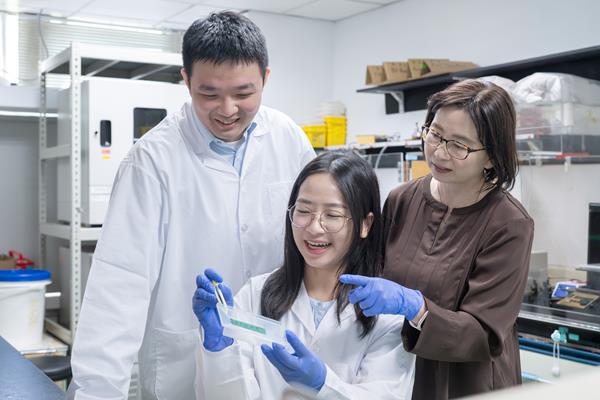
First Definitive Evidence of a Quantum Critical Point in Cuprates
National Tsing Hua University (NTHU) and collaborators have published a landmark study in Nature Communications that identifies a hidden quantum critical point (QCP) in the phase diagram of the high‑temperature superconductor La${2-x}$Sr$x$CuO$_4$ (LSCO). Using high‑resolution resonant inelastic X‑ray scattering (RIXS) at the Taiwan Photon Source, the team tracked charge‑density‑wave (CDW) behavior across a range of dopings and temperatures, revealing a clear scaling collapse that signals quantum critical scaling.
How the QCP Was Uncovered
The researchers varied doping and temperature while measuring the intensity and correlation length of CDWs. Near a specific doping level, the CDW signal vanished and the data from different conditions collapsed onto a single curve—a hallmark of quantum critical scaling. This collapse allowed the team to pinpoint the QCP where the material transitions from a regime of intertwined CDW, superconductivity, and pair‑density‑wave order to a regime dominated by pure superconductivity.
Why the Finding Matters
A QCP is a zero‑temperature boundary separating distinct quantum phases. Its existence in cuprates has been hypothesized for decades because it could explain the anomalous properties of these materials and guide theories of high‑temperature superconductivity. By providing a concrete experimental benchmark, the NTHU study offers:
- A target for theoretical models: Any successful theory must now reproduce the observed scaling behavior and the location of the QCP.
- A roadmap for material engineering: Understanding the QCP may help researchers tune cuprates (or related compounds) to optimize superconducting properties.
- A methodological template: The combination of RIXS with systematic doping/temperature sweeps demonstrates a powerful approach for probing hidden quantum phases in other correlated electron systems.
The International Team Behind the Work
Key contributors include Dean Chung‑Yu Mou (NTHU), Di‑Jing Huang (National Synchrotron Radiation Research Center), Hsiao‑Yu Huang (experiment and data acquisition), Atsushi Fujimori (sample preparation), and Academician Ting‑Kuo Lee (theoretical insight). Their collaborative effort underscores the importance of shared facilities and cross‑institutional expertise in tackling long‑standing condensed‑matter puzzles.
Looking Ahead
The discovery opens several avenues for future research:
- Extended material families: Applying the same RIXS protocol to other cuprate families (e.g., YBCO, Bi‑2212) to test the universality of the QCP.
- Pressure‑tuned studies: Exploring whether external pressure can shift the QCP, offering another control knob for superconductivity.
- Theoretical refinement: Using the new benchmark to discriminate between competing models of quantum criticality and pairing mechanisms.
As the community digests this result, the clarified phase diagram will likely become a reference point for both experimental and theoretical work aimed at finally unlocking the secrets of high‑temperature superconductivity.
--- Source: https://www.globenewswire.com/news-release/2026/11/11/3400956/0/en/nthu-identifies-a-quantum-critical-point-in-high-temperature-cuprate-superconductors-shedding-light-on-a-40-year-old-mystery.html
Hype check
RealThe paper in Nature Communications provides peer‑reviewed experimental data that directly demonstrates quantum critical scaling, fulfilling the headline claim.
- Peer-reviewed paper, or press release only?Paper — Published in Nature Communications, a peer‑reviewed journal
- Error-corrected (logical) qubits, or physical qubits only?Logical / not a qubit claim — Not a qubit‑count claim
- A new milestone, or a rebrand / restatement?New — First definitive evidence of a QCP in cuprates
- Independent confirmation?Not yet — No external replication mentioned in the input
- Does the headline claim match what the source shows?Matches — Headline accurately reflects the reported discovery
An editorial assessment of the claim as reported, not a judgment of the company or researchers. Checked against: globenewswire.com. How we rate hype →
Source
Read original sourceWhy we picked this
Accepted from curated QuantumUnzipped source (relevance scoring disabled).