NEC and IBM Japan Demonstrate Hybrid QKD and Post-Quantum Cryptography TLS Proxy Architecture
NEC and IBM Japan showcased a joint TLS‑proxy that combines quantum‑key distribution with post‑quantum cryptography for enterprise‑grade security.
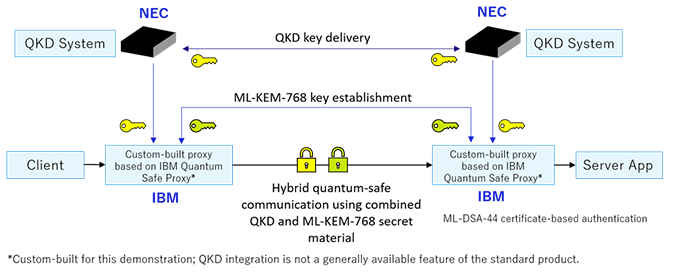
Hybrid Quantum‑Safe TLS Proxy Demonstration
NEC Corporation and IBM Japan announced the successful completion of a joint proof‑of‑concept that merges quantum key distribution (QKD) with post‑quantum cryptography (PQC) inside a single Transport Layer Security (TLS) proxy. Conducted between July and September 2026, the trial linked NEC’s QKD hardware to a customized IBM Quantum Safe Proxy, validating that two different quantum‑resistant key‑exchange mechanisms can interoperate without any changes to existing enterprise applications.
Architecture Overview
The demonstration employed three core components:
- QKD Key Delivery Interface – NEC’s QKD system communicated via the ETSI GS QKD 014 REST API, moving quantum‑generated secret material from an optical‑fiber link into the proxy.
- Hybrid Key Establishment – The proxy combined a lattice‑based key encapsulation mechanism (ML‑KEM‑768) with the QKD‑derived secret using HKDF‑SHA256. The resulting key material protected TLS traffic.
- Peer Authentication – Digital signatures were generated with ML‑DSA‑44, a NIST‑standardized PQC algorithm, preserving X.509‑based certificate verification.
A customized IBM Quantum Safe Proxy sat in front of legacy servers, terminating TLS connections and performing the dual‑key exchange. Because the proxy operates at the network layer, existing applications required no code modifications, allowing a seamless upgrade path for organizations that wish to adopt quantum‑safe security.
What Was Tested
The trial focused on two practical questions:
- Interoperability – Can a QKD system from one vendor and a PQC‑enabled TLS proxy from another exchange keys using a common API?
- Operational Simplicity – Does the proxy architecture let legacy software benefit from quantum‑safe keys without a rewrite?
The experiment succeeded on both fronts. The QKD link supplied fresh entropy, which the proxy blended with the ML‑KEM‑768 encapsulation to derive session keys. The resulting TLS sessions were indistinguishable from standard TLS traffic to the endpoints, demonstrating that the hybrid approach can be deployed transparently.
Limitations and Next Steps
The partners emphasized that the demonstration did not evaluate QKD as a fallback when optical links fail, nor did it replace certificate‑based authentication with QKD alone. Future work will explore commercial roll‑outs for financial institutions, core‑banking transaction systems, and inter‑data‑center links, where the added security margin of dual‑key exchange could be most valuable.
Why It Matters
- Layered Security – Combining a physical key‑distribution channel with a mathematically hard lattice‑based scheme mitigates the risk that a single technology is compromised.
- Vendor‑Neutral Integration – By adhering to open standards (ETSI GS QKD 014, HKDF‑SHA256), the architecture can be replicated with other QKD hardware or PQC libraries.
- Enterprise‑Ready Path – The proxy model shows how organizations can adopt quantum‑safe cryptography today, without waiting for full‑stack quantum‑ready applications.
The demonstration adds a concrete, interoperable example to the growing portfolio of quantum‑safe solutions, illustrating that hybrid security can move from theory to practice.
--- The information above is based on the NEC and IBM Japan press releases referenced in the source article.
Hype check
Not a research claimThe story reports a joint demonstration of hybrid QKD‑PQC TLS proxy architecture; there is no performance claim to hype.
We rate research and technical results only. How we rate hype →
Source
Read original sourceWhy we picked this
Accepted from curated QuantumUnzipped source (relevance scoring disabled).