NEC and IBM Japan Demonstrate Integrated QKD and PQC Communications
NEC and IBM Japan demonstrated Japan’s first hybrid quantum‑safe communication system that combines QKD with post‑quantum cryptography.
Hybrid Quantum‑Safe Communications Take a Step Forward in Japan
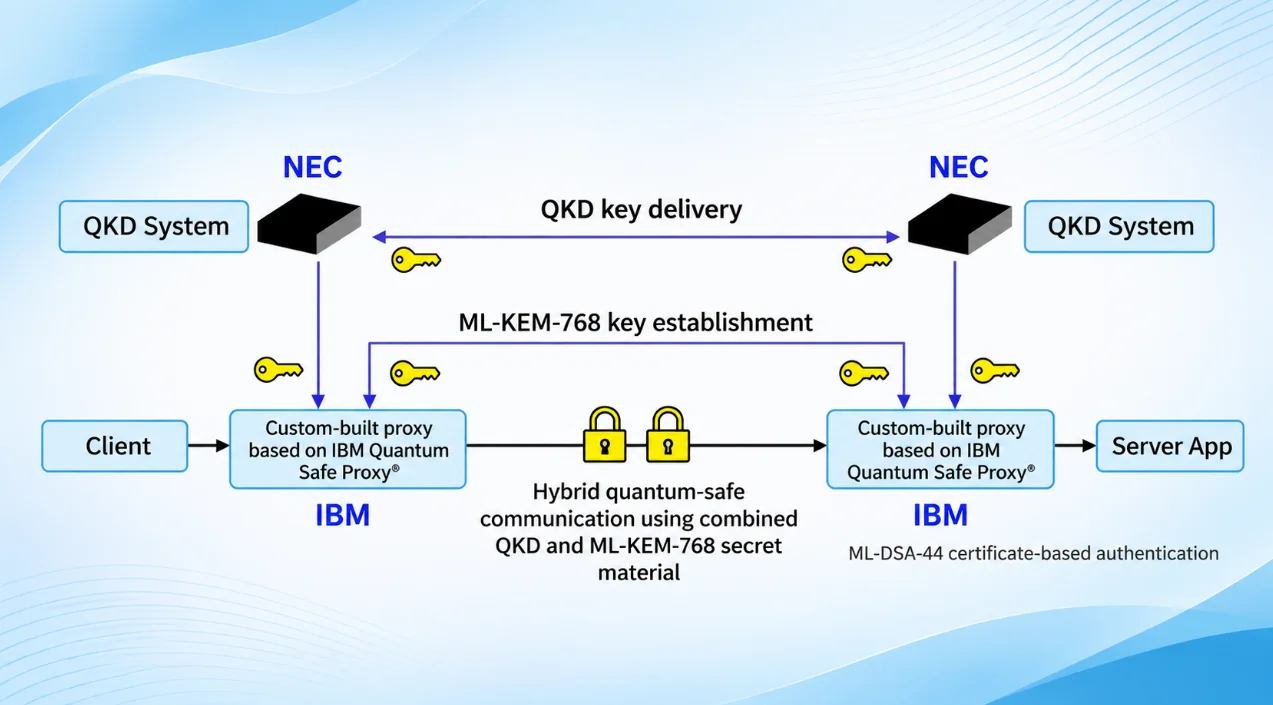
NEC and IBM Japan have completed the country’s first integrated demonstration of a quantum‑safe communication architecture that merges quantum key distribution (QKD) with post‑quantum cryptography (PQC). The proof‑of‑concept shows that a proxy layer can combine QKD‑derived key material with the lattice‑based algorithm ML‑KEM‑768, while using ML‑DSA‑44 for certificate authentication, all without altering existing TLS‑based applications.
How the Integration Works
The test linked NEC’s QKD hardware to IBM’s custom Quantum Safe Proxy via a REST‑based API that follows the ETSI GS QKD 014 specification. The proxy performed three key functions:
- Key Delivery – QKD keys were delivered through the API to the proxy.
- Hybrid Key Derivation – QKD keys and ML‑KEM‑768 outputs were cryptographically combined using HKDF‑SHA256 to produce the TLS traffic‑protection secret.
- Certificate Authentication – Peer identities were verified with ML‑DSA‑44 signatures, preserving the standard certificate‑based model.
By inserting this proxy between applications and the network, the demonstration proved that existing software stacks can adopt quantum‑safe methods without major rewrites.
Why This Matters
- Future‑Proof Security – QKD offers information‑theoretic key distribution, while PQC provides algorithmic resistance against quantum attacks. Their combination gives operators flexibility: use QKD when a fiber link is available, fall back to PQC otherwise.
- Minimal Disruption – The proxy approach means legacy systems continue to run unchanged, easing the migration path for sectors that cannot tolerate downtime, such as banking and critical infrastructure.
- Standard‑Based Interoperability – Leveraging ETSI’s QKD API demonstrates that multi‑vendor solutions can work together, a prerequisite for broader industry adoption.
Looking Ahead
NEC and IBM Japan plan to explore deployments in core banking, inter‑bank transaction networks, and data‑center communications. Their next steps include scaling the system to longer fiber distances, assessing performance under real‑world traffic loads, and collaborating with regulators to define compliance frameworks for hybrid quantum‑safe communications.
The demonstration marks a practical milestone toward securing tomorrow’s digital infrastructure against the emerging threat of quantum computers, showing that quantum‑safe technologies can be introduced incrementally rather than as a disruptive overhaul.
--- For organizations evaluating quantum‑safe strategies, the key takeaway is that hybrid QKD‑PQC solutions can be piloted today using a proxy layer, providing a realistic pathway to future‑proof security.
Hype check
RealThe press release documents a concrete demonstration of integrated QKD and PQC, confirming feasibility and interoperability, though no peer‑reviewed paper is cited.
- Peer-reviewed paper, or press release only?Press release only — Only a press release is provided, no paper or preprint cited
- Error-corrected (logical) qubits, or physical qubits only?Logical / not a qubit claim — Claim does not involve qubit counts or logical qubits
- A new milestone, or a rebrand / restatement?New — First integrated QKD‑PQC demo in Japan, not a rebrand
- Independent confirmation?Not yet — No external verification or replication mentioned
- Does the headline claim match what the source shows?Matches — Headline accurately reflects the demonstrated integration
An editorial assessment of the claim as reported, not a judgment of the company or researchers. How we rate hype →
Source
Read original sourceWhy we picked this
Accepted from curated QuantumUnzipped source (relevance scoring disabled).