Neon film cuts energy loss in superconducting qubits, study finds
A solid‑neon film treatment markedly reduces TLS‑related energy loss in superconducting resonators, boosting their quality factors.
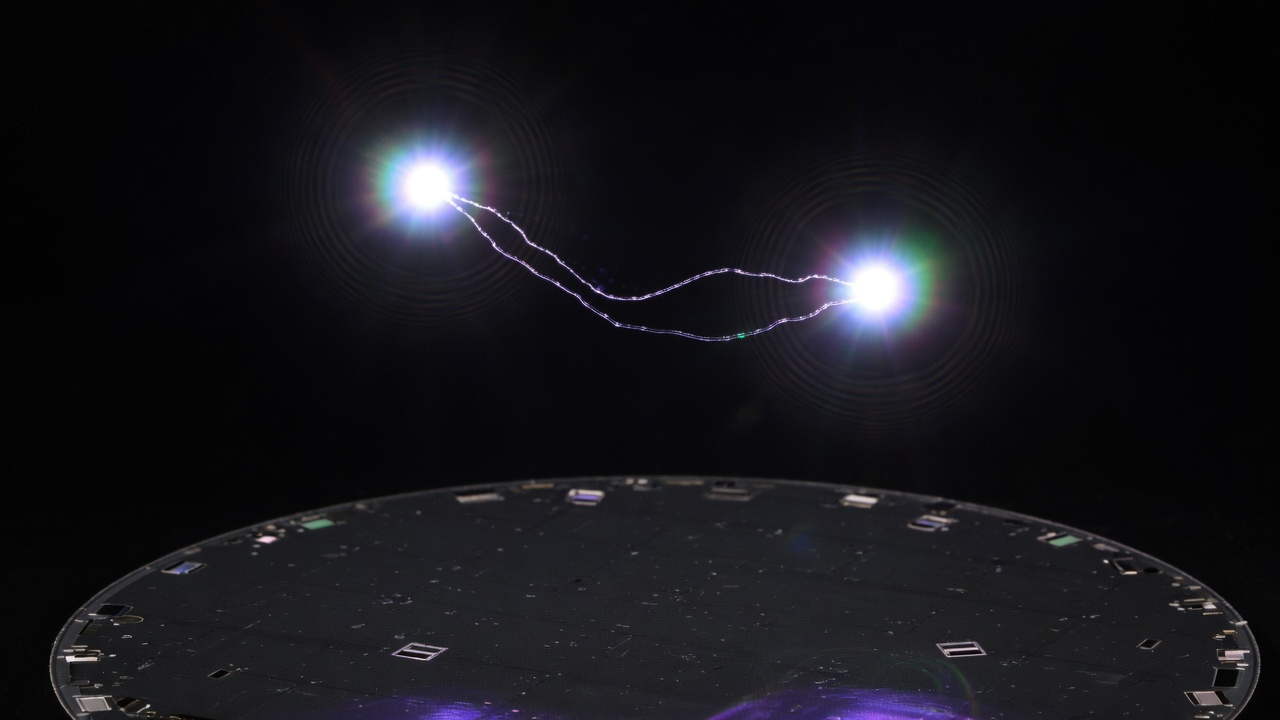
Neon Film Treatment Lowers TLS Losses in Superconducting Devices
A recent study demonstrates that depositing a thin layer of solid neon on superconducting NbTiN resonators—and then removing it—significantly suppresses loss mechanisms tied to two‑level systems (TLS). The effect persists after the neon evaporates, offering a gentle, non‑destructive alternative to harsh cleaning methods that can damage delicate quantum hardware.
How the Neon Process Works
The researchers coated NbTiN coplanar‑waveguide resonators with solid neon at cryogenic temperatures, later allowing the film to sublimate. Atomic‑force microscopy of hexagonal‑boron‑nitride flakes revealed that the neon exposure redistributes polymer residues left from fabrication, clustering contaminants into micrometer‑scale islands and clearing large surface areas. This redistribution appears to reduce the density of TLS that couple to the microwave field, thereby lowering dielectric loss.
Measured Performance Gains
Two sets of resonators were examined:
- Device 1 (Si substrate) – internal quality factor \(Q_i\) improved by an average factor of 4.3× after a single neon cycle.
- Device 2 (sapphire substrate) – \(Q_i\) increased by 2.4× under the same treatment.
The enhancement remained across a range of photon numbers down to the single‑photon regime and was reproduced in a second dilution‑refrigerator setup, indicating that the effect is not specific to a single measurement environment. Temperature‑dependent measurements confirmed that the improvement stems from reduced TLS loss rather than changes in quasiparticle dissipation.
Why This Matters for Quantum Hardware
TLS defects are a dominant source of decoherence in superconducting qubits, resonators, and kinetic‑inductance detectors. Conventional cleaning—acid baths, plasma etches—can strip away or damage thin‑film materials, limiting their applicability to fragile platforms. The solid‑neon approach is chemically inert, operates at low temperature, and leaves the underlying material untouched, making it attractive for a broad class of superconducting circuits.
Outlook and Open Questions
The study provides a clear pathway to mitigate TLS loss without invasive processing. Future work will need to:
- Quantify how the redistribution of specific contaminant species correlates with TLS density.
- Test the method on actual qubit devices to confirm coherence‑time improvements.
- Explore scalability—whether repeated neon cycles can be integrated into standard fabrication flows.
If these steps succeed, solid‑neon treatment could become a routine step in the quantum‑hardware toolbox, helping bridge the gap between laboratory‑scale devices and larger‑scale quantum processors.
--- For the full pre‑print and detailed data, see the authors’ arXiv submission.
Hype check
PartlyThe paper presents experimental data showing Q‑factor improvements, but it is only a preprint and lacks independent verification.
- Peer-reviewed paper, or press release only?Press release only — Result is reported on arXiv preprint, not a peer‑reviewed journal.
- Error-corrected (logical) qubits, or physical qubits only?Logical / not a qubit claim — Claim does not involve qubit‑count or logical‑vs‑physical qubits.
- A new milestone, or a rebrand / restatement?New — Demonstrates a novel, reproducible reduction of TLS loss using neon.
- Independent confirmation?Not yet — No external replication or third‑party confirmation mentioned.
- Does the headline claim match what the source shows?Matches — Headline accurately reflects the study’s finding of reduced energy loss.
An editorial assessment of the claim as reported, not a judgment of the company or researchers. Checked against: arxiv.org. How we rate hype →
Source
Read original sourceWhy we picked this
Accepted from curated QuantumUnzipped source (relevance scoring disabled).