New light-conversion tool could help speed up quantum computing
UT Austin researchers demonstrated asymmetric coupled quantum wells that boost light‑conversion efficiency over sevenfold, a material advance that could accelerate quantum‑computing hardware.
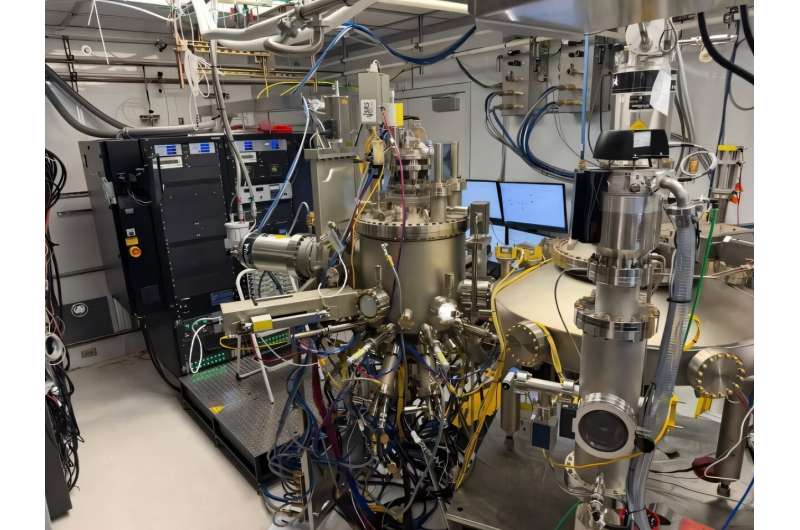
New Light‑Conversion Tool Could Help Speed Up Quantum Computing
Researchers at the University of Texas at Austin, together with seven partner institutions, have reported a novel semiconductor structure—asymmetric coupled quantum wells—that dramatically improves the efficiency of converting light for quantum‑information applications. The work, described in Optica (Ramesh et al., 2026), shows more than a seven‑fold increase in nonlinear optical response compared with conventional materials.
How the Tool Works
The device consists of stacked ultrathin layers of different semiconductor materials. By carefully tuning the thickness and composition of each layer, the team creates an asymmetry that enhances interband optical nonlinearities. This stronger interaction allows photons to be manipulated more effectively, a key requirement for photonic quantum‑computing platforms that rely on precise control of light‑matter interactions.
Why Light Matters for Quantum Computing
Photonic quantum processors encode qubits in the quantum states of photons. The speed at which these photons can be generated, routed, and detected directly influences the overall clock rate of a quantum computer. Materials that increase the conversion efficiency of incoming light into usable quantum signals can therefore reduce latency, shrink device footprints, and improve scalability.
Potential Impact and Next Steps
While the study is a materials‑science breakthrough, its relevance to quantum hardware is clear:
- Faster, more efficient photon sources could lower error rates in optical quantum gates.
- Enhanced nonlinearities may enable new on‑chip frequency‑conversion schemes, simplifying the integration of disparate quantum modules.
- The ability to “tune” the quantum‑well stack offers a pathway to tailor devices for specific quantum algorithms or communication protocols.
Future work will likely focus on integrating these wells into actual photonic circuits, testing their performance in realistic quantum‑computing environments, and exploring compatibility with existing silicon‑photonic platforms.
Bottom Line
The asymmetric coupled quantum‑well architecture represents a significant material advance that could help accelerate the development of faster, more compact photonic quantum processors. Though still at the laboratory stage, the reported seven‑fold improvement in light conversion is a promising step toward practical quantum‑computing hardware.
Hype check
RealThe paper in Optica provides peer‑reviewed data showing a >7× improvement in light conversion; the claim matches the reported result and is a genuine new material milestone.
- Peer-reviewed paper, or press release only?Paper — Published in Optica, a peer‑reviewed journal
- Error-corrected (logical) qubits, or physical qubits only?Logical / not a qubit claim — Not a qubit‑count claim
- A new milestone, or a rebrand / restatement?New — First demonstration of asymmetric coupled quantum wells with 7× efficiency
- Independent confirmation?Not yet — No external replication mentioned in the input
- Does the headline claim match what the source shows?Matches — Headline reflects the reported material improvement
An editorial assessment of the claim as reported, not a judgment of the company or researchers. Checked against: phys.org. How we rate hype →
Source
Read original sourceWhy we picked this
Accepted from curated QuantumUnzipped source (relevance scoring disabled).