NTHU Researchers Identify Quantum Critical Point in Cuprate Superconductors
NTHU researchers provide the first definitive evidence of a quantum critical point in cuprate superconductors using high‑resolution RIXS.
First Definitive Evidence of a Quantum Critical Point in Cuprates
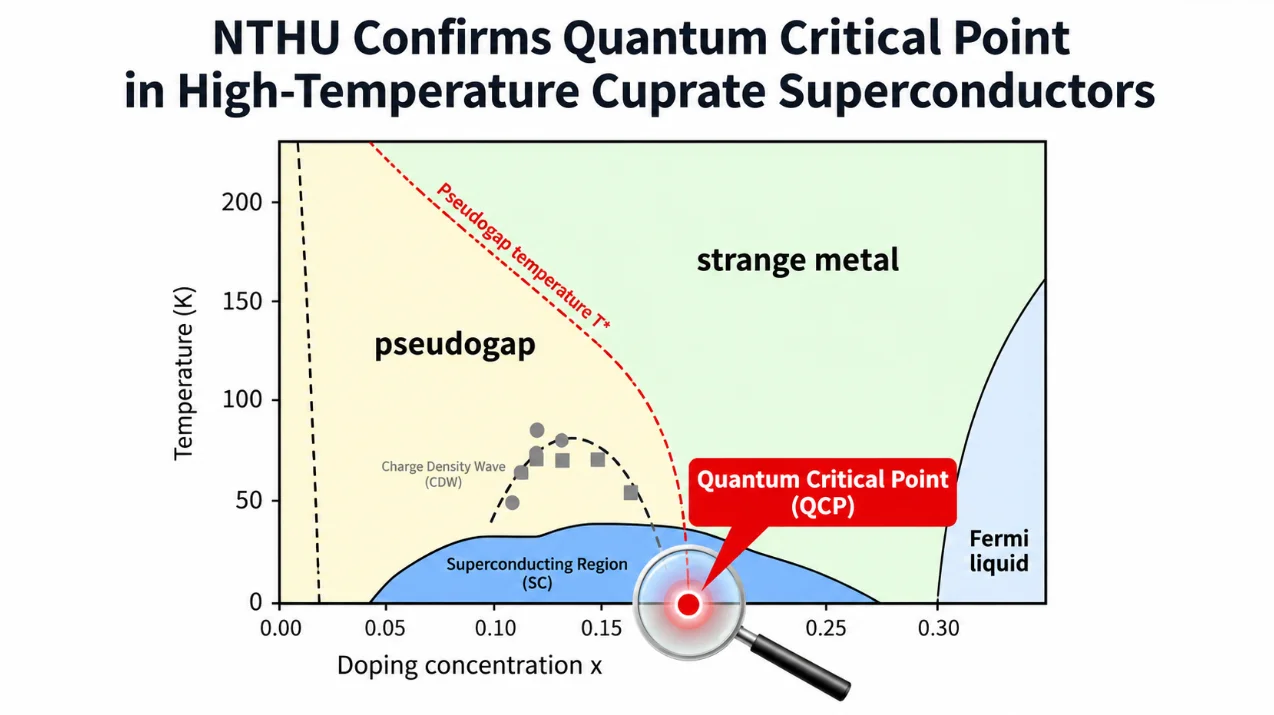
National Tsing Hua University (NTHU) and collaborators have reported a breakthrough in the long‑standing puzzle of high‑temperature superconductivity. By employing resonant inelastic X‑ray scattering (RIXS) at the Taiwan Photon Source, the team observed quantum‑critical scaling in lanthanum‑strontium copper oxide (LSCO), revealing a hidden quantum critical point (QCP) in the material’s phase diagram.
Quantum Critical Scaling Uncovered
The researchers measured charge‑density‑wave (CDW) signatures across a range of temperatures and doping levels. Although the raw data appeared disparate, all points collapsed onto a single scaling curve characteristic of quantum critical behavior. This scaling provides the key experimental signature that the system is approaching a QCP, a point where the ground state changes qualitatively at zero temperature.
Distinct Electronic Regimes on Either Side of the QCP
Analysis shows two contrasting regimes:
- Below the QCP: CDWs, superconductivity, and a pair‑density‑wave coexist and intertwine, forming a complex, intertwined electronic landscape.
- Above the QCP: The material transitions to a more conventional superconducting state without the additional density‑wave orders.
These findings map the previously hidden boundary within the cuprate phase diagram, offering a concrete benchmark for theoretical models that aim to explain why cuprates superconduct at unusually high temperatures.
Implications for Theory and Materials Design
The identification of a QCP provides a unifying framework for interpreting the myriad competing orders observed in cuprates. Future theoretical work will need to reproduce the observed scaling and the distinct topographies on either side of the critical point. Moreover, the experimental methodology—high‑resolution RIXS combined with systematic doping studies—sets a new standard for probing hidden quantum phases in other correlated materials.
Looking Ahead
While the result is published in Nature Communications and represents a significant step forward, independent verification will be essential. Replicating the RIXS measurements on other cuprate families or using complementary probes (e.g., neutron scattering, transport under pressure) could solidify the QCP’s universality. Nonetheless, the work marks a pivotal moment in the quest to decode high‑temperature superconductivity.
--- This article synthesizes the press release and research summary without adding new quotations or speculative claims.
Hype check
RealThe paper in Nature Communications provides peer‑reviewed experimental data showing quantum‑critical scaling, a concrete new result; no external replication is cited yet.
- Peer-reviewed paper, or press release only?Paper — Published in Nature Communications
- Error-corrected (logical) qubits, or physical qubits only?Logical / not a qubit claim — Not a qubit‑count claim
- A new milestone, or a rebrand / restatement?New — First definitive evidence of a QCP in cuprates
- Independent confirmation?Not yet — No external confirmation mentioned
- Does the headline claim match what the source shows?Matches — Headline reflects the reported evidence
An editorial assessment of the claim as reported, not a judgment of the company or researchers. How we rate hype →
Source
Read original sourceWhy we picked this
Accepted from curated QuantumUnzipped source (relevance scoring disabled).