One Broken Symmetry Opens a Path to Universal Quantum Control
Breaking mirror symmetry in globally driven qubit chains enables universal quantum control, demonstrated with three‑atom interactions in a Rydberg‑atom array.
Introduction
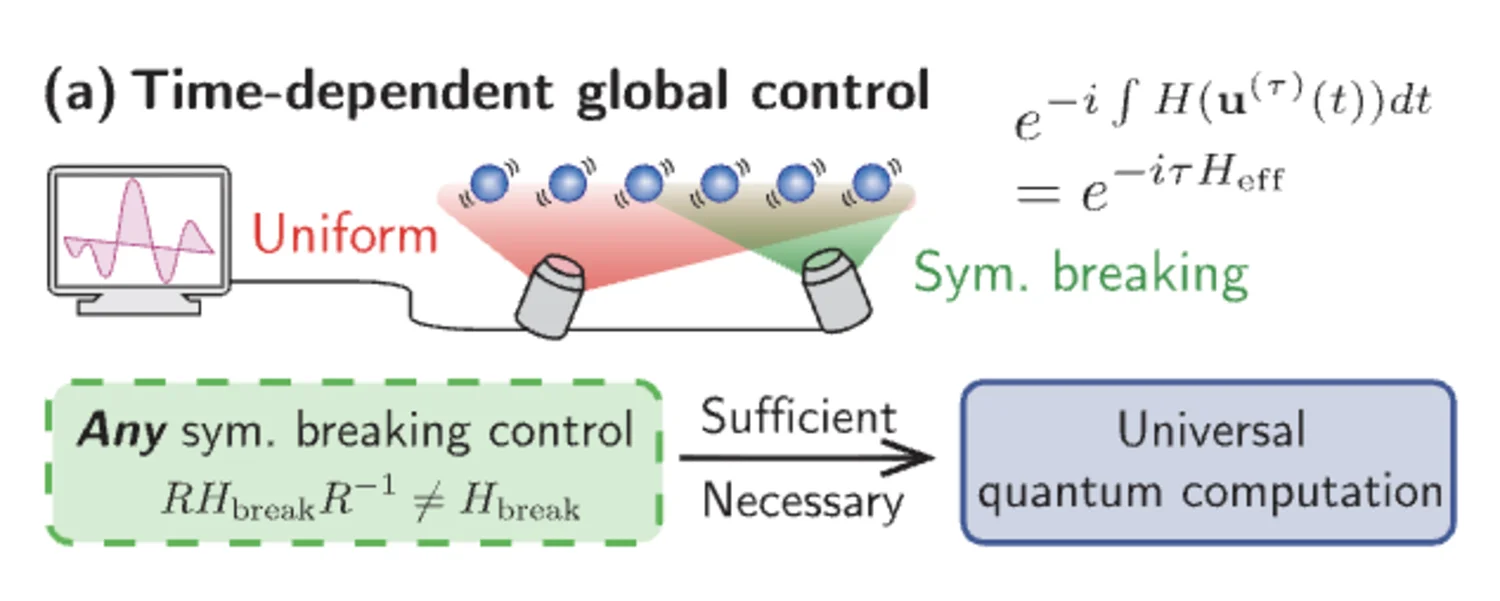
A recent study shows that a simple symmetry break can turn a globally driven quantum simulator into a fully universal processor. By adding a controllable field that destroys mirror symmetry in a one‑dimensional chain of qubits with uniform nearest‑neighbor couplings, researchers proved that any quantum operation becomes achievable. The theory was validated experimentally in a Rydberg‑atom array, where optimized global laser pulses generated an effective three‑atom ZXZ interaction and revealed signatures of topological edge modes.
Theoretical breakthrough: symmetry as the missing ingredient
In many quantum simulators, a handful of laser beams act on every atom simultaneously, simplifying hardware but raising the question of controllability. For a linear chain with identical nearest‑neighbor interactions and global rotations, the system’s dynamics remain confined by mirror symmetry: atoms on opposite sides of the chain are indistinguishable, limiting the reachable set of unitary operations. The authors proved that breaking this mirror symmetry—by introducing a tunable local field or interaction—removes the restriction and yields universal quantum control. The result extends to both fermionic and bosonic lattices, offering a general rule for globally driven platforms.
From theory to the lab: optimal‑control pulses in a Rydberg array
To translate the abstract proof into a practical protocol, the team employed direct quantum optimal control. This method searches for laser pulse shapes that respect experimental constraints such as finite laser power, bandwidth, and atomic motion. In an eight‑atom Rydberg‑atom chain, the optimized global pulses produced an effective ZXZ interaction involving three neighboring atoms—a coupling that does not exist in the native pairwise Rydberg blockade Hamiltonian. The experiment operated outside the usual blockade regime, demonstrating that global fields can engineer higher‑order interactions when guided by optimal‑control algorithms.
Observing topological edge signatures
The three‑atom interaction enabled the chain to exhibit dynamics reminiscent of topological phases. Measurements showed that the end atoms retained distinct correlation patterns while the bulk evolved, a hallmark of edge modes protected by the engineered Hamiltonian. Numerical simulations further indicated that random global pulses spread quantum information rapidly, with characteristic statistics emerging on a timescale that grows only logarithmically with system size.
Practical implications and outlook
The work bridges a gap between abstract controllability criteria and experimentally viable techniques. It suggests that many existing quantum simulators—trapped‑ion strings, neutral‑atom arrays, and superconducting qubit lattices—could achieve universal control simply by adding a modest symmetry‑breaking knob and applying pulse‑shaping software. This opens pathways for scalable quantum computation, error‑corrected operations, and the exploration of exotic many‑body phenomena without redesigning hardware.
--- The findings highlight how a single broken symmetry can unlock the full potential of globally driven quantum devices, turning modest experimental setups into versatile quantum processors.
Source
Read original sourceWhy we picked this
Accepted from curated QuantumUnzipped source (relevance scoring disabled).