Pavia Team Models How Shaped Lasers Improve Ion Quantum Gates
Shaped laser gradients that excite axial phonons can cut crosstalk and spectral crowding, offering a clearer path to scalable trapped‑ion quantum gates.
Introduction
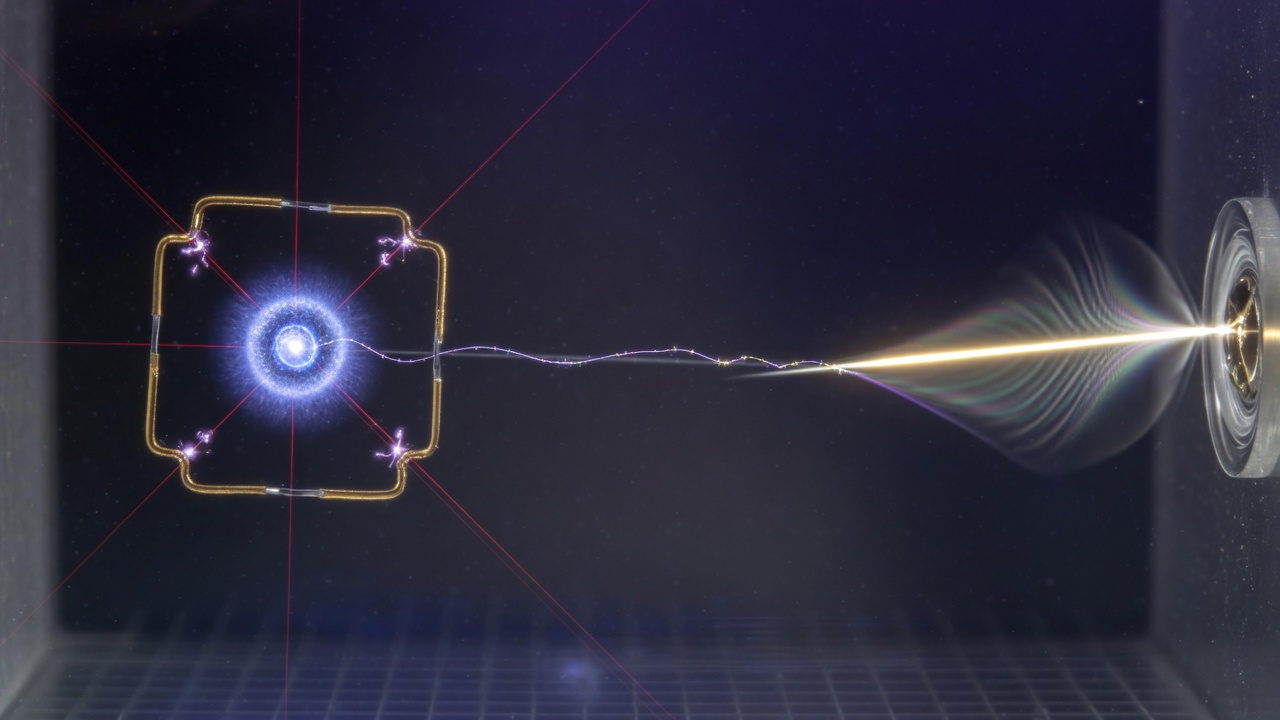
Trapped‑ion quantum computers rely on precise laser‑driven interactions to entangle qubits. As ion chains grow, two persistent problems emerge: crosstalk, where a laser intended for one ion unintentionally perturbs its neighbours, and spectral mode crowding, where the dense spectrum of vibrational modes makes it hard to isolate the desired interaction. A recent theoretical study from the Pavia team, led by Pablo Viñas and collaborators at Universität Innsbruck, shows that structured light gradients can selectively excite axial phonons—vibrations along the ion chain—thereby mitigating both issues and improving gate fidelity for medium‑sized ion crystals.
Shaping Light to Target Axial Phonons
Traditional geometric‑phase gates often drive radial phonons, which are transverse to the chain. Radial modes are numerous and closely spaced, so as the number of ions (N) increases the laser field inevitably couples to unwanted modes, inflating error rates. The new model proposes a laser configuration where the beam propagates perpendicular to the chain, creating a spatial intensity gradient that couples primarily to axial motion. By tailoring the gradient’s shape, the researchers derive a set of parameters that maximize the state‑dependent force on the targeted axial mode while suppressing off‑resonant coupling.
Key points of the model:
- Axial phonon excitation reduces the overlap with the dense radial spectrum, directly addressing spectral mode crowding.
- The engineered gradient yields a force profile that is highly localized to the addressed ion, lowering crosstalk to neighbouring qubits.
- Simulations indicate that for chains up to N = 20 ions, the error contribution from motional dephasing drops dramatically, bringing two‑qubit gate errors well below the typical 1 % threshold for fault‑tolerant operation.
Benefits and Trade‑offs
The primary advantage of axial‑phonon gates is the error reduction achieved without requiring exotic hardware. By keeping the laser beam orthogonal to the chain, the method sidesteps the dense radial mode structure that hampers scalability. The authors also provide explicit formulas for the required laser intensity, detuning, and gradient curvature, giving experimental groups a clear roadmap for implementation.
However, the approach introduces a geometric constraint: the perpendicular beam must reach each ion without obstructing others, which can be challenging in densely packed or three‑dimensional trap architectures. This limits the immediate applicability to linear chains or planar traps where optical access from the side is feasible. Moreover, while the model predicts high fidelity for up to 20 ions, extending the technique to larger arrays will likely demand additional engineering, such as segmented beam shaping or dynamic re‑orientation of the gradient.
Outlook for Scalable Trapped‑Ion Processors
The Pavia team’s findings represent a concrete step toward scalable trapped‑ion quantum processors. By demonstrating a theoretically viable pathway to suppress crosstalk and spectral crowding, the work complements ongoing hardware advances—such as segmented traps, modular ion‑link networks, and improved cooling techniques. If experimental groups can translate the gradient parameters into stable laser setups, we can expect near‑term demonstrations of two‑qubit gates with error rates approaching the 10⁻³ regime for medium‑size ion crystals.
In the broader context, the study underscores the growing importance of classical control engineering in quantum hardware. Shaping light fields with high precision is a classical problem, yet its solution directly lifts quantum performance. As the community pushes toward larger qubit counts, such interdisciplinary approaches will be essential.
Practical Takeaway
For researchers and engineers working on trapped‑ion platforms, the key actionable insight is to experiment with side‑propagating, gradient‑shaped laser beams to preferentially drive axial phonons. The paper supplies concrete parameter ranges that can be tested on existing linear traps. While the method may not yet suit fully connected, multi‑dimensional architectures, it offers a low‑overhead route to improve gate fidelity in the near term, bringing scalable ion‑based quantum computing a step closer.
Source
Read original sourceWhy we picked this
Accepted from curated QuantumUnzipped source (relevance scoring disabled).