Phase-aware programming cuts error in on-chip Butler matrix to 2.0°
Phase‑aware programming dramatically lowers the direction‑of‑arrival error of an on‑chip Butler matrix to 2.0°.
Phase‑aware programming trims Butler‑matrix error to 2.0°
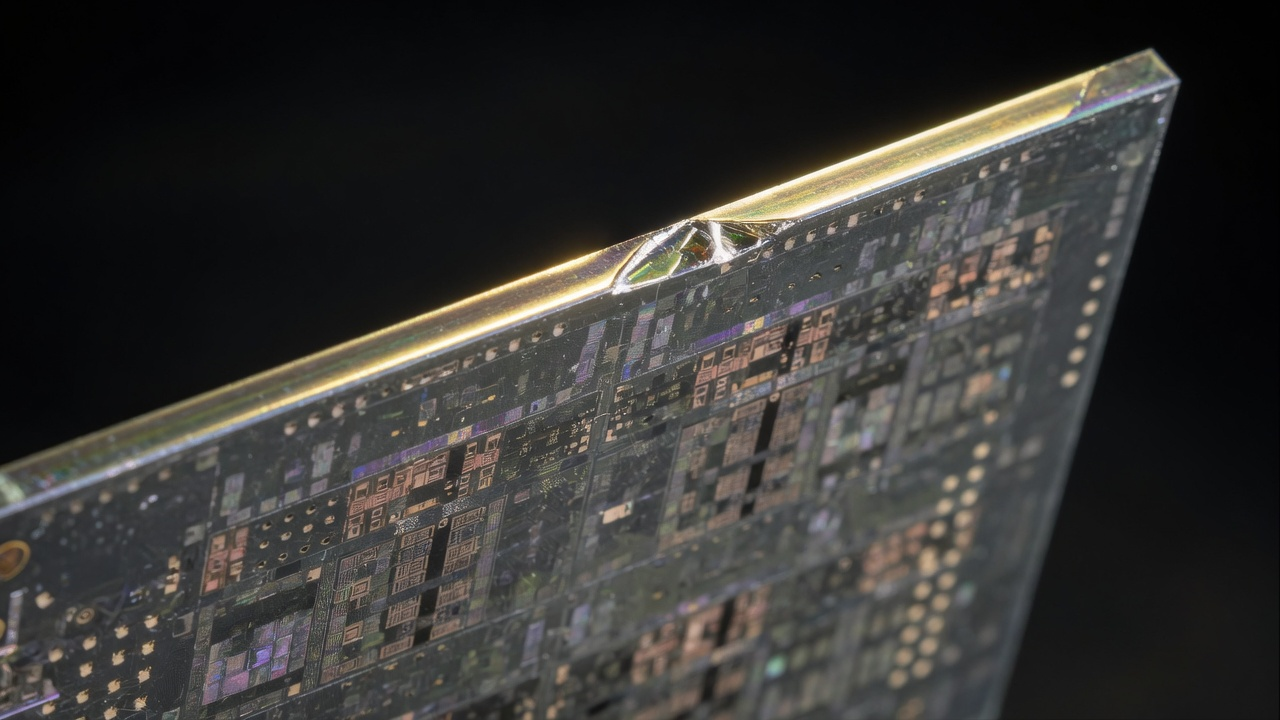
Researchers at KTH Royal Institute of Technology and Huazhong University of Science and Technology have introduced a phase‑aware programming technique for photonic processors that slashes the direction‑of‑arrival error of an on‑chip Butler matrix from 29° to just 2.0°. The work, demonstrated on a 12 × 12 photonic mesh, shows how a digital twin trained only on intensity measurements can infer phase information, enabling high‑fidelity control without direct phase sensing.
From intensity‑only to phase‑aware control
- Intensity‑only training – Using only power measurements, the digital twin predicts the phase of programmed transformations with a Bhattacharyya fidelity of 0.9987 after fitting 2 880 settings. This yields a phase fidelity of 0.690.
- Phase‑aware programming – By feeding the twin’s phase predictions back into the programming loop, the team raises phase fidelity to 0.996. The same intensity fidelity is retained, but the phase error drops dramatically.
Reducing Butler‑matrix error
A Butler matrix routes optical signals based on the phase of incoming light. With the new approach, the measured direction‑of‑arrival error falls from 29° (intensity‑only) to 2.0° (phase‑aware). The improvement comes from a self‑referencing calibration that eliminates the need for external interferometers or additional optics.
Scalable digital‑twin modeling
- The twin’s weights correspond to physical chip parameters, allowing it to predict gauge‑invariant phase across 10 × 10 blocks and, by extension, larger meshes.
- On‑chip interference protocols built into the mesh itself provide direct phase measurements for validation, showing a mean absolute deviation of 0.065 rad and a maximum of 0.19 rad between twin predictions and measured phases.
Practical implications
- Simplified hardware – No separate phase‑measurement hardware is required during training or operation.
- Faster deployment – Programs can be calibrated quickly from intensity data alone, accelerating the development of photonic processors for communications, sensing, and quantum information tasks.
- Potential scalability – The method’s success on 12 × 12 and 10 × 10 blocks suggests it could be applied to much larger photonic circuits, paving the way for more complex on‑chip signal‑processing applications.
The authors provide a detailed account of the digital‑twin architecture, training methodology, and experimental validation in an arXiv pre‑print.
--- For readers interested in the technical details, the full manuscript is available on arXiv.
Hype check
PartlyThe result is reported in an arXiv pre‑print with no peer‑review or independent replication, so the claim is promising but not fully verified.
- Peer-reviewed paper, or press release only?Press release only — Only an arXiv pre‑print is cited
- Error-corrected (logical) qubits, or physical qubits only?Logical / not a qubit claim — Not a qubit‑count claim
- A new milestone, or a rebrand / restatement?New — Demonstrates a new phase‑aware programming method
- Independent confirmation?Not yet — No external confirmation mentioned
- Does the headline claim match what the source shows?Matches — Headline accurately reflects the reported 2.0° error reduction
An editorial assessment of the claim as reported, not a judgment of the company or researchers. Checked against: arxiv.org. How we rate hype →
Source
Read original sourceWhy we picked this
Accepted from curated QuantumUnzipped source (relevance scoring disabled).