Photon fluctuations offer new way to probe electron dynamics in crystals
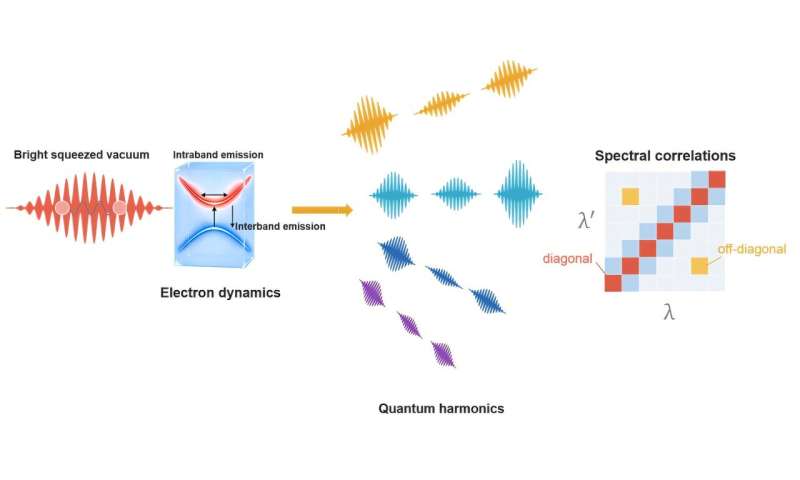
Using bright squeezed vacuum light, researchers demonstrated that photon‑fluctuation measurements can reveal electron dynamics during high‑harmonic generation in a lithium‑niobate crystal.
Probing Electron Motion with Photon Fluctuations
High‑harmonic generation (HHG) in solids has become a powerful tool for watching electrons zip through energy bands on sub‑femtosecond timescales. Traditionally, scientists have examined only the average brightness and spectrum of the emitted harmonics, missing a wealth of information hidden in pulse‑to‑pulse variations. A new study published in Advanced Photonics shows that quantum‑engineered light—bright squeezed vacuum (BSV)—can expose those hidden fluctuations and provide a fresh window onto the underlying electron dynamics.
Bright Squeezed Vacuum as a Probe
BSV is a non‑classical state of light generated by spontaneous parametric down‑conversion. Although it contains many photons, they are produced in correlated pairs, leading to large intensity fluctuations (photon bunching) and spectral correlations. The authors used BSV centered at 2,060 nm to illuminate a 200‑µm‑thick lithium‑niobate crystal. By recording the harmonic spectrum one laser pulse at a time, they could track how the intensity of each harmonic varied from shot to shot.
Photon Bunching Reveals Competing HHG Mechanisms
When the BSV was spectrally filtered to a nearly single mode, the crystal emitted harmonics up to the 10th order. The measured photon statistics showed strong bunching that rose from the second to the fifth harmonic and then fell off for higher orders. Numerical simulations based on quantum‑corrected semiconductor Bloch equations linked this pattern to a crossover between two HHG pathways:
- Intraband currents dominate at lower orders, reflecting electron motion within a band.
- Interband polarization takes over at higher orders, involving transitions between valence and conduction bands.
Because these mechanisms respond differently to fluctuations in the driving field, the observed bunching profile directly maps the relative contribution of each process.
Correlations Survive Frequency Conversion
Removing the spectral filter allowed multiple infrared modes to interact simultaneously. The incoming BSV exhibited strong correlations between spectrally separated mode pairs. Remarkably, measurements of the third harmonic showed that these correlations persisted after the nonlinear conversion: different spectral components of the harmonic brightened and dimmed together, mirroring the input correlations. The effect was detectable for the second and third harmonics under the experimental conditions.
Toward Demonstrating Entanglement in Harmonics
While the study did not prove that the emitted harmonics themselves remain entangled, it identified experimental regimes where such tests could be feasible. Lower photon‑number regimes combined with photon‑number‑resolved or phase‑sensitive detection would be needed to confirm non‑classical properties like squeezing or entanglement in the up‑converted light.
Implications and Future Directions
The work establishes photon‑statistics measurements as a complementary diagnostic for solid‑state HHG, enriching the toolbox for ultrafast spectroscopy. By linking fluctuation patterns to specific electron‑dynamics mechanisms, researchers can gain deeper insight into material properties and potentially engineer light‑matter interactions at the quantum level. Future experiments that push toward genuine entanglement verification could open pathways for quantum‑enhanced spectroscopy and novel sources of quantum light at extreme frequencies.
--- Reference: Q. He et al., “Quantum high‑harmonic generation with entangled photon pairs,” Advanced Photonics (2026). DOI:10.1117/1.ap.9.1.016001.
Hype check
RealThe article reports a peer‑reviewed experimental study with clear data and theoretical modeling, matching the headline claim about probing electron dynamics via photon fluctuations.
- Peer-reviewed paper, or press release only?Paper — Published in Advanced Photonics, a peer‑reviewed journal
- Error-corrected (logical) qubits, or physical qubits only?Logical / not a qubit claim — Not a qubit‑count claim
- A new milestone, or a rebrand / restatement?New — First demonstration of using BSV photon statistics to study HHG dynamics
- Independent confirmation?Not yet — No external replication or confirmation mentioned
- Does the headline claim match what the source shows?Matches — Headline accurately reflects the study's findings
An editorial assessment of the claim as reported, not a judgment of the company or researchers. Checked against: phys.org. How we rate hype →
Source
Read original sourceWhy we picked this
Accepted from curated QuantumUnzipped source (relevance scoring disabled).