Photonic qubits gain purity with a new Spontaneous Parametric Down Conversion source design
A new SPDC source design decouples spatial and spectral properties, yielding brighter, high‑purity OAM‑entangled photons without lossy filtering.
Introduction
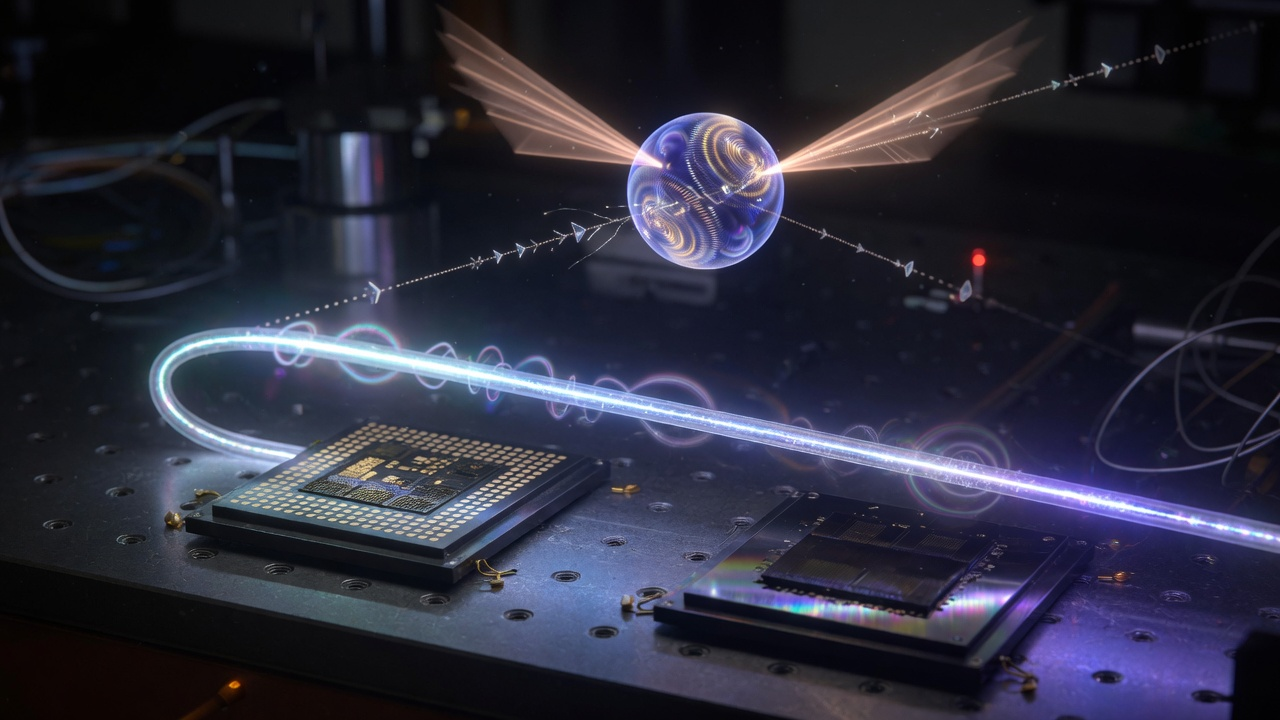
Recent work by researchers at Nicolaus Copernicus University and the University of Canterbury demonstrates a practical route to generate photonic qubits with markedly higher spatial purity. By carefully engineering the parameters of a type‑I Spontaneous Parametric Down‑Conversion (SPDC) source, they suppress the unwanted coupling between transverse (spatial) and frequency (spectral) degrees of freedom. The result is a brighter source of orbital‑angular‑momentum (OAM) entangled photon pairs that requires little or no post‑generation filtering—an advance that directly supports scalable high‑dimensional quantum communication and imaging.
Decoupling Spatial and Spectral Correlations
The core of the approach lies in matching the pump beam’s spatial and temporal profiles to the crystal length so that the phase‑matching function factorizes into independent spatial and spectral components. By adopting a factorized Gaussian model and optimizing a dimensionless parameter \(\alpha\) (different values for short and long pump pulses), the researchers achieve a joint amplitude that separates cleanly into transverse and frequency parts. This separation eliminates the spatial‑spectral correlations that normally introduce distinguishability and reduce coherence.
Key practical insights include:
- Crystal length vs. pump waist: Shorter crystals combined with appropriately sized pump waists minimize the longitudinal phase‑mismatch, preserving OAM mode purity across a range of OAM orders.
- Parameter \(\alpha\) tuning: Setting \(\alpha\approx0.4\) for femtosecond pulses and \(\alpha\approx1\) for longer pulses aligns the pump’s Gaussian envelope with the phase‑matching bandwidth, removing the need for external spectral filters.
- Four‑Gaussian approximation: A simplified four‑Gaussian model accurately predicts the spatial purity of the biphoton state, allowing rapid design iterations without full numerical simulations.
High‑Purity OAM Entanglement
Using Laguerre‑Gaussian modes to encode OAM, the team quantified the normalized spatial purity of the generated photons. Their maps show regions where purity remains near unity even as the OAM quantum number, crystal length, and pump waist vary. This robustness means that high‑dimensional OAM‑based protocols—such as quantum key distribution with dozens of alphabet symbols—can operate with minimal loss and maximal contrast.
Practical outcomes:
- Brighter sources: Because filtering is largely unnecessary, photon fluxes increase by up to an order of magnitude compared to conventional SPDC setups.
- Scalable mode matching: High spatial purity simplifies coupling into fibers or waveguides, a critical step for building large‑scale photonic circuits.
- Enhanced quantum imaging: Stable OAM modes improve rotational‑symmetry contrast and enable multiplexed quantum optical coherence tomography without intermodal dispersion.
Implications for Quantum Technologies
The ability to engineer SPDC sources that deliver pure OAM entanglement directly at the generation stage addresses a major bottleneck in photonic quantum hardware. It reduces system complexity, lowers loss budgets, and opens pathways for:
- High‑dimensional quantum key distribution (QKD): More alphabet symbols per photon increase key rates while maintaining security.
- Quantum networking: Pure OAM modes can be multiplexed across free‑space or fiber links, expanding channel capacity.
- Integrated photonics: The factorable model guides the design of on‑chip nonlinear waveguides that replicate the bulk‑crystal performance.
Practical Takeaways
- Design checklist: Choose crystal length and pump waist to satisfy the factorization condition; adjust \(\alpha\) based on pulse duration.
- Model first: Use the four‑Gaussian approximation to predict purity before building hardware.
- Skip filters: Verify purity experimentally; if near‑unity, eliminate spectral filters to retain photon flux.
- Test across OAM orders: Confirm that purity holds for the intended OAM range, ensuring scalability of the protocol.
By providing clear, experimentally validated guidelines, this work equips quantum optics labs with a straightforward method to boost the quality and brightness of OAM‑entangled photons—an essential step toward practical, high‑dimensional photonic quantum technologies.
Source
Read original sourceWhy we picked this
Accepted from curated QuantumUnzipped source (relevance scoring disabled).