Progress in Logical Teleportation
Quantinuum reports a new logical‑teleportation fidelity of 99.82%, surpassing its physical‑qubit performance.
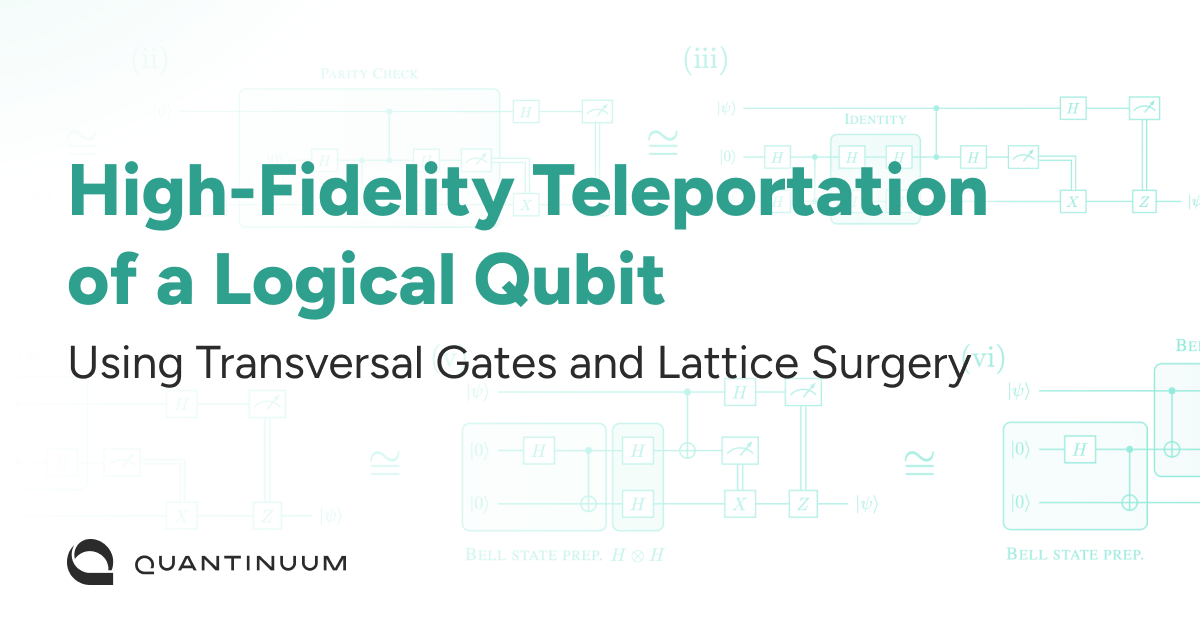
Quantinuum’s New Logical Teleportation Record
Quantinuum says it has pushed logical‑qubit teleportation fidelity to 99.82 %, up from the 97.5 % reported a year earlier. The improvement is attributed to hardware upgrades on the H2‑1 system and refined error‑correction using the Steane (d=3 color) code. Notably, the logical fidelity now exceeds the physical‑qubit teleportation fidelity on the same device, a break‑even point the company highlights as a milestone for fault‑tolerant quantum computing.
Why Teleportation Matters
Teleportation of a logical qubit is a stringent test of a quantum processor’s capabilities. It requires:
- High‑fidelity state preparation
- Entangling gates across multiple qubits
- Mid‑circuit measurement and real‑time decoding
- Robust error‑correction on logical qubits
Successfully moving a logical qubit’s state while preserving its information demonstrates that the system can handle the complex operations needed for large‑scale, fault‑tolerant algorithms.
Technical Highlights
- Architecture: Quantinuum’s QCCD (Quantum Charge‑Coupled Device) platform provides all‑to‑all connectivity, enabling the transversal gates required for the Steane code.
- Error‑Correction: Conditional logic and real‑time decoding were used to implement the Steane error‑correction cycle, reducing the logical error rate to roughly one‑third of the physical error rate.
- Benchmarking: The same QASM programs run in March 2024 were re‑executed after hardware improvements, showing consistent fidelity gains for both physical and logical teleportation experiments.
Implications for Fault‑Tolerance
Achieving logical fidelity above the physical baseline suggests that the error‑correction overhead is beginning to pay off. In practice, this could:
- Shorten the time needed for quantum error correction, speeding up overall computation.
- Enable long‑range logical communication within a processor, effectively increasing logical connectivity.
- Serve as a benchmark for other platforms aiming to demonstrate fault‑tolerant operations.
Looking Ahead
Quantinuum plans to launch its next‑generation system, Helios, within months. If the current trajectory continues, Helios could further tighten logical error rates and expand the range of algorithms that can run fault‑tolerantly. The company positions this progress as a stepping stone toward large‑scale quantum advantage in fields such as materials discovery, cryptography, and quantum‑enhanced AI.
The claim is based on Quantinuum’s own reporting; independent verification has not yet been disclosed.
Hype check
PartlyThe fidelity figure is presented in a press release without a peer‑reviewed paper, and no external replication is cited, so the claim is plausible but not fully verified.
- Peer-reviewed paper, or press release only?Press release only — Result described only in company press release, no paper cited
- Error-corrected (logical) qubits, or physical qubits only?Logical / not a qubit claim — Claim concerns logical‑qubit teleportation fidelity
- A new milestone, or a rebrand / restatement?New — Record logical teleportation fidelity reported
- Independent confirmation?Unclear — No external confirmation or replication mentioned
- Does the headline claim match what the source shows?Matches — Headline about progress matches the reported fidelity improvement
An editorial assessment of the claim as reported, not a judgment of the company or researchers. How we rate hype →
Source
Read original sourceWhy we picked this
Accepted from curated QuantumUnzipped source (relevance scoring disabled).