Qluster Raises €4.7 Million Pre-Seed Round Led by Quantonation to Build Continuous-Variable Photonic Quantum Computers
Paris‑based Qluster has closed a €4.7 million pre‑seed round to develop continuous‑variable photonic quantum computers.
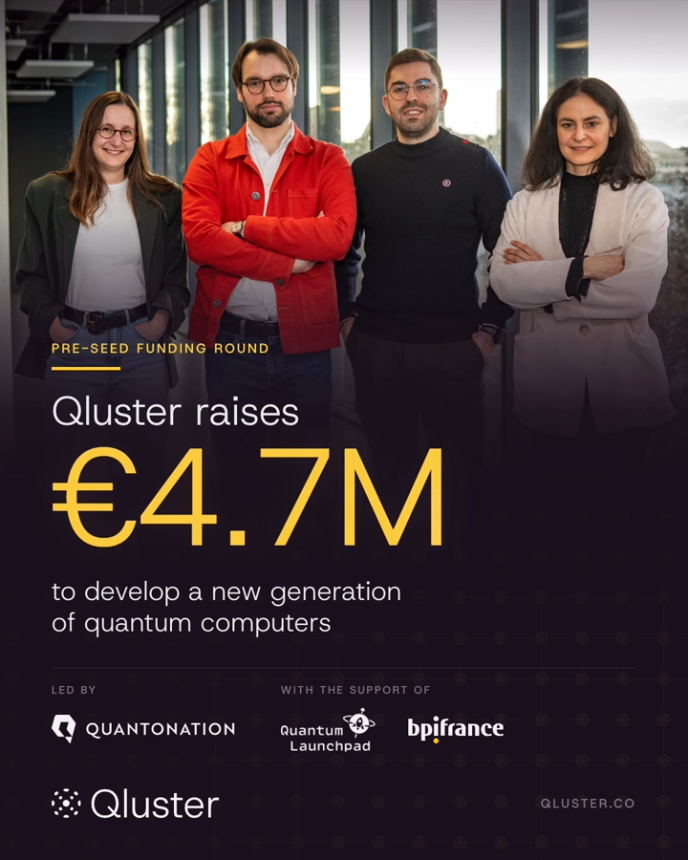
Qluster Secures €4.7 M Pre‑Seed Funding for CV Photonic Quantum Computing
Paris‑based photonic quantum startup Qluster announced a €4.7 million (≈ $5.2 M) pre‑seed round led by Quantonation, with participation from Quantum Launchpad and Bpifrance. The capital will fund an independent R&D laboratory, expand experimental‑physics and quantum‑architecture teams, and accelerate the company’s roadmap toward an intermediate‑scale quantum processor by 2032 and a fault‑tolerant universal machine by 2036.
Why Continuous‑Variable Photonics?
Qluster’s approach diverges from the more common discrete‑photon or superconducting qubit architectures. Instead of encoding information in single‑photon paths, the company leverages continuous‑variable (CV) cluster states across spectrally multiplexed optical modes. This design promises several practical advantages:
- Room‑temperature operation – eliminating the need for costly cryogenic infrastructure.
- Scalable optical hardware – miniature multimode squeezed‑light sources can be densely integrated on a chip.
- Data‑center friendliness – the optical platform can, in principle, be co‑located with classical computing resources.
The technology builds on patented squeezed‑light sources developed at France’s Laboratoire Kastler Brossel (LKB) by co‑founders David Fainsin and Valentina Parigi.
Co‑Design Methodology
Qluster pairs its hardware development with an application‑driven co‑design process. Target industrial workloads are first mapped onto abstract metrics—circuit depth, logical‑qubit count, and power budget—before the physical processor topology is finalized. This early‑stage budgeting aims to ensure that the eventual hardware can meet real‑world performance expectations without excessive over‑engineering.
Funding Landscape and Milestones
The round follows earlier support from France 2030’s i‑Lab Grand Prize (2026), as well as backing from Agoranov, CNRS Innovation, and Sorbonne Université’s startup programs. Qluster’s stated milestones are:
- 2028‑2032 – Demonstrate an intermediate‑scale CV photonic processor capable of running benchmark algorithms.
- 2033‑2036 – Scale the platform to a fault‑tolerant universal processor, leveraging error‑corrected CV cluster states.
These timelines are ambitious, especially given the nascent state of large‑scale CV photonic hardware, but the funding provides a clear runway for the company’s R&D.
Market Context
Photonic quantum computing has attracted growing interest because of its potential for room‑temperature operation and compatibility with existing telecom infrastructure. However, most public demonstrations remain at the few‑dozen‑mode level, and scaling to the hundreds or thousands of modes required for practical advantage is an open challenge. Qluster’s focus on spectral multiplexing and miniaturized squeezed‑light sources positions it within a competitive niche that includes other European and North‑American photonic ventures.
Outlook
While the pre‑seed round does not yet translate into a demonstrable quantum processor, it signals investor confidence in CV photonic approaches and provides Qluster with the resources to move from laboratory prototypes to a dedicated engineering team. Stakeholders should watch for the company’s first hardware milestones, which will be the first concrete evidence of whether the CV architecture can meet the scalability promises touted in the announcement.
--- This article is based on the funding announcement and related coverage; no technical results were disclosed.
Hype check
Not a research claimFunding announcement for CV photonic quantum computers; no technical result to evaluate, just investment news.
We rate research and technical results only. How we rate hype →
Source
Read original sourceWhy we picked this
Accepted from curated QuantumUnzipped source (relevance scoring disabled).