Quandela and NVIDIA Benchmark Photonic Quantum Simulability Frontiers on H100 GPUs
Quandela, CNRS and NVIDIA released a preprint defining a unified “simulability frontier” that quantifies when photonic quantum processors surpass exact classical simulation on a single NVIDIA H100 GPU.
Benchmarking Photonic Quantum Simulability on NVIDIA H100 GPUs
Researchers from Quandela, the French National Centre for Scientific Research (CNRS) and NVIDIA have published a technical preprint that introduces a standardized metric – the simulability frontier – for assessing when photonic quantum processors become harder to simulate exactly on classical hardware. The study focuses on a single NVIDIA H100 PCIe GPU, the current flagship for high‑performance AI workloads, and provides a clear, quantitative benchmark for the photonic community.
A Unified Frontier Metric
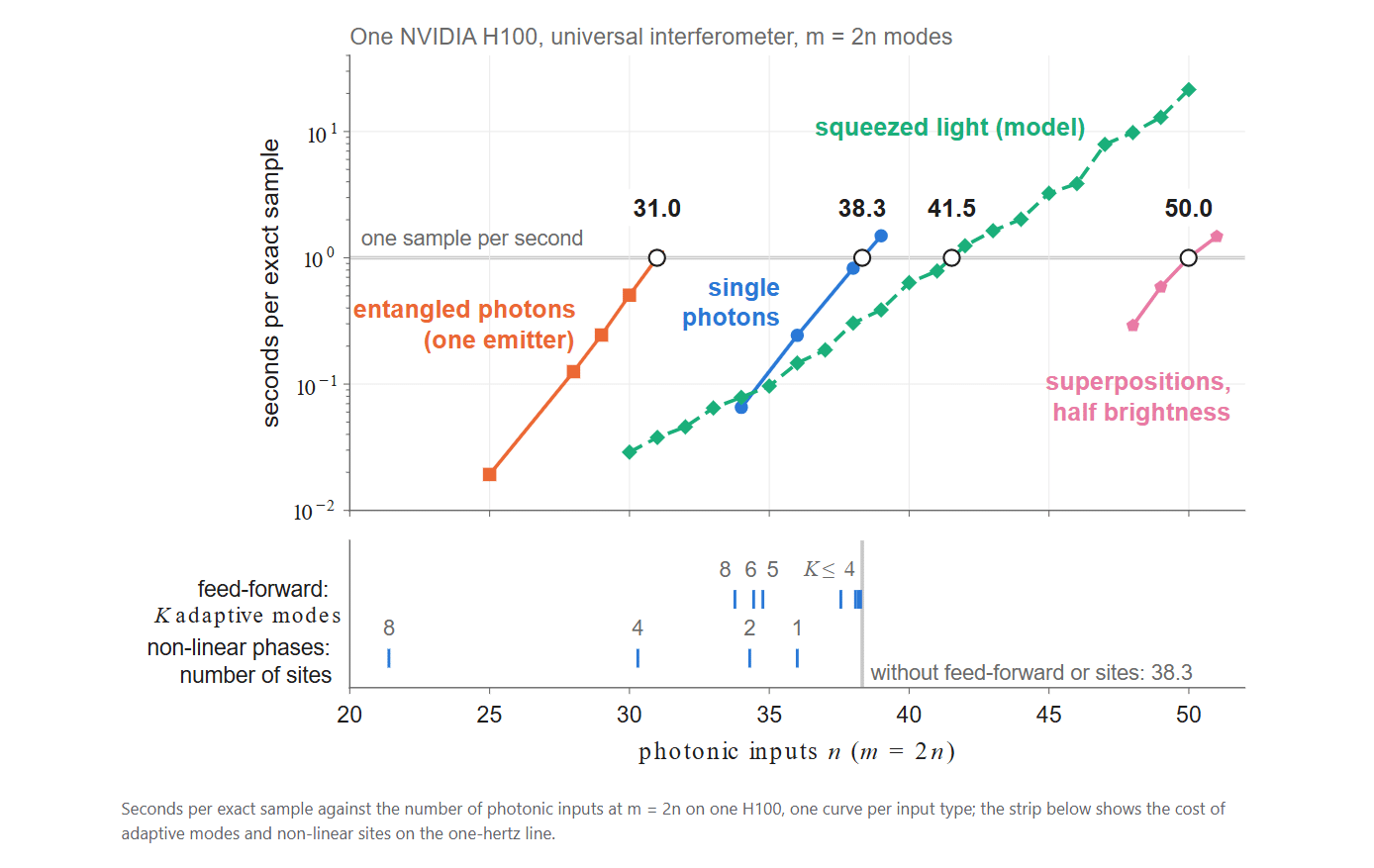
Previous literature reported a wide range of photon‑count thresholds (50 – 98 photons) for the point at which classical simulation becomes infeasible. The new work replaces these disparate figures with a single throughput‑based metric: the number of photonic inputs at which the fastest exact classical sampler can sustain one sample per second on a universal interferometer with twice as many optical modes as inputs ( m = 2 n ). This definition ties the benchmark directly to real‑time sampling capability, making it easier to compare across hardware platforms and algorithmic improvements.
Key Findings Across Photonic Modalities
| Modality | Measured / Modelled Frontier (photonic inputs) | |----------|-----------------------------------------------| | Entangled quantum emitters | 31.0 | | Single‑photon (Fock) inputs | 38.3 | | Squeezed‑light (0.5 photons/squeezer) | 41.5 (modelled) | | Coherent superpositions (α = π/4) | 50.0 | | Memory‑limited (RAM) | 13 | | Floating‑point‑limited (fp64) | 55 – 62 |
The frontier scales modestly with additional GPUs: eight H100 GPUs add roughly 3.5 photons to the single‑photon frontier, while a massive deployment of 16 384 GPUs adds about 16.2 photons. The authors also demonstrate that algorithmic refinements—replacing the 2018 Clifford‑boson‑sampling algorithm with a 2020 output‑collapsed formulation and custom CUDA kernels—raise the single‑photon frontier from 32.5 to 38.3 inputs on identical hardware.
Practical Implications
- Real‑time stream reproduction – A three‑source entangled processor operating at 1 GHz with 48 photons across 96 modes can generate individual 10‑photon samples that are still classically tractable, but reproducing its continuous output stream in real time would require roughly 30 H100 GPUs.
- Energy consumption – Direct board‑level power measurements (270 – 344 W) show that generating a single 38‑photon sample consumes about 7.3 × 10⁻² Wh on an H100, suggesting an energetic advantage for photonic hardware below roughly 12 photons.
Looking Ahead
The benchmark provides a concrete target for photonic hardware developers: surpassing the 38‑photon single‑photon frontier on a single H100 would mark a clear advantage over exact classical simulation. At the same time, the study highlights the steep hardware scaling required to push beyond 50 photons, emphasizing the need for algorithmic breakthroughs and more efficient photonic architectures.
For readers interested in digging deeper, the authors have made the photonic‑engines GPU library open‑source and have posted the full technical preprint on arXiv. These resources enable the community to reproduce the results, explore alternative simulation strategies, and extend the frontier analysis to future GPU generations.
--- This article synthesizes the information provided in the original briefing without adding external quotations or unpublished data.
Hype check
RealThe preprint presents concrete benchmark data and a defined metric, backed by a technical paper; the claim matches the evidence and is not overstated.
- Peer-reviewed paper, or press release only?Paper — Technical preprint on arXiv cited in the input
- Error-corrected (logical) qubits, or physical qubits only?Logical / not a qubit claim — Not a qubit‑count claim; focus is on photonic inputs
- A new milestone, or a rebrand / restatement?New — Introduces a unified simulability frontier metric
- Independent confirmation?Unclear — No external confirmation mentioned in the input
- Does the headline claim match what the source shows?Matches — Headline accurately reflects the benchmarking study
An editorial assessment of the claim as reported, not a judgment of the company or researchers. How we rate hype →
Source
Read original sourceWhy we picked this
Accepted from curated QuantumUnzipped source (relevance scoring disabled).