Quantinuum Raises Revenue Outlook After Landing Its Largest Cloud Agreement
Quantinuum’s Q3 surge, highlighted by a massive cloud deal and record error‑correction results, lifts its 2026 revenue outlook despite widening losses.
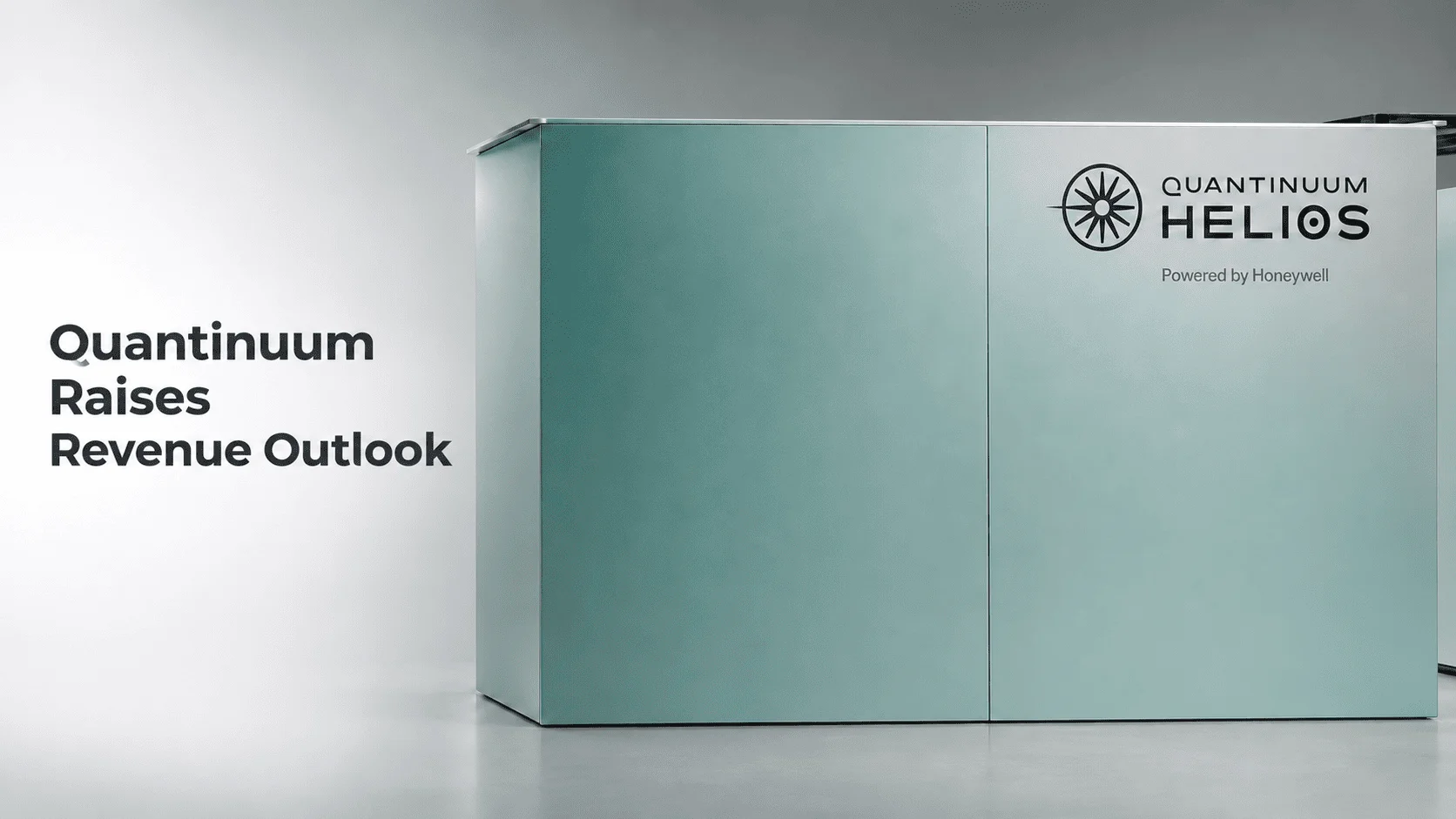
Quantinuum’s Q3 Momentum and Outlook
Quantinuum reported a dramatic third‑quarter revenue jump to $9.1 million, a 233 % increase year‑over‑year, and used the momentum to raise its full‑year 2026 revenue guidance to $31‑$34 million. The boost stems from a landmark multiyear cloud agreement with a leading global financial institution that guarantees future access to Quantinuum’s upcoming Apollo quantum computer, as well as continued growth of its Nexus software platform, now serving 215 organizations.
---
1. The Largest Cloud Agreement Fuels Commercial Expansion
The new cloud contract is the company’s biggest to date, covering both hardware and software across the Apollo roadmap. By locking in demand for future generations of trapped‑ion quantum processors, the deal signals strong confidence from the financial sector in Quantinuum’s long‑term roadmap.
Additional commercial wins this quarter include:
- A partnership with one of the world’s five largest pharmaceutical firms to apply quantum‑enhanced AI to cancer‑therapy material design.
- An agreement with GE Vernova focused on superconducting‑material research.
- A maritime logistics collaboration with Abu Dhabi Maritime Academy and Quincus.
- Expanded distribution through an unnamed major cloud provider and a joint beta program with Oracle for quantum‑AI applications.
These deals illustrate Quantinuum’s strategy of diversifying across finance, pharma, energy, and logistics while leveraging its cloud‑first approach to reach developers worldwide.
---
2. Technical Progress: Error‑Correction Milestones
Quantinuum’s hardware team posted record logical‑fidelity results on its Helios system, achieving 99.9995 % logical fidelity in October—an order‑of‑magnitude improvement over the September run and 100 × better than the best published results on competing platforms. The achievement relied on two error‑correction codes operating within a single system design, bringing logical error rates into the target range for the future Apollo processor.
While the Helios milestones are not yet a full Apollo system, they validate the company’s approach of minimizing additional hardware overhead for fault‑tolerance. The next hardware milestone, Sol, remains on track for a second‑half‑2027 debut, with full‑scale control‑system validation already completed and integration slated for early 2027.
---
3. Software Adoption Accelerates
Quantinuum’s Nexus platform, designed to let customers migrate applications across successive hardware generations, saw a 20 % quarter‑over‑quarter increase in adoption, reaching 215 organizations. Job submissions on the platform surged tenfold over the past year, reflecting growing developer confidence.
Recent software releases include:
- An expanded Guppy toolkit for logical‑qubit programming, reducing the need for code rewrites when error‑correction schemes change.
- A forthcoming December update that will add cross‑platform workflows, support for additional error‑correction codes, and performance‑diagnostic tools.
The company also launched QUOPS with Sandia National Laboratories and NVIDIA to benchmark useful computational scale, and its Q‑Net community now exceeds 800 members.
---
4. Financial Picture: Better Margins, Wider Losses
Revenue growth translated into a turnaround in gross margin, which improved to 33.3 % from a negative 43.5 % a year earlier. Adjusted gross margin climbed to 74.6 %, an 8.5‑point increase. However, the company’s net loss widened to $118 million, driven by higher R&D and scaling expenses, while adjusted EBITDA loss expanded to $80 million.
Quantinuum ends the quarter with a robust cash position—$1.94 billion in cash and cash equivalents—providing ample runway for continued hardware development, software expansion, and strategic partnerships.
---
5. Looking Ahead
Quantinuum’s roadmap remains ambitious: Sol is slated for early‑2027 integration, and the fault‑tolerant Apollo system targets a 2029 launch. Validation of cooling infrastructure and manufacturing partnerships with GlobalFoundries, Infineon, Honeywell Aerospace, and Monarch Quantum reinforce the hardware timeline.
On the commercial side, the company will continue to deepen its cloud presence, expand Nexus adoption, and pursue industry‑specific collaborations that showcase quantum advantage. The combination of technical breakthroughs, a growing software ecosystem, and high‑profile cloud agreements positions Quantinuum to capitalize on the emerging quantum‑computing market, even as it navigates short‑term profitability challenges.
---
Practical Takeaway
Quantinuum’s Q3 results demonstrate that strategic cloud contracts and tangible error‑correction progress can drive top‑line growth and investor confidence, despite elevated losses during a scaling phase. Stakeholders should watch the upcoming Sol rollout and the evolution of the Apollo partnership, as these milestones will likely shape the company’s valuation and market positioning through the end of the decade.
Source
Read original sourceWhy we picked this
Accepted from curated QuantumUnzipped source (relevance scoring disabled).