Quantinuum Reports a 10x Reduction in Logical Error Rate on Helios
Quantinuum achieved a ten‑fold reduction in logical error rate on its Helios trapped‑ion quantum computer using a color‑code error‑correction scheme, reaching 99.9995% logical fidelity.
Introduction
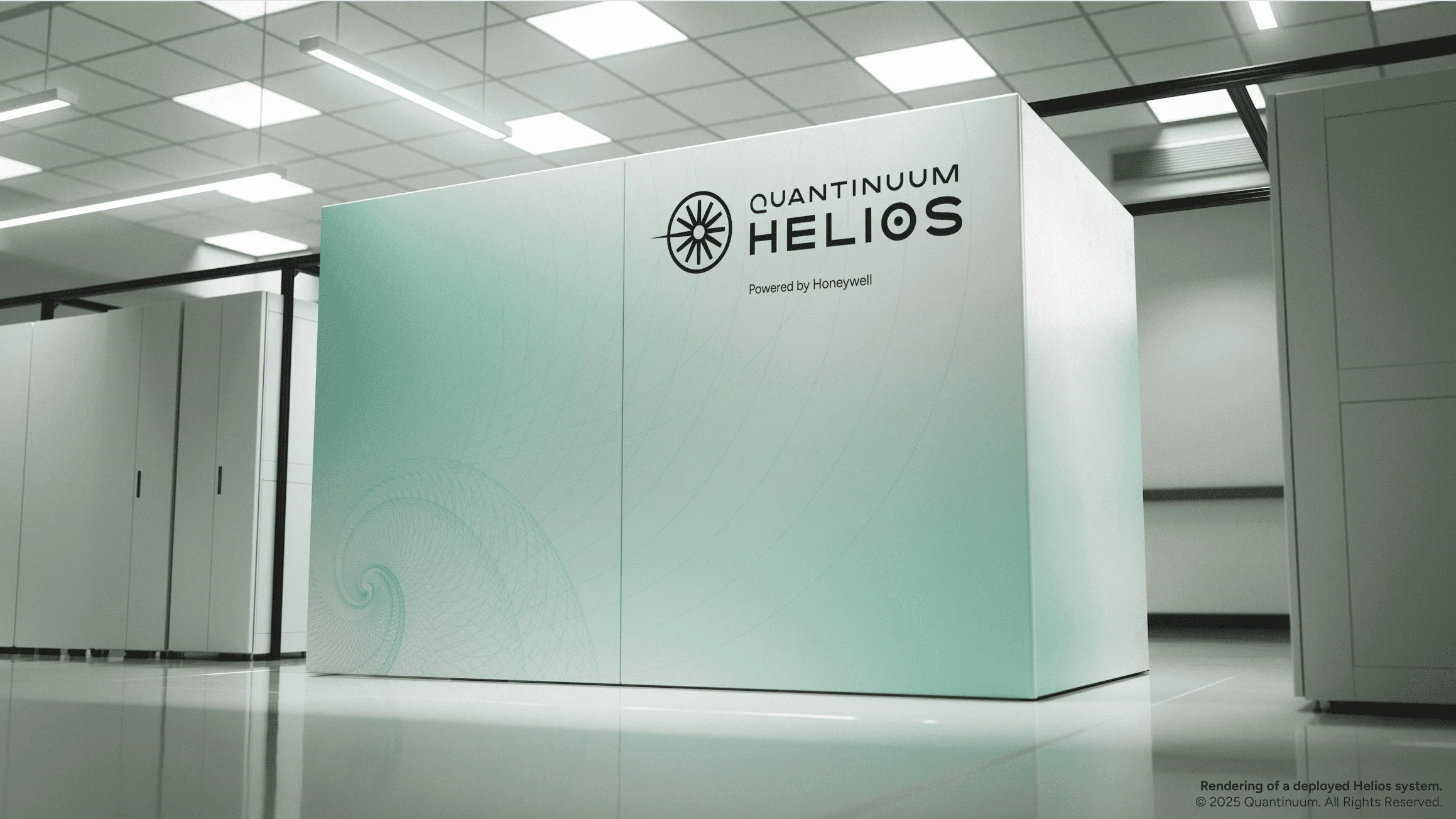
Quantinuum announced a new benchmark for quantum error correction on its commercial Helios trapped‑ion system. By employing a color‑code error‑correction architecture, the company reported a logical fidelity of 99.9995%, equivalent to five errors per million operations. This represents a ten‑fold improvement over its previous record and a hundred‑fold improvement compared with the best published result from other hardware platforms.
How the color‑code achieved the record
The color‑code implementation leverages Quantinuum’s end‑to‑end framework, which integrates all‑to‑all qubit connectivity, high‑fidelity physical gates, and AI‑driven decoders. On Helios, the code required up to 37 physical qubits to encode a single logical qubit, but the added redundancy enabled a dramatic suppression of logical errors. As the code distance—the number of physical qubits protecting each logical qubit—increased, logical errors fell exponentially, with each tested increase cutting the remaining error rate by a factor of about 12. This scaling behavior is a key indicator that the architecture can support larger, fault‑tolerant systems without prohibitive resource overhead.
Comparing code families on the same hardware
Earlier in September 2026, Quantinuum demonstrated a different error‑correction scheme, the Helix code, on the same Helios hardware. Helix used only 10 physical qubits per logical qubit, offering higher qubit efficiency but a higher logical error rate than the color code. The side‑by‑side results illustrate Quantinuum’s ability to prototype multiple codes rapidly and choose the optimal trade‑off between qubit overhead and accuracy for a given application. While the color code delivers the lowest error rates, Helix may be preferable for workloads where speed or qubit count is the primary constraint.
Implications for fault‑tolerant quantum computing
The reported logical fidelity places Quantinuum’s system within the target range for its planned universal fault‑tolerant machine, Apollo, slated for 2029. Independent commentary from Robin Blume‑Kohout of Sandia National Laboratories highlighted that a logical qubit with error rates this low could enable useful fault‑tolerant computation with fewer than a million physical qubits—a significant reduction compared with estimates for superconducting platforms. The flexibility of Quantinuum’s architecture—supporting adaptive syndrome extraction, chain‑mapping of codes, and real‑time decoding—provides multiple pathways to further lower error rates while managing resource demands.
Practical outlook
For developers and enterprises preparing quantum‑ready applications, Quantinuum’s progress signals that high‑accuracy, error‑corrected qubits are becoming more accessible on commercial hardware. The company’s full‑stack platform, which bundles the hardware, error‑correction architecture, and developer tools, aims to let users experiment with different codes and optimize for specific problem domains such as materials science, chemistry, finance, and logistics. As logical error rates continue to drop, the threshold for economically viable quantum advantage narrows, encouraging early adoption of quantum‑enhanced workflows.
--- Quantinuum’s latest result underscores the rapid pace of improvement in trapped‑ion quantum computing and demonstrates that flexible, code‑agnostic error‑correction architectures can deliver both high fidelity and scalable resource requirements.
Source
Read original sourceWhy we picked this
Accepted from curated QuantumUnzipped source (relevance scoring disabled).