Quantum algorithm tackles jet identification with just five superconducting qubits
Researchers used a five‑qubit superconducting processor to train and test a quantum classifier for heavy‑flavor jet identification on real hardware.
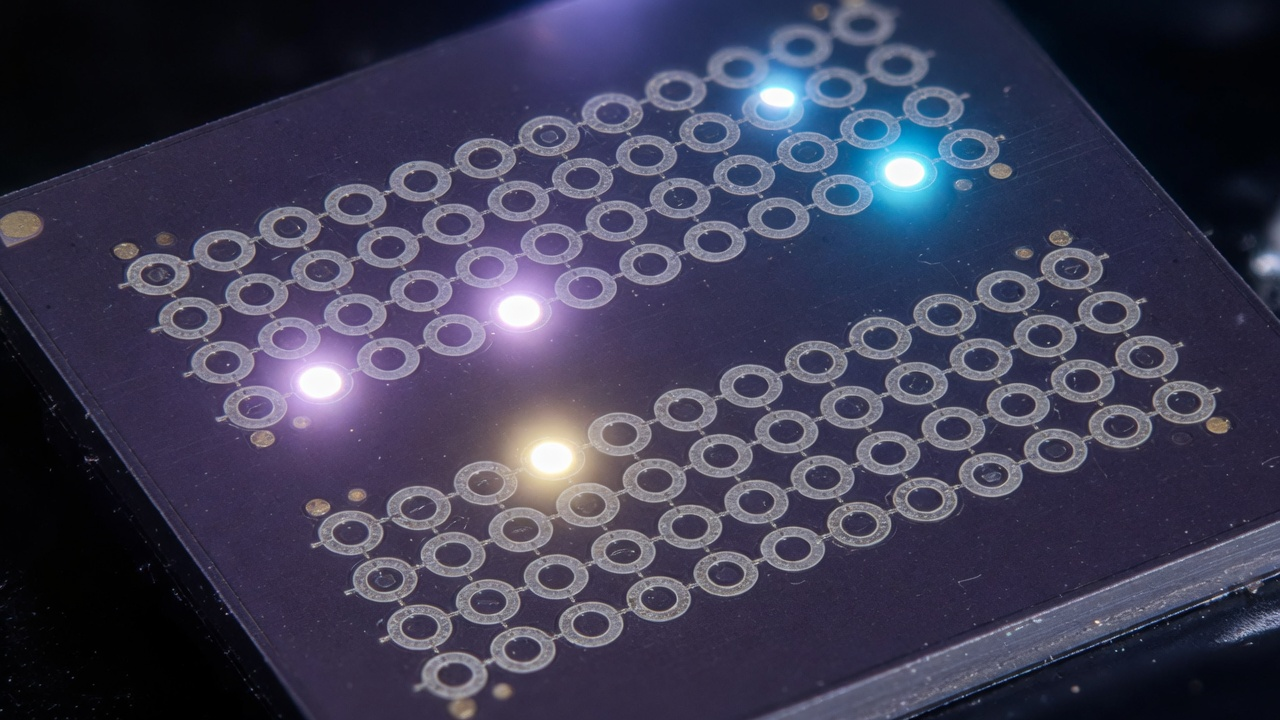
Quantum Algorithm Classifies LHC Jets on a Five‑Qubit Processor
A team from Italy’s INFN and Politecnico di Torino has demonstrated that a variational quantum circuit (VQC) can be trained and tested entirely on a superconducting quantum processor to distinguish beauty‑ and charm‑quark jets – a key task for the Large Hadron Collider’s (LHC) data analysis. The work, described in an arXiv pre‑print, marks the first end‑to‑end quantum‑machine‑learning pipeline for jet tagging that runs on actual quantum hardware rather than relying on classical post‑processing.
End‑to‑End Training on Real Hardware
The researchers encoded classical jet features into quantum states on IQM’s five‑qubit superconducting processor. A hybrid loop optimized the VQC parameters using the parameter‑shift rule, while a classical optimizer handled gradient updates. Both the training phase (parameter convergence) and the inference phase (classification) were executed on the quantum processing unit (QPU), a step not previously achieved for LHC‑style simulated data.
Performance Despite Noise
Hardware‑induced noise altered the training trajectory compared with ideal simulators, but the final classifier’s accuracy remained comparable to noise‑aware simulations. The authors report that the noise did not significantly degrade performance, suggesting that modest‑size quantum devices can tolerate realistic error rates for certain high‑energy‑physics tasks.
Why Five Qubits Matter
Current superconducting platforms are limited to a few dozen physical qubits, and many quantum‑machine‑learning proposals require far larger registers. By designing a circuit that fits within five qubits yet still captures enough information to separate b‑ and c‑jets, the team shows a practical pathway for early‑stage quantum advantage studies. The paper discusses scalability, noting that future processors with ~100 qubits could represent richer jet feature spaces and enable more direct comparisons with classical methods.
Outlook and Open Challenges
The demonstration opens several research directions:
- Gradient‑estimation improvements – the bulk of training time is spent evaluating gradients; techniques such as simultaneous perturbation stochastic approximation could reduce overhead.
- Hybrid surrogate models – classical neural networks might approximate circuit outputs, further speeding up optimization.
- Larger datasets and qubit counts – extending the approach to full LHC datasets will likely require processors with dozens to hundreds of qubits.
While the result does not yet claim a computational advantage over classical classifiers, it validates that a full quantum learning workflow can operate on noisy hardware without catastrophic loss of fidelity. This is a crucial benchmark for the quantum‑high‑energy‑physics community and a concrete step toward leveraging quantum processors for complex scientific analyses.
--- The work is documented in the pre‑print “Beauty and charm jet identification with end‑to‑end training on a superconducting quantum processor” (arXiv:2611.16607v1).
Hype check
PartlyThe paper shows a concrete end‑to‑end demonstration on a 5‑qubit device, but it is only a pre‑print and lacks peer review or independent verification.
- Peer-reviewed paper, or press release only?Press release only — Only an arXiv pre‑print is cited
- Error-corrected (logical) qubits, or physical qubits only?Physical only — The result uses five physical superconducting qubits
- A new milestone, or a rebrand / restatement?New — First full training‑and‑testing pipeline on real hardware for LHC jets
- Independent confirmation?Not yet — No external replication mentioned in the input
- Does the headline claim match what the source shows?Matches — Headline accurately reflects the five‑qubit demonstration
An editorial assessment of the claim as reported, not a judgment of the company or researchers. Checked against: arxiv.org. How we rate hype →
Source
Read original sourceWhy we picked this
Accepted from curated QuantumUnzipped source (relevance scoring disabled).