Quantum blueprint maps a practical path to testing unusual entanglement
UT researchers propose a realistic Rydberg‑atom protocol to simulate Motzkin spin chains and test their unusually high entanglement.
From Theory to Testable Entanglement
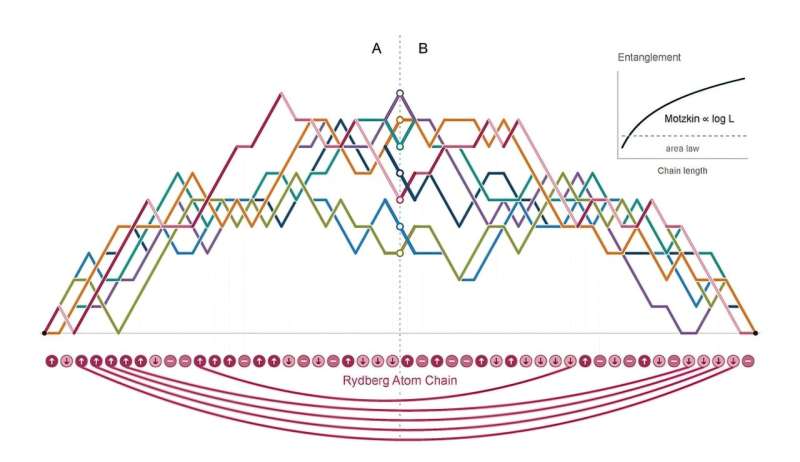
A collaboration between condensed‑matter and AMO physicists at the University of Tennessee has turned a long‑standing mathematical model—the Motzkin spin chain—into a concrete experimental blueprint. Their work, published in Physical Review Letters and posted on arXiv, outlines how to encode the exotic Motzkin states in arrays of Rydberg atoms using parameters that current cold‑atom platforms can achieve.
Why Motzkin Chains Matter
Motzkin spin chains are a rare class of quantum many‑body systems whose entanglement entropy grows faster than the familiar “area law” that governs most physical materials. This rapid growth makes them extremely hard to simulate on classical computers, yet they offer a testbed for exploring the limits of quantum correlations and could inspire new quantum‑information protocols.
The Proposed Rydberg‑Atom Protocol
The authors detail a step‑by‑step protocol:
- Prepare a tweezer‑arranged array of neutral atoms and excite them to high‑lying Rydberg states, where the atoms interact strongly at short range but become essentially non‑interacting beyond a tunable blockade radius.
- Map each effective Motzkin spin to a multi‑level Rydberg configuration, exploiting the fact that each site can host more than two internal states.
- Adjust laser detunings and Rabi couplings to engineer the specific Hamiltonian that yields the Motzkin ground state. The paper provides explicit parameter regimes that lie within the reach of existing optical‑tweezer experiments.
- Measure entanglement using established Rydberg‑atom tomography techniques, allowing a direct comparison with the theoretical predictions of super‑area‑law scaling.
The protocol leverages the “knobs” that Rydberg platforms uniquely provide—precise spatial control, tunable interactions, and flexible internal level structure—making the proposal experimentally realistic.
Outlook and Next Steps
While the paper stops at a theoretical design, the authors emphasize that several leading Rydberg‑atom groups are already capable of implementing the required parameter set. The next logical step is a collaborative experimental demonstration, which would constitute the first laboratory observation of Motzkin‑type entanglement.
If realized, this work would push the technology readiness level of exotic quantum phases from a purely mathematical curiosity toward a testable laboratory platform, opening avenues for studying non‑area‑law entanglement, benchmarking quantum simulators, and perhaps uncovering new computational primitives.
---
The article is based on the PRL paper “Quantum Simulation of Motzkin Spin Chains with Rydberg Atoms” (Mukherjee et al., 2026) and the accompanying arXiv preprint.
Hype check
RealThe claim is a peer‑reviewed theoretical protocol with clear parameter specifications; it is accurately described and does not overstate experimental achievement.
- Peer-reviewed paper, or press release only?Paper — Published in Physical Review Letters
- Error-corrected (logical) qubits, or physical qubits only?Logical / not a qubit claim — Not a qubit‑count claim
- A new milestone, or a rebrand / restatement?New — First practical protocol for Motzkin states
- Independent confirmation?Not yet — No external replication reported
- Does the headline claim match what the source shows?Matches — Headline reflects the paper’s pathway proposal
An editorial assessment of the claim as reported, not a judgment of the company or researchers. Checked against: phys.org. How we rate hype →
Source
Read original sourceWhy we picked this
Accepted from curated QuantumUnzipped source (relevance scoring disabled).