Quantum-gas microscope resolves the 'color' of individual atoms in a single shot
ICFO researchers have built a quantum‑gas microscope that images all ten spin states of individual strontium‑87 atoms in a single experimental run.
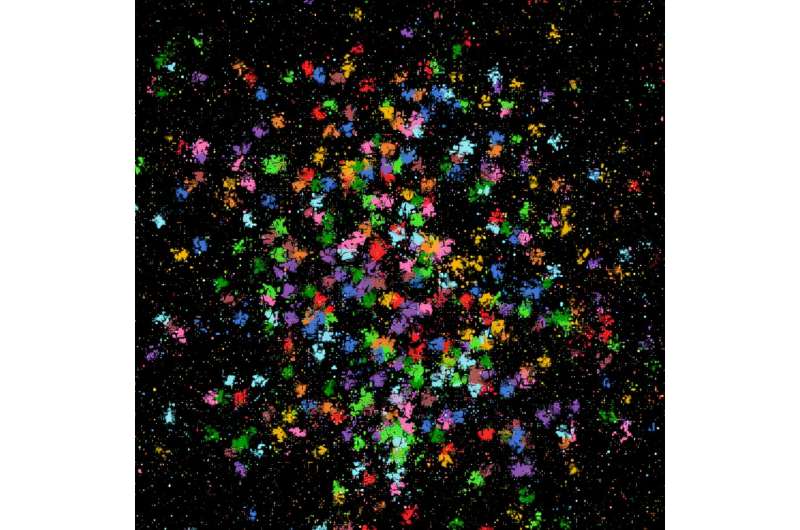
A Colorful View of Quantum Matter
A team at the Institut de Ciències Fotòniques (ICFO) has demonstrated a quantum‑gas microscope that can resolve the ten spin states of fermionic strontium‑87 atoms in one shot. By exploiting a narrow‑line optical transition that selectively excites a chosen spin, the researchers sequentially map each spin onto a bright fluorescence channel, producing a multicoloured image where each hue corresponds to a distinct spin component.
---
How the microscope works
The key to the technique is the red narrow‑line transition of strontium‑87. A laser tuned to this transition excites only atoms occupying a specific spin state, causing them to fluoresce while the remaining nine spin states stay dark. After recording the fluorescence, the experiment transfers the next spin state into the addressable level and repeats the process. By stitching together the ten fluorescence frames, the microscope yields a single‑shot, spin‑resolved picture of the atomic lattice.
Why ten spins matter
Strontium‑87 is a fermion with a ten‑fold nuclear spin degeneracy (SU(10) symmetry). Conventional quantum‑simulation platforms typically emulate electrons with only two spin states, limiting the range of many‑body phenomena that can be explored. Access to ten spin components opens the door to simulating exotic magnetic orders, multi‑component Hubbard models, and potential spin‑liquid phases that are otherwise inaccessible.
Implications for quantum simulation and computing
- Quantum simulation – The ability to image each spin component in situ provides a powerful diagnostic for studying strongly correlated materials, high‑temperature‑superconductor analogues, and novel quantum magnetism.
- Qudit platforms – Neutral‑atom qudits (quantum digits) can encode more than two logical levels. The demonstrated read‑out scheme offers a scalable, high‑fidelity method for measuring qudit states, aligning with proposals that use alkaline‑earth atoms for quantum information processing.
Looking ahead
The authors anticipate extending the technique to larger lattices and integrating it with dynamical control of spin interactions. Combined with recent advances in optical‑tweezer arrays and programmable potentials, the color‑resolved microscope could become a cornerstone tool for next‑generation analog quantum simulators and neutral‑atom quantum computers.
---
The work, “Spin‑Resolved Microscopy of ⁸⁷Sr SU(N) Fermi‑Hubbard Systems,” appears in Physical Review X (2026).
Hype check
RealThe paper in Physical Review X provides peer‑reviewed evidence of the single‑shot, ten‑spin imaging; the claim matches the reported result and no external verification is needed for this experimental milestone.
- Peer-reviewed paper, or press release only?Paper — Published in Physical Review X (2026)
- Error-corrected (logical) qubits, or physical qubits only?Logical / not a qubit claim — Not a qubit‑count claim; focus is on spin‑resolved imaging
- A new milestone, or a rebrand / restatement?New — First realization of a microscope detecting 10 spin states in one shot
- Independent confirmation?Not yet — No external replication mentioned in the input
- Does the headline claim match what the source shows?Matches — Headline accurately reflects the single‑shot, color‑resolved imaging
An editorial assessment of the claim as reported, not a judgment of the company or researchers. Checked against: phys.org. How we rate hype →
Source
Read original sourceWhy we picked this
Accepted from curated QuantumUnzipped source (relevance scoring disabled).