Quantum Machines Demonstrates Sub-Microsecond Surface-Code Decoding on OPX1000 Using NVIDIA CUDA-Q QEC and NVQLink
Quantum Machines showed sub‑microsecond surface‑code decoding on its OPX1000 controller using NVIDIA CUDA‑Q and NVQLink.
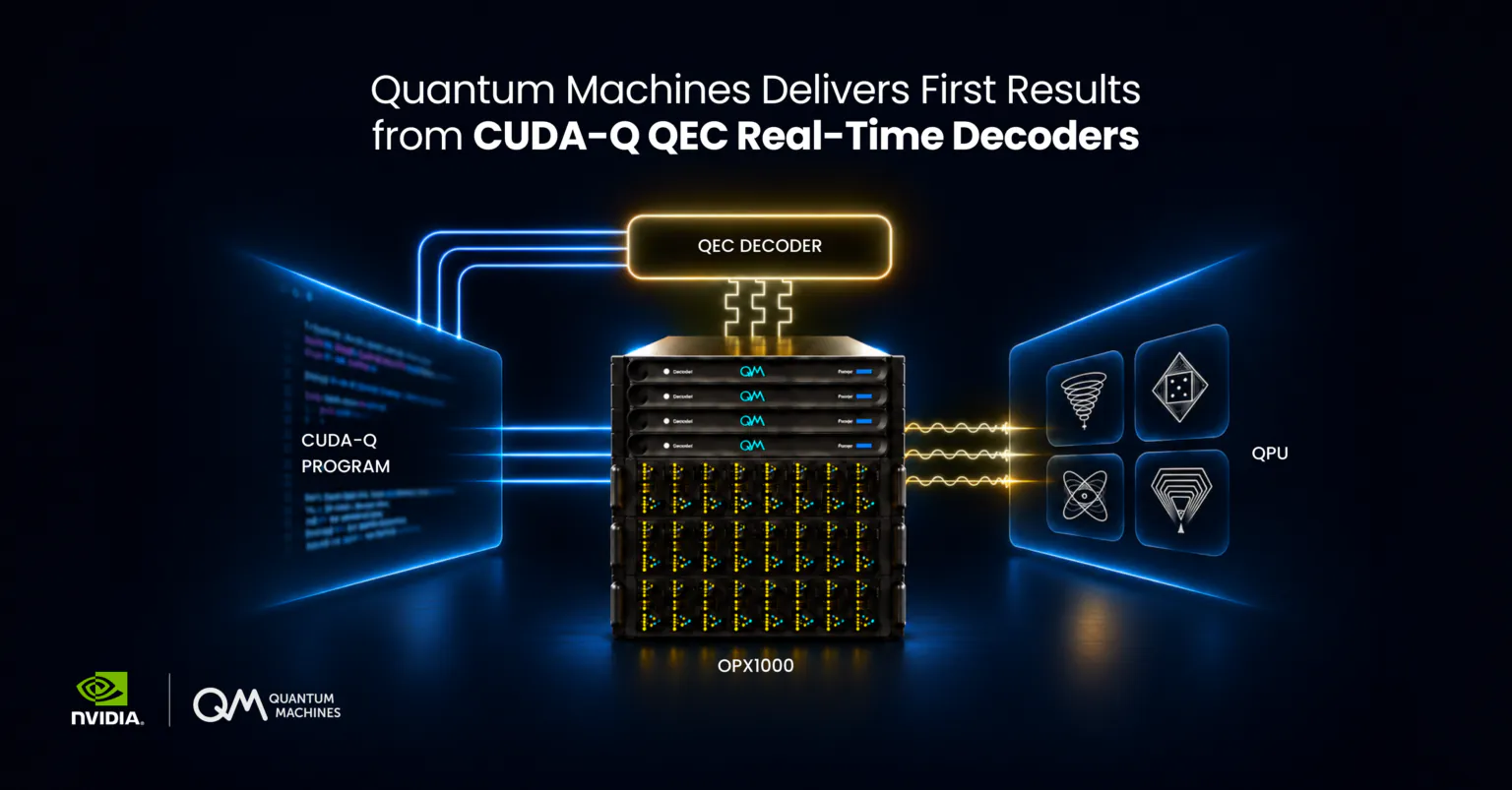
Quantum Machines’ Sub‑Microsecond Surface‑Code Decoding Demo
Quantum Machines (QM) announced that its OPX1000 quantum‑control platform can perform real‑time surface‑code error‑correction decoding in under a microsecond per round. The achievement relies on a tight integration with NVIDIA’s CUDA‑Q Realtime API and a transport‑agnostic CUDA‑Q QEC decoding server linked via NVIDIA NVQLink.
How the Test Was Conducted
- Hardware: An NVIDIA GH200 Grace Hopper server hosted the decoding workload, while the OPX1000 handled syndrome collection and feedback.
- Workload: Pre‑sampled surface‑code memory syndromes were generated at a physical error rate of 0.1 %.
- Latency: The bridge maintained a 2.4 µs round‑trip latency between controller and decoder. For code distances 7 and 11, per‑round decoding times were 0.19‑0.22 µs and 0.56‑0.67 µs respectively, comfortably below the 1 µs target for a single QEC cycle.
- Scalability: Distance‑15 decoding ran at 1.20‑1.50 µs per round, indicating room for further GPU‑dispatch optimisation.
Technical Highlights
- CUDA‑Q Realtime Bridge: The bridge compiles static CUDA‑Q memory circuits through Quake to QUA, streaming syndrome data via `enqueuesyndromes` and retrieving corrections with `getcorrections` during execution, eliminating post‑processing delays.
- Modular Decoder Server: By decoupling decoder logic from transport code, users can swap algorithms (e.g., PyMatching, NVIDIA’s fusion decoder) through simple YAML configuration changes, without firmware updates.
- Future Roadmap: The current implementation routes callbacks through host‑CPU threads on the GH200. Direct GPU dispatch is slated for a later release, promising even lower latencies.
What This Means for Quantum Error Correction
Achieving sub‑microsecond decoding is a critical step toward practical mid‑circuit QEC, where feedback must keep pace with fast quantum gate cycles. While the demonstration uses pre‑sampled syndromes rather than live qubit data, the latency figures suggest that the OPX1000‑CUDA‑Q stack could support real‑time error correction on near‑term quantum processors once integrated with actual hardware.
Looking Ahead
Quantum Machines plans to make early‑access to the OPX1000 CUDA‑Q integration available to customers in December 2026. Continued optimisation—particularly moving the decoder onto the GPU itself—should push decoding times further below the microsecond barrier for larger code distances, bringing fault‑tolerant quantum computing a step closer to reality.
For more details, see the Quantum Machines press release and NVIDIA technical blog referenced in the original announcement.
Hype check
PartlyThe announcement provides latency numbers but lacks peer‑reviewed data or independent verification, so the claim is partially supported.
- Peer-reviewed paper, or press release only?Press release only — Only a press release and blog references are mentioned.
- Error-corrected (logical) qubits, or physical qubits only?Logical / not a qubit claim — The story does not claim a logical‑qubit count.
- A new milestone, or a rebrand / restatement?New — Sub‑microsecond decoding for distances 7 and 11 is presented as a new result.
- Independent confirmation?Not yet — No external confirmation or reproduction is cited.
- Does the headline claim match what the source shows?Matches — Headline accurately reflects the latency results described.
An editorial assessment of the claim as reported, not a judgment of the company or researchers. How we rate hype →
Source
Read original sourceWhy we picked this
Accepted from curated QuantumUnzipped source (relevance scoring disabled).