Quantum Motion and NVIDIA Integrate CUDA-Q Backend into QUICHE for End-to-End Quantum Chemistry Workflows
Quantum Motion and NVIDIA added a CUDA‑Q backend to the open‑source QUICHE framework, enabling end‑to‑end GPU‑accelerated quantum chemistry simulations.
Quantum Motion & NVIDIA Bring CUDA‑Q to QUICHE
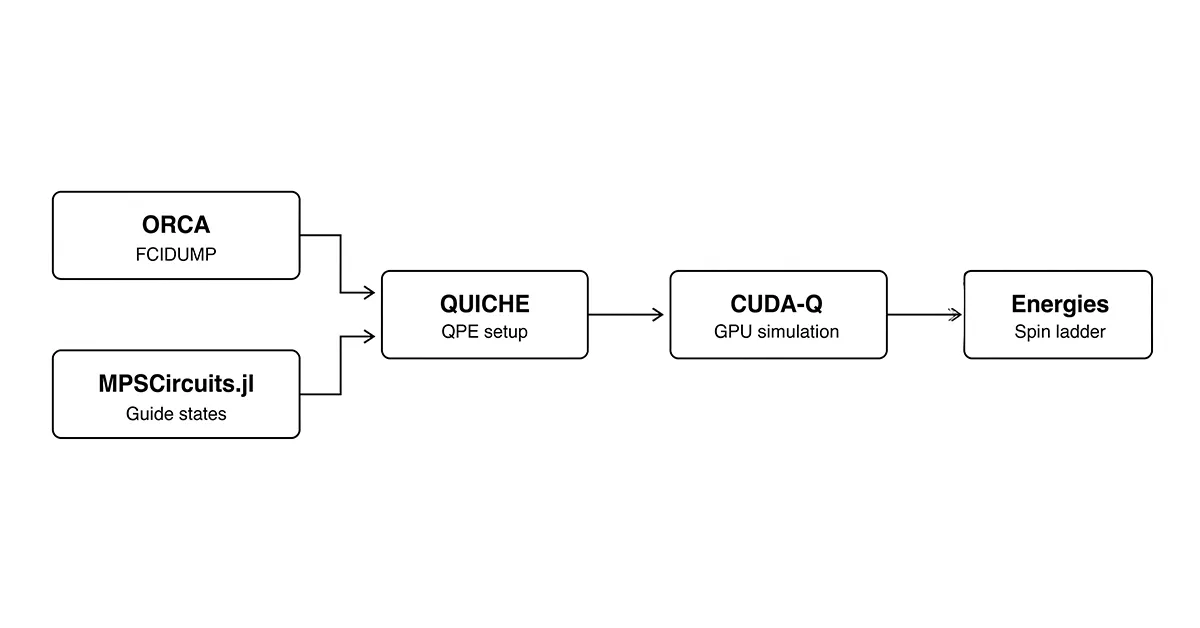
Quantum Motion and NVIDIA have announced a prototype integration that couples NVIDIA’s CUDA‑Q quantum‑programming stack with QUICHE, an open‑source interface for quantum chemistry workflows. The new backend automates the path from classical electronic‑structure calculations to GPU‑accelerated quantum phase estimation (QPE), removing the need for hand‑crafted quantum circuits.
How the workflow works
- Classical preparation – Researchers run a standard ORCA calculation to generate active‑space integrals, exported as an FCIDUMP file.
- QUICHE ingestion – QUICHE reads the integrals together with high‑level specifications for the Hamiltonian, QPE protocol, and desired energy precision.
- CUDA‑Q compilation – The CUDA‑Q Algorithms layer builds the qubit Hamiltonian and compiles QPE kernels that run directly on NVIDIA GPUs.
- Result verification – Energy estimates from the GPU‑based QPE are compared against exact CASSCF benchmarks.
Demonstration case
The teams validated the pipeline on a model iron‑sulfur complex, Fe(SH)₄⁻, using a five‑electron, five‑orbital active space. The entire simulation, from integral generation to QPE, executed on a single GPU, reproducing the reference CASSCF energies.
Why it matters
- End‑to‑end automation eliminates manual circuit design, lowering the barrier for chemists to explore quantum algorithms.
- GPU acceleration leverages existing high‑performance hardware, offering a practical path toward near‑term quantum‑chemistry studies.
- Open‑source availability of QUICHE and the demonstration notebook encourages community adoption and further development.
Next steps
Quantum Motion and NVIDIA plan to expand the integration to larger active spaces and more complex molecules, and to explore fault‑tolerant resource‑estimation workflows that use the same specification language. Interested users can access the technical announcement, the QUICHE codebase, and the SC26 Jupyter notebook through the links provided in the original release.
The integration showcases how software advances can bridge classical and quantum chemistry, accelerating research without waiting for large‑scale fault‑tolerant hardware.
Hype check
Not a research claimThe story reports a software integration and demonstration, not a performance claim, so it is a factual news item with no hype.
We rate research and technical results only. How we rate hype →
Source
Read original sourceWhy we picked this
Accepted from curated QuantumUnzipped source (relevance scoring disabled).