Quantum observers can 'agree to disagree,' but within limits, new theorem shows
A new theorem shows that quantum observers can maintain differing probability estimates under common certainty, but only when their measurements disturb the system in specific ways.
Quantum Agreement and Its Limits
A recent paper in Proceedings of the National Academy of Sciences introduces a quantum analogue of Aumann’s classic agreement theorem. The authors—María García Díaz, Giannicola Scarpa, and Adam Brandenburger—prove that two observers who start with the same quantum description can still assign different probabilities to a future measurement, even when each knows the other's estimate and that this knowledge is common‑knowledge. The key lies in the quantum nature of measurement: unlike classical updates, a measurement can change the underlying state and thus the probabilities being estimated.
Common Certainty in Quantum Settings
The theorem defines common certainty as the quantum extension of common knowledge, requiring that each observer knows the other's estimate, knows that the other knows theirs, and so on ad infinitum. When the observers’ measurement operators commute with the operator representing the property they are estimating, the theorem forces agreement—mirroring the classical result. However, if the observers’ measurements do not commute with the target property, the act of measurement can destroy quantum coherence, leading to divergent probability assessments.
A Simple Illustrative Model
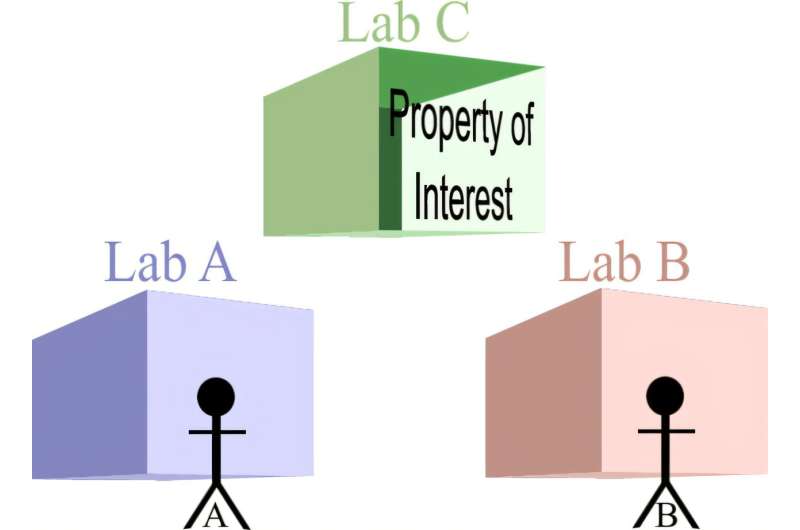
The authors illustrate the principle with a three‑part system shared by Alice (lab A), Bob (lab B), and an inaccessible third subsystem (lab C). Alice performs a measurement that distinguishes two coherent alternatives, collapsing the state and leaving her with a one‑third chance that a subsequent yes‑or‑no test on her part and C would return “yes.” Bob’s measurement, which does not distinguish the alternatives, retains the coherence and yields a two‑thirds estimate for the same test. Both observers satisfy common certainty, yet their probabilities differ because Alice’s measurement perturbs the property being estimated.
Restoring Agreement via Classical Records
The paper further shows that when a classical register records which measurements were performed and their outcomes, both observers can update their calculations using the recorded state. In the example, incorporating Alice’s measurement into the recorded state removes the interfering coherence, and both Alice and Bob converge on the one‑third probability. Thus, classical recording can reconcile quantum disagreement, provided the common‑certainty condition holds for the recorded assessments.
Implications and Boundaries
This work clarifies the precise circumstances under which quantum observers can maintain divergent views of a system despite shared information. It also delineates a hard limit: observers cannot both be certain that a property holds and that the other is certain it does not, when referring to the same underlying quantum state. The theorem deepens our understanding of quantum information sharing, measurement disturbance, and the role of classical records in achieving consensus.
---
The findings are technical and theoretical, offering a new lens on quantum foundations rather than immediate experimental applications. Readers interested in the formal proofs can consult the original PNAS article.
Hype check
RealThe paper presents a peer‑reviewed theorem with clear mathematical proof; the claim matches the published result and is not overstated.
- Peer-reviewed paper, or press release only?Paper — Published in PNAS with DOI 10.1073/pnas.2613021123
- Error-corrected (logical) qubits, or physical qubits only?Logical / not a qubit claim — Not a qubit‑count claim
- A new milestone, or a rebrand / restatement?New — Introduces a novel quantum agreement theorem
- Independent confirmation?Not yet — No external confirmation mentioned
- Does the headline claim match what the source shows?Matches — Headline accurately reflects theorem’s scope
An editorial assessment of the claim as reported, not a judgment of the company or researchers. Checked against: phys.org. How we rate hype →
Source
Read original sourceWhy we picked this
Accepted from curated QuantumUnzipped source (relevance scoring disabled).