Quantum physics confirms a person’s location, NIST scientists demonstrate
NIST researchers have experimentally demonstrated quantum position verification, using entangled photons to prove a person’s physical location.
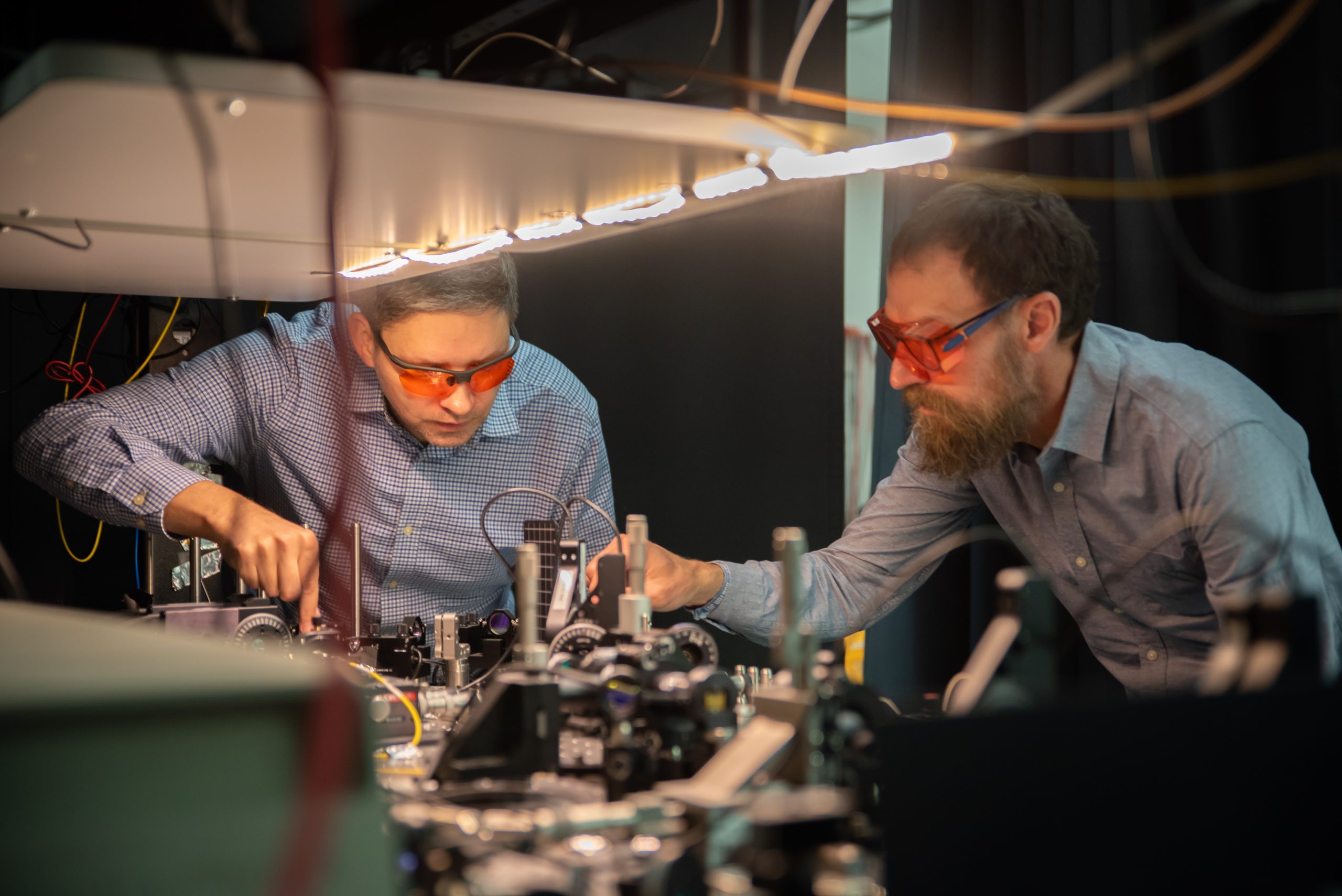
Quantum Position Verification: A First Full Demonstration
A team at the National Institute of Standards and Technology (NIST) has shown that quantum mechanics can be used to confirm a person’s location with high confidence. The experiment, published in Nature, implements a complete quantum‑position‑verification (QPV) protocol that relies on entangled photons and a loophole‑free Bell test. While practical deployment is still a decade away, the work marks a concrete step toward security systems anchored in physical reality rather than computational complexity.
How the Protocol Works
The NIST setup uses two spatially separated verifiers that each receive one photon from an entangled pair generated by a highly efficient source developed at the agency. The prover—whose location is to be verified—measures the incoming photons and reports the results back to the verifiers. By timing the arrival of these classical reports and checking that the measurement outcomes violate a Bell inequality, the verifiers can be certain that the prover was physically present at the claimed location. Any attempt to spoof the position would introduce a measurable delay, breaking the Bell‑test statistics and exposing the fraud.
Key hardware components include:
- Entangled‑photon source: A bright, narrow‑band source capable of producing millions of photon pairs per second.
- Superconducting nanowire single‑photon detectors: Near‑unity detection efficiency, essential for closing detection loopholes in the Bell test.
- Low‑loss optical fibers: Preserve entanglement over the distances required for the verification experiment.
The experiment achieved statistical confidence by collecting a large dataset of measurement outcomes, demonstrating that the protocol can operate reliably under laboratory conditions.
Significance and Potential Applications
Quantum position verification promises security guarantees that are impossible to achieve with classical methods alone. Because the verification is tied to the laws of physics, an adversary cannot simply replay or forge credentials without being physically present. Potential future uses include:
- High‑value financial transactions: Preventing fraudulent wire transfers by requiring the sender’s verified location.
- Critical‑infrastructure access: Securing control systems for power grids, nuclear facilities, or medical data centers.
- Quantum‑network authentication: Providing a trusted anchor for larger quantum communication networks.
The authors stress that the current demonstration is a proof‑of‑concept; scaling the system to real‑world distances and integrating it with existing infrastructure will require further advances in quantum networking, photon‑source brightness, and detector technology.
Outlook and Challenges
While the result is a clear milestone, several hurdles remain before QPV can be deployed commercially:
- Network infrastructure: Large‑scale quantum networks capable of distributing entanglement over hundreds of kilometers are still under development.
- Device robustness: The laboratory‑grade photon sources and detectors must be hardened for field operation.
- Standardization and certification: Protocols will need to be vetted by independent bodies to ensure interoperability and security.
NIST researchers estimate a timeline of ten years or more for mature applications, reflecting the need for continued investment in quantum hardware and networking.
Bottom Line
The NIST experiment provides the first complete, loophole‑free demonstration of quantum position verification. By linking authentication to a provable physical location, the work opens a new avenue for securing digital interactions that could eventually complement or replace traditional cryptographic methods.
--- Source: https://www.nist.gov/news-events/news/2026/11/quantum-physics-can-verify-persons-location-nist-researchers-show
Hype check
RealThe paper appears in Nature, describes a complete experimental demonstration, and the headline accurately reflects the result; no external replication is reported yet.
- Peer-reviewed paper, or press release only?Paper — Published in Nature as stated in the brief
- Error-corrected (logical) qubits, or physical qubits only?Logical / not a qubit claim — Not a qubit‑count claim, so logical‑qubit question not applicable
- A new milestone, or a rebrand / restatement?New — First complete demonstration of quantum position verification protocol
- Independent confirmation?Not yet — No external confirmation or replication mentioned
- Does the headline claim match what the source shows?Matches — Headline matches the experimental claim of verifying location via quantum physics
An editorial assessment of the claim as reported, not a judgment of the company or researchers. Checked against: nist.gov. How we rate hype →
Source
Read original sourceWhy we picked this
Accepted from curated QuantumUnzipped source (relevance scoring disabled).