Quantum software matches classical benchmark for a molecular interaction
Kvantify’s BEAST‑VQE algorithm reproduces CCSD(T) accuracy for a DNA‑derived dispersion interaction using far fewer orbitals, with hardware results matching simulations.
Quantum Software Meets Classical Accuracy on a Molecular Benchmark
Predicting how molecules interact is a cornerstone of drug discovery, yet many subtle forces—especially dispersion (π‑stacking) interactions—remain out of reach for classical computers. A recent study from the Danish quantum‑software firm Kvantify demonstrates that a tailored quantum algorithm can capture these forces with the same precision as the gold‑standard classical method CCSD(T), while dramatically reducing the computational load.
A Targeted Molecular Test Case
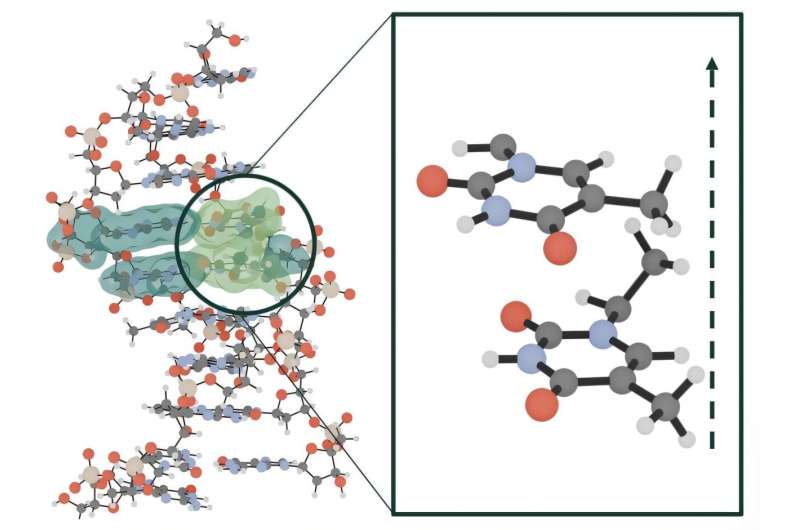
The researchers focused on a pair of aromatic rings extracted from a DNA fragment, a system where dispersion forces dominate the binding energy. By varying the inter‑ring distance they generated a small benchmark curve that is sensitive to the quality of the electronic‑structure description.
BEAST‑VQE: More Efficient, Still Accurate
Kvantify’s algorithm, BEAST‑VQE, was combined with an exact quantum‑circuit simulation platform (Qrunch integrated with NVIDIA’s cuTensorNet). The key innovation is a reduction of the active orbital space from 236 orbitals (required by conventional CCSD(T) calculations) to just 53 orbitals, without sacrificing accuracy. The resulting interaction energies line up closely with the CCSD(T) reference across the tested geometries.
From Simulation to Real Quantum Hardware
To validate the approach beyond idealised simulations, the team executed the same calculations on Quantinuum’s System Model H2 quantum computer for two representative geometries. The hardware outcomes were virtually indistinguishable from the simulated results, confirming that current noisy‑intermediate‑scale devices can already support chemically relevant calculations when paired with clever algorithmic reductions.
Implications for Quantum‑Assisted Chemistry
While the study does not claim a commercial quantum advantage, it provides a concrete benchmark for future quantum‑chemistry workflows. The ability to obtain CCSD(T)‑level accuracy with far fewer orbitals suggests a pathway toward practical quantum‑enhanced simulations of larger, more complex biomolecules as hardware improves.
Looking Ahead
The next challenge highlighted by the authors is to address the remaining classical bottlenecks—particularly the preprocessing steps that generate the reduced orbital spaces—so that the full potential of quantum hardware can be realised. Continued integration of quantum and classical resources will be essential for tackling the next generation of drug‑discovery problems.
This article is based on the press release and summary provided by Phys.org on 20 November 2026.
Hype check
PartlyThe headline accurately reflects the reported benchmark, but the claim lacks peer‑reviewed validation and independent confirmation.
- Peer-reviewed paper, or press release only?Press release only — No peer‑reviewed paper or preprint cited in the input
- Error-corrected (logical) qubits, or physical qubits only?Logical / not a qubit claim — The story does not involve qubit‑count claims
- A new milestone, or a rebrand / restatement?New — First reported matching of CCSD(T) accuracy with reduced orbitals
- Independent confirmation?Not yet — No external verification mentioned
- Does the headline claim match what the source shows?Matches — Headline claim aligns with described benchmark results
An editorial assessment of the claim as reported, not a judgment of the company or researchers. Checked against: phys.org. How we rate hype →
Source
Read original sourceWhy we picked this
Accepted from curated QuantumUnzipped source (relevance scoring disabled).