Quantum teleportation method uses weaker entanglement to transfer encoded information
Researchers teleported a logical qubit encoded in a distance‑7 surface code across weakened entanglement on a 125‑qubit superconducting chip.
A New Twist on Quantum Teleportation
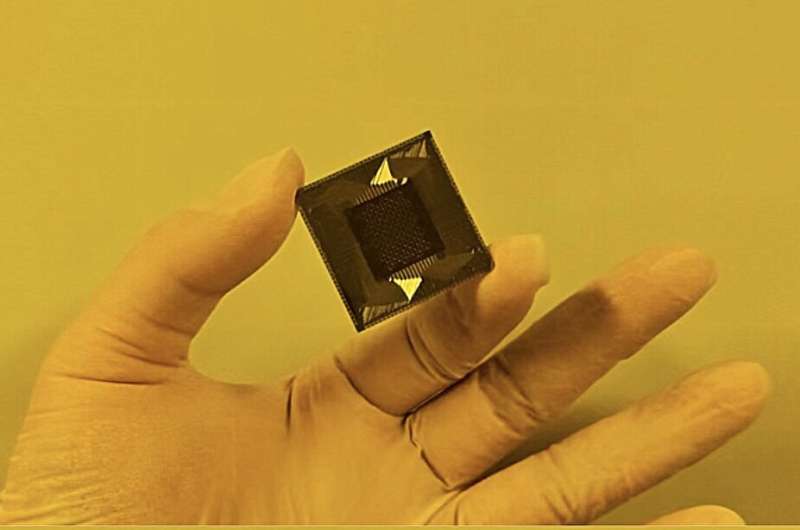
In a recent Nature Physics paper, a team from Zhejiang University and Hong‑Kong University of Science and Technology (Guangzhou) demonstrated that a logical qubit encoded in a distance‑7 surface code can be teleported across a single superconducting chip even when the entanglement linking the two code patches is deliberately weakened. The experiment used the 125‑qubit processor Tianmu‑2, arranging 98 qubits into two interleaved groups ("Alice" and "Bob") each implementing a distance‑7 surface‑code patch.
How Weaker Entanglement Still Works
The researchers varied the strength of the transversal entangling gates between the two patches, effectively tuning the entanglement channel from near‑ideal to almost broken. By decoding the measurement outcomes with a maximum‑likelihood decoder, they tracked the logical error rate of the teleported state. They observed a clear teleportation transition: above a critical entanglement strength the logical error rate fell with larger code distance, while below that threshold increasing the distance actually worsened performance. Balancing bit‑flip and phase‑flip error components raised the critical threshold, allowing teleportation to succeed with much weaker entanglement.
Key Results
- Logical error rate after teleportation at the strongest entanglement was ~2.5 %.
- The pseudo‑threshold for the entanglement strength matched the predicted Nishimori critical point.
- Teleportation succeeded for both standard logical‑zero states and an H‑type magic state, a resource needed for universal fault‑tolerant computing.
Why It Matters
Teleporting encoded quantum information, rather than a single physical qubit, is a crucial step toward scalable quantum networks and distributed quantum computing. The ability to tolerate weaker entanglement channels could simplify the hardware requirements for linking separate quantum processors, bringing modular architectures closer to reality.
Looking Ahead
The authors plan to develop a correlated decoder that leverages measurements from both patches, potentially lowering the entanglement threshold further. Future work aims to move beyond two patches on a single chip to teleport logical states between distinct chips or modules, a concrete pathway toward distributed fault‑tolerant quantum computation.
--- This article is based on the Phys.org report and the underlying Nature Physics paper (DOI: 10.1038/s41567-026-03484-0).
Hype check
RealThe claim is backed by a peer‑reviewed Nature Physics paper, presents a concrete logical‑qubit teleportation experiment, and the headline accurately reflects the result.
- Peer-reviewed paper, or press release only?Paper — Nature Physics paper cited
- Error-corrected (logical) qubits, or physical qubits only?Logical / not a qubit claim — Teleportation of a distance‑7 surface‑code logical qubit
- A new milestone, or a rebrand / restatement?New — First demonstration of distance‑7 surface‑code teleportation
- Independent confirmation?Unclear — No external replication mentioned in the input
- Does the headline claim match what the source shows?Matches — Headline matches the paper’s finding
An editorial assessment of the claim as reported, not a judgment of the company or researchers. Checked against: phys.org. How we rate hype →
Source
Read original sourceWhy we picked this
Accepted from curated QuantumUnzipped source (relevance scoring disabled).