Qubit defects merge and vanish following a square-root law
A recent study shows that qubit topological defects merge and vanish in pairs following a predictable square‑root law, driven solely by a controlled non‑coherence‑generating quantum channel.
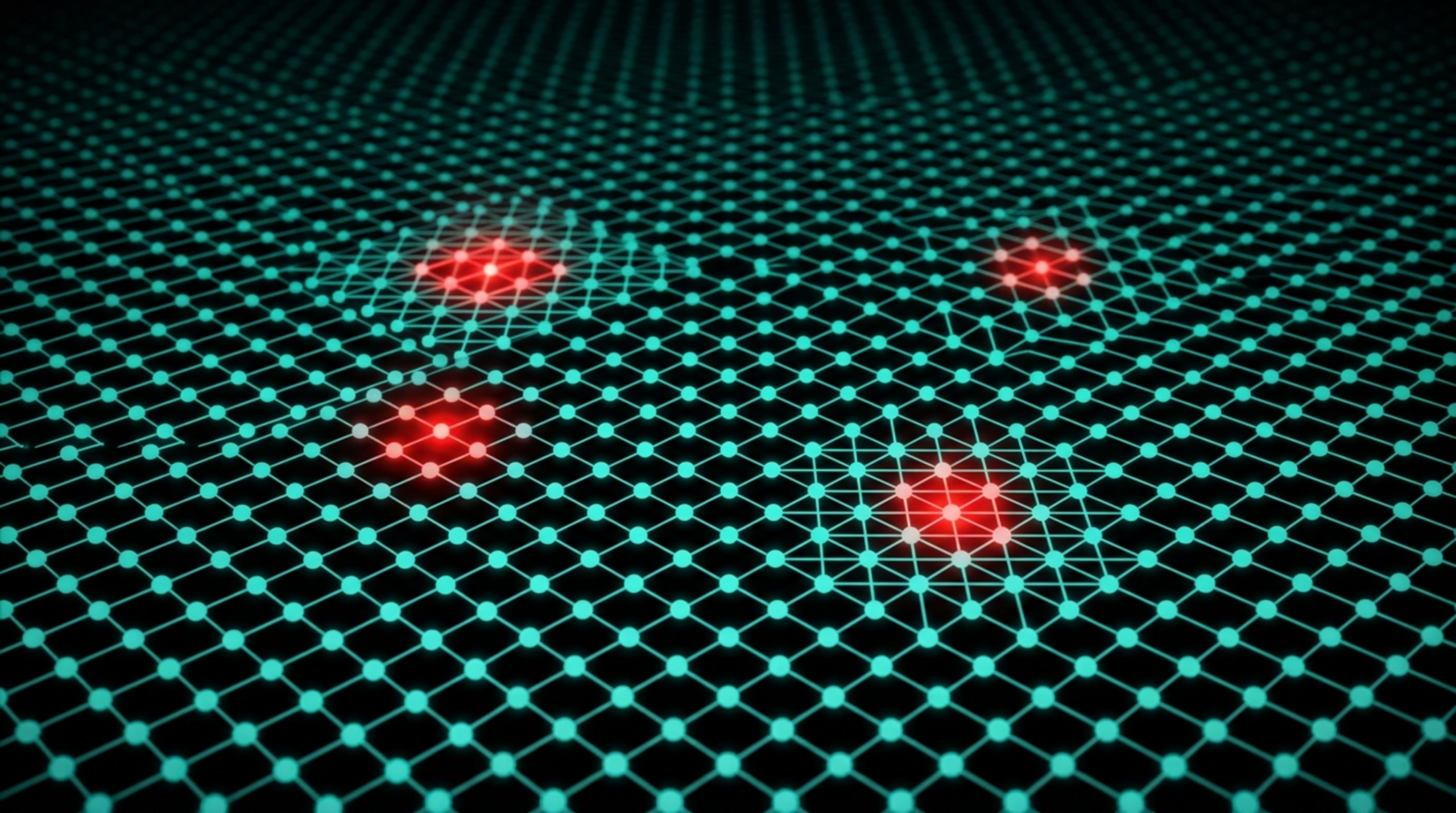
Qubit Defects Merge and Vanish: A Square‑Root Law
Researchers at the Universidad Nacional Autónoma de México and Universidad Autónoma de Baja California have uncovered a strikingly simple mathematical rule governing the disappearance of topological defects in qubits. By cycling a specially designed quantum channel—rather than tweaking the qubit’s Hamiltonian—they induce a geometric (Uhlmann) phase and observe that defect pairs annihilate according to a square‑root coalescence law. This behavior contrasts sharply with the abrupt, global winding‑number jumps seen in traditional thermal Uhlmann transitions.
---
1. Channel‑Induced Geometric Phase
The team focuses on a non‑coherence‑generating (NCG) channel that leaves diagonal states unchanged while attenuating existing coherences. By varying a single channel parameter \(\chi\) along a closed loop, the qubit’s Bloch vector traces a two‑parameter family of trajectories inside the Bloch ball. The resulting evolution is described by a completely positive, trace‑preserving map with Kraus operators \(K_\ell(t;\lambda)\).
Crucially, the Uhlmann phase—a geometric phase defined for mixed states—emerges only from the channel’s trajectory. An initially pure qubit, which carries no intrinsic geometric phase, acquires a non‑trivial holonomy solely because the environment (the channel) forces it around a closed path in state space.
---
2. Topological Defects and the Poincaré‑Hopf Constraint
The channel’s geometry creates vortex‑antivortex pairs on a toroidal parameter space. These defects correspond to zeros of the complex holonomy amplitude, where the Uhlmann phase becomes undefined. The Poincaré‑Hopf theorem enforces a net topological charge of zero, guaranteeing that vortices always appear with opposite‑sign partners.
When the input‑state orientation approaches critical angles, the defects move toward each other. Their separation shrinks as \(\Delta(t) \propto \sqrt{t}\), leading to a square‑root law for the number of defects \(N(t) \sim N_0 - C\sqrt{t}\). This law mirrors the mean‑field behavior of continuous phase transitions (e.g., Ginzburg‑Landau theory) but arises here from purely quantum‑information dynamics.
---
3. Localized Criticality vs. Global Invariants
Traditional thermal Uhlmann transitions involve a global winding‑number jump—the entire system’s topological invariant changes abruptly. In the channel‑driven scenario, criticality is localized: only the defect cores undergo a transition, while the bulk of the qubit’s state remains topologically trivial. The annihilation of a vortex‑antivortex pair eliminates the associated geometric phase contribution, causing the overall Uhlmann phase to shrink to zero as the channel is turned off.
This distinction suggests new ways to manipulate quantum information without disturbing global invariants, potentially offering finer control for quantum gates that rely on geometric phases.
---
4. Toward Experimental Realization
The authors note that photonic simulators can already implement arbitrary single‑qubit CPTP maps, making the proposed NCG channel experimentally accessible. A minimal implementation would require:
- One ancilla qubit to enact the Kraus operators.
- A cyclic modulation of the channel parameter \(\chi\).
- Measurement of the resulting Uhlmann phase via interferometric techniques.
While a full protocol for reading out the phase remains future work, the theoretical framework provides clear targets for laboratory tests.
---
Closing Thoughts
The discovery that qubit defects obey a square‑root annihilation law under a controlled quantum channel deepens the link between topology, geometry, and quantum dynamics. By showing that a geometric phase can be generated—and erased—purely through environmental control, the work opens pathways for robust, channel‑based quantum operations that sidestep the need for intricate Hamiltonian engineering. As experimental platforms catch up, we can expect these insights to inform the design of fault‑tolerant gates, topological error‑correction schemes, and novel quantum‑simulation architectures.
Source
Read original sourceWhy we picked this
Accepted from curated QuantumUnzipped source (relevance scoring disabled).