Qubit Pharmaceuticals and Sorbonne Université Develop Polynomial-Time Lie Algebra Generator Pool Construction for Quantum Chemistry
Qubit Pharmaceuticals and Sorbonne Université present a polynomial‑time method to build minimal complete operator pools for VQE, dramatically cutting quantum chemistry simulation costs.
Scalable Operator Pools for Quantum Chemistry
A joint team from Qubit Pharmaceuticals and Sorbonne Université has introduced a new algebraic framework that constructs Minimal Complete Pools (MCPs) for variational quantum eigensolvers (VQE) in polynomial time. By representing Pauli operator sets as binary anti‑commutation adjacency matrices over \(\mathbb{F}_2\), the authors can certify Lie‑algebraic completeness via matrix rank in \(O(N^3)\) operations, sidestepping the exponential cost of traditional commutator calculations.
From Theory to Benchmarks
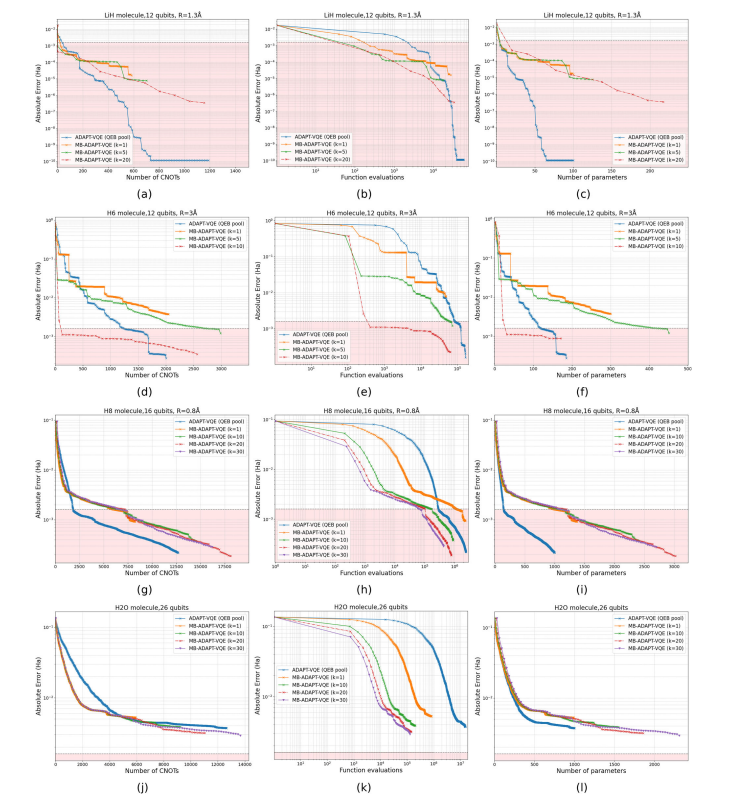
The paper, published in Communications Physics, demonstrates the approach on several molecular benchmarks:
| Molecule (basis) | Qubits | Standard QEB pool | Constructed MCP / Augmented pool | |---|---|---|---| | LiH (STO‑3G) | 12 | 561 operators | 20 (MCP) / 34 (Augmented) | | H₆ chain (STO‑3G) | 12 | 561 operators | 20 (MCP) / 59 (Augmented) | | H₈ chain (STO‑3G) | 16 | 1,940 operators | 28 (MCP) / 174 (Augmented) | | H₂O (6‑31G) | 26 | 15,275 operators | 48 (MCP) / 667 (Augmented) |
For symmetry‑preserving Hamiltonians the MCPs achieve a target rank of \(2N-4\) while scaling linearly with qubit count, a stark contrast to the \(O(N^4)\) scaling of conventional unitary‑coupled‑cluster or qubit‑excitation‑based pools.
Algorithmic Enhancements
Because a strictly minimal pool can limit the direction of optimization, the authors augment the MCP core with physics‑informed starter excitations. They pair this augmented pool with two algorithms:
- MB‑ADAPT‑VQE – a batched adaptive scheme that reduces the number of energy evaluations by up to two orders of magnitude on strongly correlated systems.
- NI‑DUCC‑VQE – a non‑iterative, fixed‑ansatz method that pushes the previous 14‑qubit ceiling to 26 qubits, achieving chemical accuracy for water.
All benchmarks were run on the Jean Zay supercomputer using GPU‑accelerated state‑vector simulations.
Open‑Source Release
The researchers have released their C++ and CUDA code for rank‑based MCP verification on GitHub, enabling other groups to reproduce the results and integrate the method into existing quantum chemistry toolchains.
---
Practical Takeaway: By turning the pool‑construction problem into a tractable matrix‑rank computation, the new framework makes adaptive VQE methods viable for larger molecular systems, potentially accelerating the path toward quantum‑advantaged chemistry simulations.
Hype check
RealThe paper is peer‑reviewed, presents a concrete polynomial‑time algorithm, and provides benchmark data; no external replication is cited but the evidence is sufficient.
- Peer-reviewed paper, or press release only?Paper — Paper published in Communications Physics
- Error-corrected (logical) qubits, or physical qubits only?Logical / not a qubit claim — Not a qubit‑count claim
- A new milestone, or a rebrand / restatement?New — Introduces a novel polynomial‑time MCP construction
- Independent confirmation?Not yet — No external confirmation mentioned
- Does the headline claim match what the source shows?Matches — Headline reflects the paper's content
An editorial assessment of the claim as reported, not a judgment of the company or researchers. How we rate hype →
Source
Read original sourceWhy we picked this
Accepted from curated QuantumUnzipped source (relevance scoring disabled).