Qubit Pharmaceuticals, Sorbonne Université, and Q-CTRL Demonstrate 3D Protein Hydration-Site Prediction on IBM Heron Processors
A peer‑reviewed study shows that IBM’s Heron quantum processors can predict 3‑D protein hydration sites using a QUBO formulation on up to 123 physical qubits.
Quantum Computing Tackles Protein Hydration Prediction
Researchers from Qubit Pharmaceuticals, Sorbonne Université, and Q‑CTRL have demonstrated a quantum‑based workflow for three‑dimensional protein‑pocket hydration‑site prediction. By mapping the continuous 3D‑RISM water‑density model onto a quadratic unconstrained binary optimization (QUBO) problem, the team ran experiments on IBM’s Heron superconducting‑qubit processors, achieving results that match or exceed classical solvers for several drug‑target structures.
---
From Theory to QUBO: Encoding Hydration Physics
The workflow begins with the Reference Interaction Site Model (3D‑RISM), which provides a statistical description of water distribution around a protein. The continuous density field is fitted to a Gaussian Mixture Model (GMM), and the resulting parameters are encoded as binary variables. This conversion yields a QUBO that can be submitted to a quantum annealer or gate‑based quantum processor. The authors used Q‑CTRL’s Fire Opal optimizer to compile and error‑suppress the circuits before execution on IBM’s Heron hardware.
---
Benchmarking on IBM Heron Processors
- Hardware: Experiments ran on two generations of IBM’s Heron chips—Heron r2 (Kingston) with up to 156 qubits and Heron r3 (Pittsburgh) with 123 qubits allocated to the problem.
- Problem Sizes: Eleven protein‑ligand instances required 41‑116 qubits on Heron r2 and a 123‑qubit instance on Heron r3.
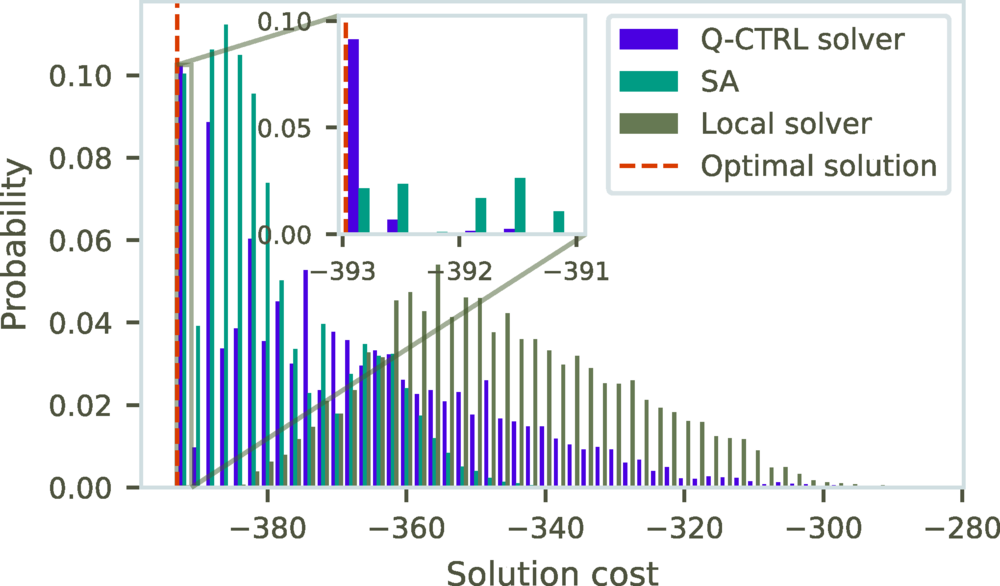
- Results: Fire Opal identified the exact, classically verified optimal water placements for all 11 instances on Heron r2, achieving roughly a 9 % sampling probability for the optimal solution on the 116‑qubit case (versus ~2 % for simulated annealing). On the 123‑qubit benchmark, the quantum processor found a lower‑energy configuration in 25 minutes, outpacing the classical CPLEX solver that timed out after three hours.
---
Scaling Outlook and Practical Utility
The authors extrapolated gate‑count requirements from the observed compilations, estimating that a problem requiring about 900 physical qubits and 100 000 two‑qubit gates would become competitive with leading classical hydration tools. They argue that early error‑corrected processors could soon handle full‑pocket water placement for computer‑aided drug discovery (CADD), bridging the gap between quantum advantage and real‑world pharmaceutical workflows.
---
Implications for Quantum‑Enabled Drug Discovery
This study provides the first experimental validation that gate‑based quantum hardware can solve a realistic, chemistry‑relevant optimization problem at a scale beyond what has been demonstrated for purely synthetic benchmarks. By integrating domain‑specific modeling (3D‑RISM) with quantum‑ready optimization (QUBO + Fire Opal), the work showcases a concrete pathway toward quantum‑accelerated CADD, complementing classical methods rather than replacing them outright.
---
Conclusion
The collaboration’s peer‑reviewed results mark a tangible step forward for quantum computing in drug discovery. While the demonstrated qubit counts are still physical and the workflow relies on sophisticated error‑suppression, the ability to outperform a classical exact solver on a 123‑qubit instance signals that quantum hardware is approaching problem sizes of practical interest. Continued improvements in qubit fidelity, logical error correction, and solver integration will be essential to realize the projected utility at the ~900‑qubit threshold.
Hype check
RealThe paper is peer‑reviewed, presents concrete hardware experiments on up to 123 physical qubits, and the headline accurately reflects the demonstrated result.
- Peer-reviewed paper, or press release only?Paper — Published in Physical Review Research
- Error-corrected (logical) qubits, or physical qubits only?Physical only — Counts refer to physical qubits on IBM Heron
- A new milestone, or a rebrand / restatement?New — First demonstration of 3D hydration prediction on quantum hardware
- Independent confirmation?Not yet — No external replication mentioned
- Does the headline claim match what the source shows?Matches — Headline matches the demonstrated experiment
An editorial assessment of the claim as reported, not a judgment of the company or researchers. How we rate hype →
Source
Read original sourceWhy we picked this
Accepted from curated QuantumUnzipped source (relevance scoring disabled).