Queen’s University Pins Conditional Phase Despite Emitter Decay
Queen’s University researchers have derived an exact model showing that the crucial π conditional phase in solid‑state emitters survives pure dephasing, while a new two‑photon calculation recovers up to 81 % of signals previously discarded.
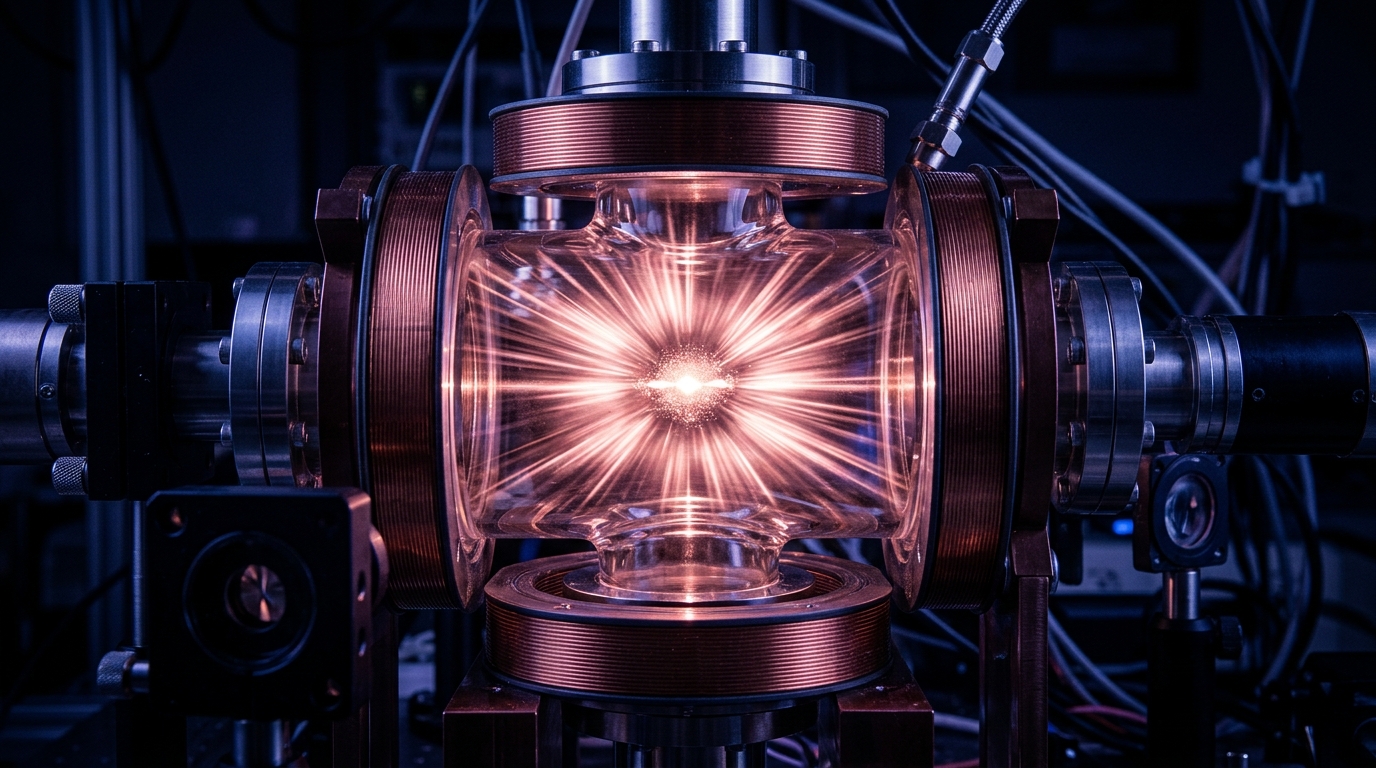
Conditional Phase Persists in Dephasing Emitters
A recent theoretical study from Queen’s University demonstrates that the nonlinear π phase—essential for quantum photonic neural networks—remains intact even when solid‑state emitters suffer pure dephasing. At the same time, the authors introduce an exact replacement method for standard two‑photon scattering calculations that can reclaim a substantial fraction of photon pairs (16 %–81 %) that earlier approximations mistakenly discarded.
---
Why Pure Dephasing Matters
Pure dephasing describes a loss of coherence that scrambles the phase of an emitter’s optical response without directly reducing the total emitted power. In solid‑state platforms such as quantum dots or color centers, this noise source is ubiquitous and often dominates over radiative decay. Prior models treated dephasing as a uniform attenuation, assuming that all photon‑number channels lose signal equally. The new analysis shows that dephasing actually redistributes amplitude between the one‑photon and two‑photon sectors, erasing the amplitude that carries the nonlinear phase while leaving the phase itself unchanged.
Exact Two‑Photon Scattering with Dephasing
Standard approaches to two‑photon scattering approximate the emitter’s response to first order in the decay rate. When the dephasing rate γφ exceeds roughly 0.1 γ (the natural decay rate), these approximations break down, leading to systematic under‑counting of detected photon pairs. The Queen’s team derived a closed‑form expression for the two‑photon pulse wavefunction that explicitly incorporates γφ. Validation against independent Fock‑state master‑equation simulations confirms the accuracy of the new formula across the full range 0 ≤ γφ/γ ≤ 1.
The practical upshot is a correction factor that can restore between 16 % and 81 % of the pairs lost in earlier analyses, depending on the relative strength of dephasing. This recovery is not a simple gain in overall intensity; rather, it re‑weights the contributions of different photon‑number sectors, preserving the conditional phase needed for nonlinear gates.
---
Implications for Photonic Neural Networks
Quantum photonic neural networks rely on deterministic conditional phase shifts to implement nonlinear activation functions. The persistence of the π phase under pure dephasing means that, at least theoretically, solid‑state emitters can still serve as reliable nonlinear nodes even in imperfect materials. However, the study also cautions that the redistribution of amplitude can affect training dynamics and error rates in practical devices. Since the analysis focuses solely on pure dephasing in a chiral coupling configuration, additional noise sources—such as phonon scattering, spectral diffusion, or fabrication disorder—remain to be incorporated before experimental demonstrations can be fully assessed.
---
Looking Ahead
The work fills a crucial gap in the theoretical toolkit for modeling multi‑photon interactions in realistic quantum emitters. By providing an exact scattering solution that includes dephasing, researchers can now benchmark experimental data without the risk of discarding large fractions of useful signals. Future efforts will need to extend the model to incorporate other decoherence mechanisms and to explore how the recovered signal translates into performance metrics for quantum photonic neural network training.
In summary, the conditional π phase is robust against pure dephasing, and a refined two‑photon calculation dramatically improves signal fidelity. These insights bring photonic quantum neural architectures one step closer to practical implementation, even as material imperfections continue to pose engineering challenges.
Source
Read original sourceWhy we picked this
Accepted from curated QuantumUnzipped source (relevance scoring disabled).