QuEra Computing and Lawrence Berkeley National Lab Observe Prethermal Dynamical Phase Transitions on 180 Qubits in Nature Study
QuEra and Lawrence Berkeley National Lab demonstrated pre‑thermal dynamical phase transitions on a 180‑qubit neutral‑atom processor in a peer‑reviewed Nature study.
Introduction
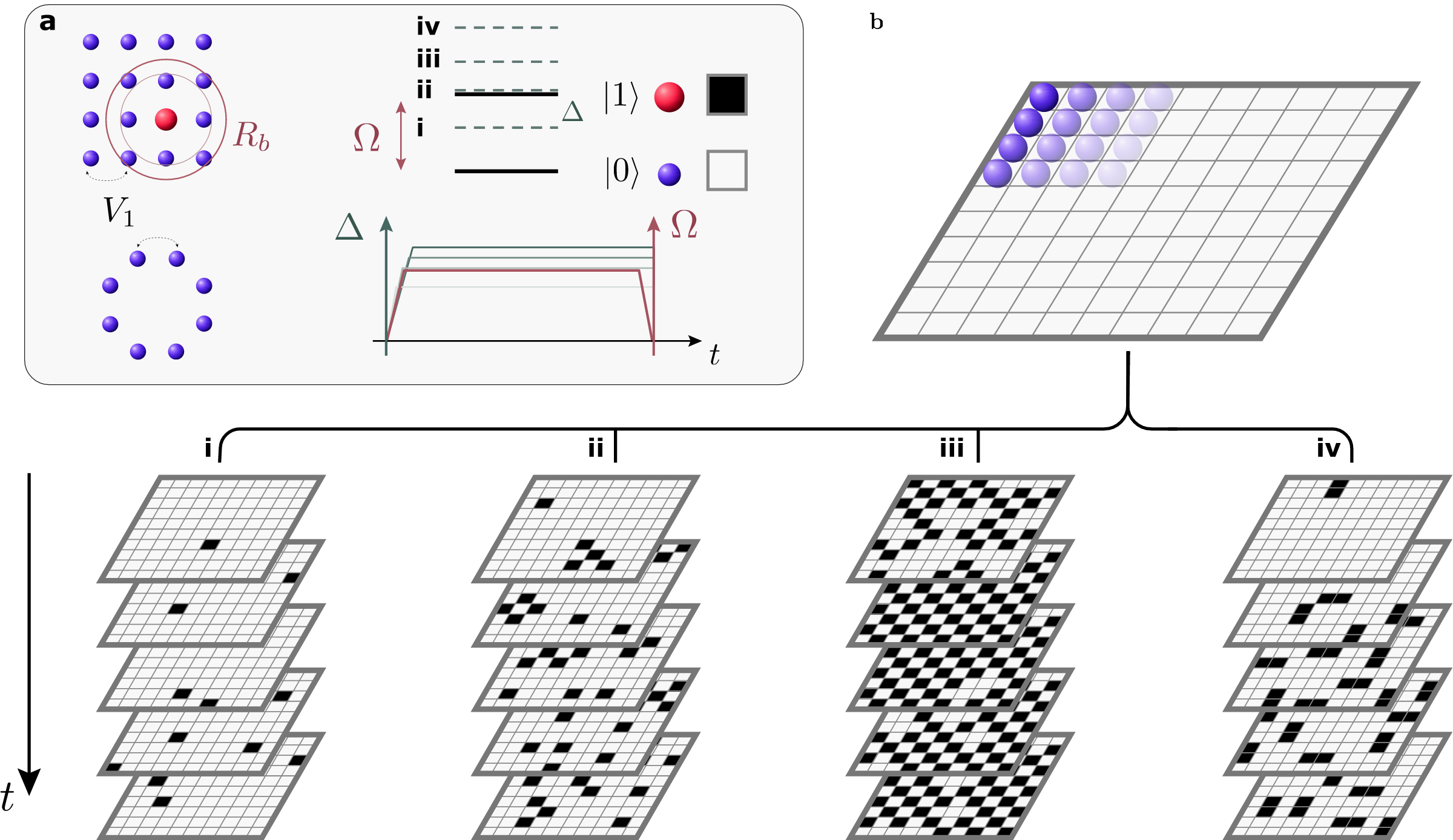
A collaborative team from QuEra Computing, Lawrence Berkeley National Laboratory, Harvard University and Boston University has published a Nature paper describing the first observation of pre‑thermal dynamical phase transitions on a neutral‑atom quantum processor with 180 qubits. The work combines experimental runs on QuEra’s Aquila device (accessed via Amazon Braket) with high‑performance classical simulations on NERSC’s Perlmutter supercomputer.
Experimental platform and methodology
- Hardware: Aquila is a programmable analog neutral‑atom array of rubidium‑87 atoms. Experiments were performed on one‑dimensional chains up to 52 atoms and two‑dimensional square lattices up to 180 atoms.
- Quench protocol: Sudden parameter changes (quenches) of up to 4 µs were applied, with detuning \(\Delta/\Omega\) ranging from –4.0 to 6.0 and blockade ratios \(R_b/a\) between 1.2 and 1.6.
- Classical benchmarking: Exact‑diagonalisation simulations (up to 20 atoms, 100 µs evolution) were run on Perlmutter using QuEra’s open‑source Bloqade.jl package, providing a reference for the quantum hardware results.
Key findings
- Floquet‑like pre‑thermal steady states – In 52‑atom chains the system settled into long‑lived states with mean excitations scaling as \(N/4\).
- Structured resonant melting – Predictable breakdown of pre‑thermal order at multi‑excitation “island” resonances (k = 2, 3).
- First‑order dynamical phase transition in 2D – Square lattices up to 180 atoms exhibited a sharp transition driven by Néel‑order defect proliferation. The authors validated the transition using a generalized Clausius–Clapeyron relation, showing the boundary sharpens with system size and has no equilibrium counterpart.
Broader impact and future work
The study showcases the capability of neutral‑atom platforms to explore non‑equilibrium many‑body physics at scales previously inaccessible. It also highlights the value of cloud‑based quantum‑hardware access (Amazon Braket) coupled with national‑lab supercomputing resources. QuEra cites a four‑year literature survey of 55 Aquila‑based publications, underscoring a growing ecosystem that will feed into its planned fault‑tolerant Libra system slated for 2028.
Practical takeaways
- Researchers can now probe dynamical phase phenomena on hardware beyond 100 qubits, opening new avenues for quantum simulation.
- The combination of hardware runs and exact‑diagonalisation benchmarks provides a reproducible workflow for future studies.
- The results reinforce neutral‑atom arrays as a competitive platform for large‑scale quantum dynamics experiments.
For readers interested in the full details, the Nature article, arXiv preprint, joint announcement, and AWS technical blog are referenced in the original brief.
Hype check
RealThe Nature paper provides a peer‑reviewed, experimentally verified result on 180 physical qubits; the claim matches the evidence and no logical‑qubit or roadmap hype is involved.
- Peer-reviewed paper, or press release only?Paper — Nature study cited in brief
- Error-corrected (logical) qubits, or physical qubits only?Logical / not a qubit claim — Not a qubit‑count performance claim
- A new milestone, or a rebrand / restatement?New — First observation of pre‑thermal dynamical phase transition on 180 qubits
- Independent confirmation?Not yet — No external replication mentioned
- Does the headline claim match what the source shows?Matches — Headline accurately reflects the Nature study
An editorial assessment of the claim as reported, not a judgment of the company or researchers. How we rate hype →
Source
Read original sourceWhy we picked this
Accepted from curated QuantumUnzipped source (relevance scoring disabled).