QuEra Computing and NVIDIA Introduce PPVM Open-Source Digital-Twin Simulation Framework for Quantum Processors
QuEra Computing and NVIDIA have launched PPVM, an open‑source digital‑twin simulation framework for quantum processors.
PPVM: An Open‑Source Digital Twin for Quantum Processors
QuEra Computing, NVIDIA, and academic partners from École Normale Supérieure and the University of Massachusetts Amherst have announced the Programmable Pauli Virtual Machine (PPVM). PPVM is a free, open‑source framework that combines circuit simulation, realistic hardware noise modeling, and classical control logic into a single digital‑twin environment. The project targets early fault‑tolerant neutral‑atom quantum computers but is applicable to a broad range of architectures.
Unified Simulation Architecture
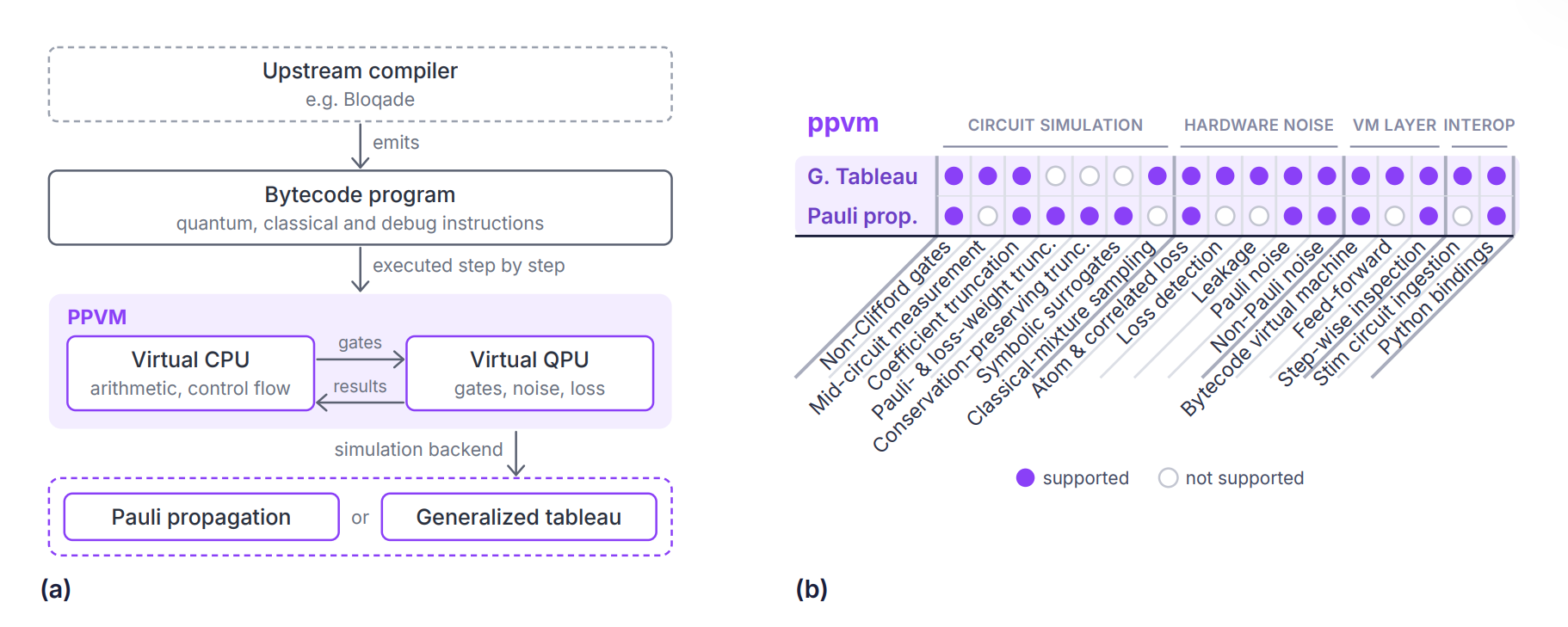
PPVM is built around a stack‑based bytecode virtual machine that separates a virtual CPU from a virtual QPU. This design lets developers write quantum programs once and run them across multiple back‑ends:
- Generalized stabilizer tableau simulation for measurement‑conditioned feed‑forward.
- Heisenberg‑picture Pauli propagation for fast observable estimation.
- Real‑time quantum error correction (QEC) integration using Bloqade QEC Studio and a deq decoder for color and STAR bicycle codes.
The framework also supports GPU‑accelerated Pauli propagation via NVIDIA’s cuPauliProp library, enabling large‑scale noisy spin‑lattice simulations.
Performance Highlights
Benchmark results shared in the announcement illustrate PPVM’s speed on modern hardware:
- Magic‑state distillation of a 5‑to‑1 protocol up to distance 23 (1,435 physical qubits) runs in ~0.1 s per shot on a single Apple M4 thread.
- GPU‑accelerated Heisenberg simulation of a 484‑qubit (22 × 22) noisy spin lattice completes in ~9 minutes on an NVIDIA GH200 Grace Hopper Superchip, a 148× speed‑up over a CPU‑only implementation.
- AI‑driven autotuning of noisy tableau mixtures yields a 5.04× speed‑up in mixture construction (≈22 µs per shot).
These numbers demonstrate that PPVM can handle realistic noise models—including atom loss, depolarization, and leakage—without recompiling circuits for each shot.
Practical Tooling
PPVM ships with Python and Rust APIs and includes a step‑by‑step bytecode debugger. Users can:
- Model state‑dependent atom loss and correlated two‑qubit gate loss.
- Track loss‑triggered qubit resets and preserve conserved quantities via protected Pauli sets.
- Test adaptive error‑correction protocols and hardware‑specific control logic before hardware is available.
The open‑source repository, documentation, and the accompanying arXiv paper are all linked in the original announcement.
Outlook
By providing a unified, hardware‑aware simulation environment, PPVM aims to accelerate the development of fault‑tolerant quantum algorithms and control software. Its open‑source nature invites contributions from the broader quantum community, potentially making it a standard reference platform for early‑stage quantum hardware design and verification.
--- For more details, see the arXiv preprint and the PPVM GitHub repository linked in the source article.
Hype check
Not a research claimThe story reports a software release; there is no performance claim to hype, just a new open‑source framework.
We rate research and technical results only. How we rate hype →
Source
Read original sourceWhy we picked this
Accepted from curated QuantumUnzipped source (relevance scoring disabled).