Qunova’s Hybrid Computing Method Matches Classical Benchmark for Iron-Sulfur Cluster
Qunova’s HI‑VQE algorithm achieved chemical‑accuracy results for an 80‑qubit iron‑sulfur cluster, matching a leading classical DMRG benchmark.
Qunova’s Hybrid Quantum‑Classical Workflow Hits Chemical Accuracy for an Iron‑Sulfur Cluster
Qunova Computing announced that its hybrid variational quantum eigensolver (HI‑VQE) has reproduced a classical benchmark for the 4Fe‑4S iron‑sulfur cubane cluster with chemical‑accuracy precision. The result was obtained by coupling an IBM Quantum System Two processor with RIKEN’s Fugaku supercomputer, marking what the company calls the first quantum‑based calculation of this scale to meet the stringent error threshold required for practical chemistry.
A hybrid workflow that leverages quantum and classical power
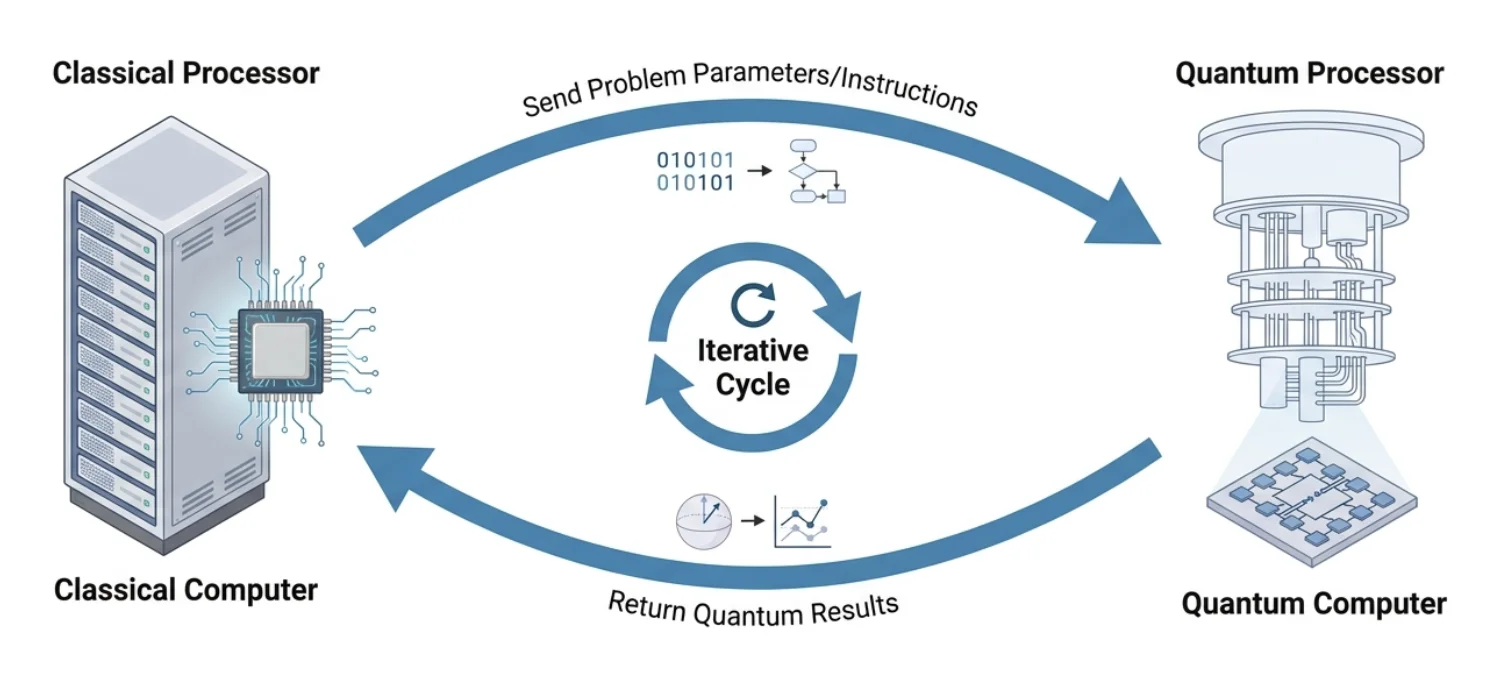
The HI‑VQE approach runs a variational algorithm on an 80‑qubit quantum device, generating a trial wavefunction for the molecule. The quantum output is then fed into a classical post‑processing pipeline on Fugaku, where extrapolation techniques refine the energy estimate. According to the press release, the final ground‑state energy of ‑327.2482 ± 0.0007 Hartree lies within the accepted chemical‑accuracy window (±0.0016 Hartree) of the reference density‑matrix‑renormalization‑group (DMRG) calculation (‑327.2471 Hartree). The workflow also reportedly required only about 2,518 Fugaku node‑hours, roughly 300 times fewer than a previously published sample‑based quantum diagonalization (SQD) study.
Why the iron‑sulfur cubane matters
Iron‑sulfur clusters are central to many biological processes, acting as electron‑transfer hubs in enzymes such as ferredoxins, hydrogenases, and nitrogenases. Accurately modeling their electronic structure is notoriously difficult; classical methods must balance computational cost against precision, and exact solutions are out of reach for systems of this size. Demonstrating that a quantum‑enhanced method can reach the same accuracy as the best classical techniques suggests a viable path toward quantum‑assisted discovery in catalysis, materials design, and drug development.
Implications for industry and future research
Qunova frames the result as a proof‑of‑concept that quantum‑HPC hybrid platforms can deliver industrial‑relevant insights. The company highlights the potential for further efficiency gains, noting that processing between 500 million and 3 billion unique quantum states could push accuracy beyond current limits. Planned upgrades—including orbital rotation and optimization—aim to broaden the method’s applicability to catalysts, electrode materials, and pharmaceutical targets.
While the achievement is promising, several caveats remain. The claim rests on a press release without a peer‑reviewed manuscript, and independent verification from external labs has not been reported. Nonetheless, the alignment with a well‑established DMRG benchmark and the substantial reduction in classical compute time provide concrete evidence that hybrid quantum‑classical workflows are moving from theoretical proposals toward practical utility.
Looking ahead
If subsequent studies confirm reproducibility and scalability, HI‑VQE could become a cornerstone technique for tackling chemically complex systems that are currently beyond the reach of classical supercomputers alone. For now, Qunova’s result serves as a noteworthy milestone, illustrating how quantum processors, even with modest qubit counts, can complement classical resources to solve real‑world scientific challenges.
Hype check
PartlyThe press release reports a concrete 80‑qubit result matching a classical benchmark, but lacks peer‑reviewed documentation and independent verification.
- Peer-reviewed paper, or press release only?Press release only — Only a press release is mentioned; no paper or preprint cited.
- Error-corrected (logical) qubits, or physical qubits only?Physical only — The 80‑qubit count refers to physical qubits on an IBM device.
- A new milestone, or a rebrand / restatement?New — Claimed first quantum algorithm to reach chemical accuracy at this scale.
- Independent confirmation?Not yet — No external confirmation or replication reported.
- Does the headline claim match what the source shows?Matches — Headline accurately reflects the benchmark‑matching claim in the text.
An editorial assessment of the claim as reported, not a judgment of the company or researchers. How we rate hype →
Source
Read original sourceWhy we picked this
Accepted from curated QuantumUnzipped source (relevance scoring disabled).