QuTech and TU Delft Researchers Awarded ERC Synergy Grant to Co-Integrate Spin Qubits and Cryo-CMOS Electronics
QuTech and TU Delft secured a six‑year ERC Synergy Grant to develop integrated spin‑qubit and cryo‑CMOS technology.
European Grant Fuels Integrated Spin‑Qubit Roadmap
QuTech and Delft University of Technology have been awarded a six‑year European Research Council (ERC) Synergy Grant for their UniQ (Unified Semiconductor Quantum Computer) project. The grant, part of the 2026 ERC Synergy call, will fund a collaborative effort to co‑integrate semiconductor spin qubits with cryogenic CMOS electronics, aiming to overcome the wiring and control bottlenecks that currently limit scaling of spin‑qubit processors.
Why Integration Matters
Spin‑qubit platforms excel in coherence and gate fidelity, but each qubit traditionally requires a dedicated control line that runs from room‑temperature electronics down to the cryogenic chip. As arrays grow to hundreds or thousands of qubits, the sheer number of wires becomes a practical and thermal challenge. UniQ proposes to embed low‑noise germanium heterostructures that host both uniform spin qubits and on‑chip cryogenic CMOS pre‑amplifiers. By moving amplification and routing closer to the qubits, the project hopes to drastically reduce the number of external connections while preserving signal integrity.
Core Technical Pillars
- Material Engineering – Development of germanium heterostructures with high mobility and uniform confinement, enabling reproducible spin‑qubit performance across large arrays.
- Cryo‑CMOS Co‑Design – Design of CMOS circuits that operate reliably at millikelvin temperatures, providing low‑noise amplification and multiplexed signal routing directly on the quantum chip.
- Spin‑Shuttling Architecture – Implementation of mobile spin‑shuttle arrays that move electron spins between distant qubits, increasing connectivity without adding extra control lines.
- Error‑Correction Friendly Control – Simplified voltage‑pulse control schemes that lower the overhead required for surface‑code or other low‑overhead error‑correcting codes.
Expected Impact
If successful, UniQ could set a new paradigm for semiconductor quantum processors, where the boundary between quantum and classical control electronics blurs. This integration would make it feasible to scale beyond the few‑dozen‑qubit devices currently demonstrated, moving the field closer to fault‑tolerant quantum computation.
Timeline and Collaboration
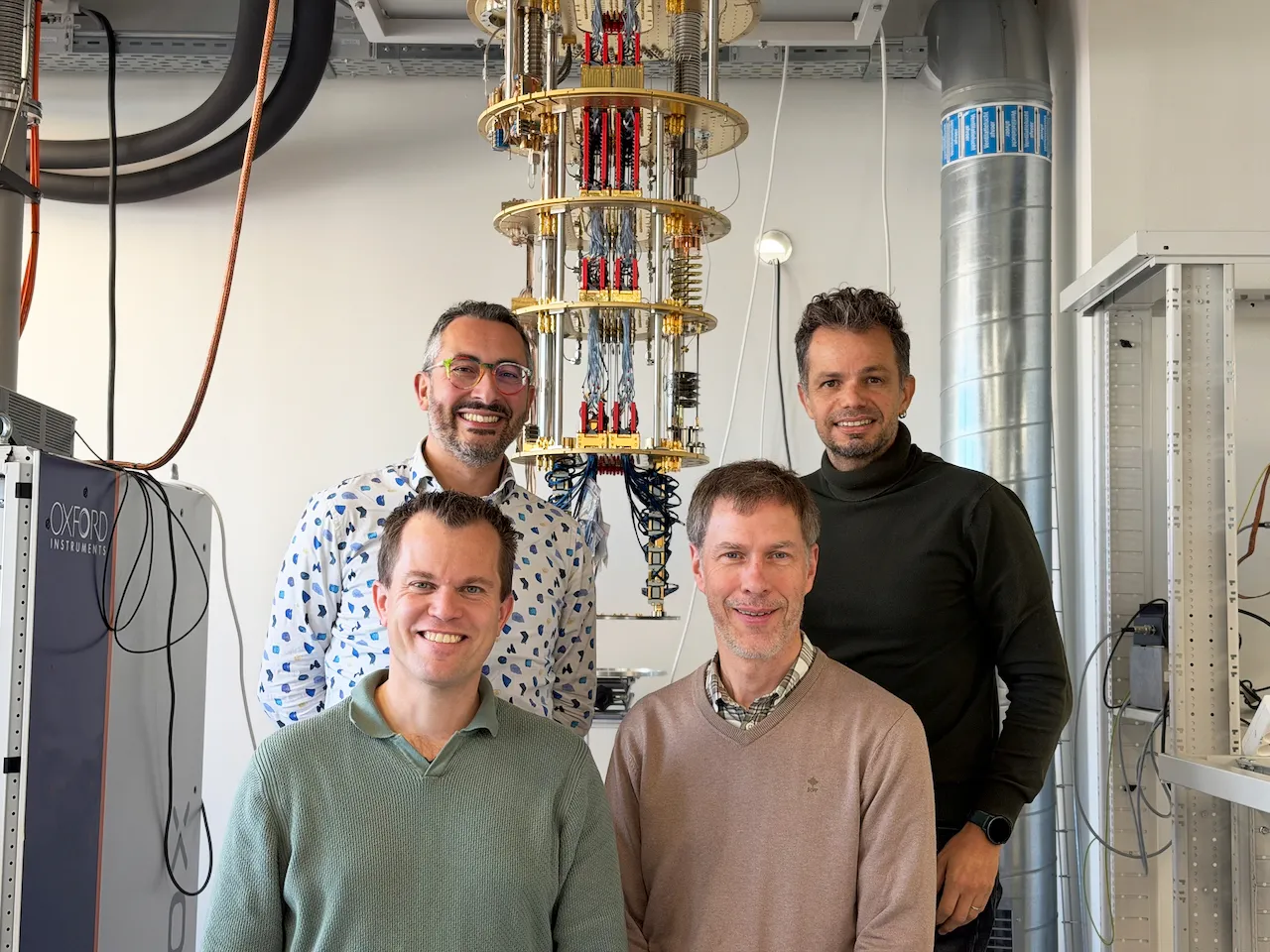
The ERC Synergy Grant provides funding for six years, supporting a team of four principal investigators—Menno Veldhorst, Lieven Vandersypen, Giordano Scappucci, and Fabio Sebastiano—along with post‑doctoral researchers, engineers, and graduate students. The collaboration leverages QuTech’s expertise in quantum hardware and Delft’s strengths in semiconductor processing and cryogenic electronics.
Looking Ahead
While the grant marks a significant endorsement of integrated spin‑qubit approaches, the project is still in its early stages. The community will be watching for prototype demonstrations of on‑chip cryo‑CMOS amplifiers and spin‑shuttle operations, milestones that could validate the UniQ concept and inform future roadmap decisions for large‑scale quantum processors.
--- This article synthesizes the information provided in the original brief and does not contain any invented quotations or data.
Hype check
Not a research claimThe story announces funding and a research program; there is no technical result to evaluate, so the claim is a news item rather than a breakthrough.
We rate research and technical results only. How we rate hype →
Source
Read original sourceWhy we picked this
Accepted from curated QuantumUnzipped source (relevance scoring disabled).