QuTech Demonstrates Coherent Control of a Majorana-Based Qubit in Coupled Kitaev Chains
QuTech has achieved coherent time‑domain control of a Majorana‑based parity qubit using coupled Kitaev chains.
Introduction
QuTech, in collaboration with the Kavli Institute of Nanoscience at Delft University of Technology and Eindhoven University of Technology, has reported the first coherent control of a parity qubit encoded in Majorana quasiparticles. The experiment, described in a recent Nature paper, demonstrates Rabi oscillations between parity states in a device built from two minimal Kitaev chains.
Device Architecture and Operating Conditions
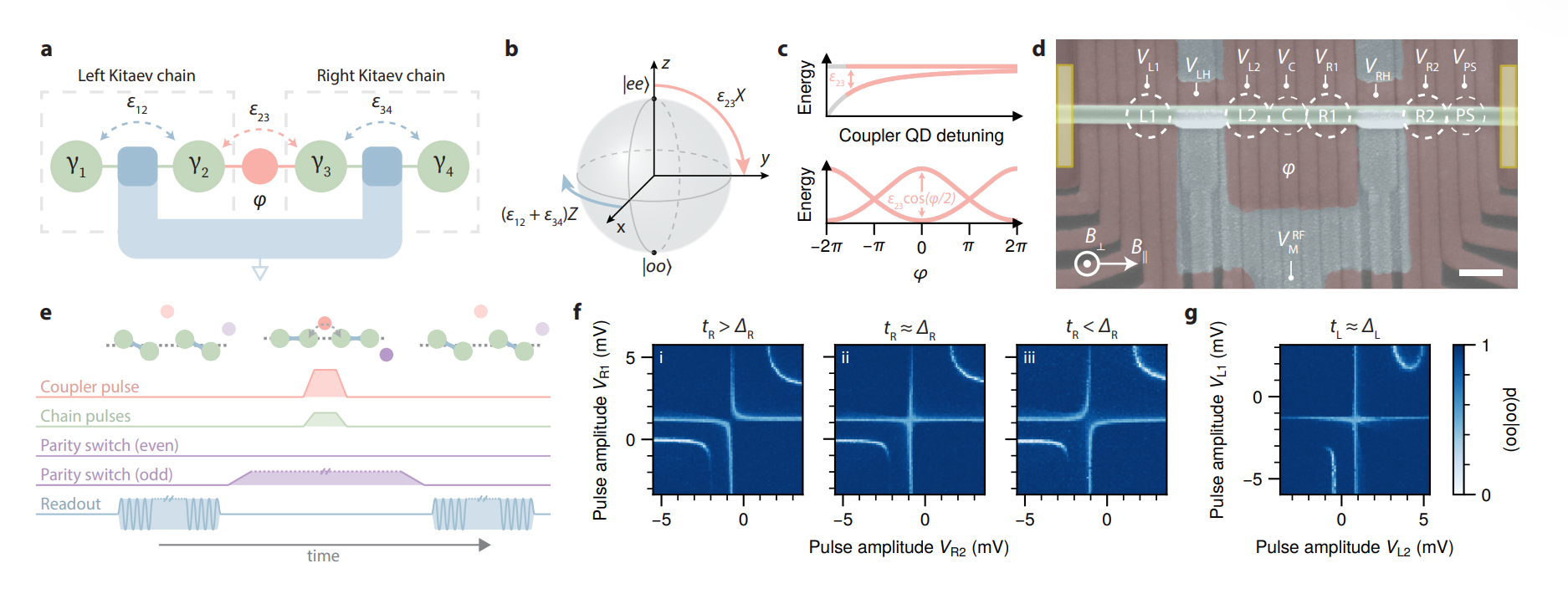
The qubit is realized in an indium antimonide (InSb) nanowire partially covered by a thin aluminum superconducting loop. Two 2‑site Kitaev chains host four Majorana modes (γ₁‑γ₄) and are linked by a central quantum‑dot coupler. An auxiliary dot provides single‑shot dispersive readout via radio‑frequency quantum capacitance. The system operates at a base temperature of ~20 mK under a 150 mT parallel magnetic field, with readout pulses of 500 µs.
Coherent Control Results
By pulsing the central coupler dot, the team drove coherent Rabi oscillations between the even‑parity manifold (|ee⟩, |oo⟩) and the odd‑parity manifold (|eo⟩, |oe⟩). Measured Rabi frequencies were 113.4 ± 0.5 MHz (even) and 117.7 ± 0.4 MHz (odd), matching within ~5 % across manifolds. The Rabi decay time T₂,Rabi was 26 ± 2 ns at a drive frequency of 106.7 MHz. Phase control was achieved by tuning the superconducting phase difference to π, which suppresses inter‑chain coupling.
Outlook and Future Work
Although the coherence time is limited to tens of nanoseconds—reflecting the partial protection of the “poor‑man’s” Majoranas—the experiment confirms that the encoded qubit state is delocalized across all four sites. QuTech plans to extend the architecture to longer Kitaev chains (e.g., three‑dot‑per‑chain arrays) to test whether increased spatial separation can exponentially suppress decoherence and eventually enable non‑Abelian braiding operations.
Practical Takeaway
The work marks a concrete step toward topological quantum computing by showing that Majorana‑based qubits can be coherently manipulated in the time domain. While still far from fault‑tolerant operation, the demonstrated control protocols provide a foundation for scaling up Majorana platforms and exploring topologically protected quantum gates.
Hype check
RealThe headline accurately reflects the peer‑reviewed Nature paper showing coherent control of a Majorana parity qubit; the result is concrete and documented, with no overstated claims.
- Peer-reviewed paper, or press release only?Paper — Nature paper cited in the input
- Error-corrected (logical) qubits, or physical qubits only?Logical / not a qubit claim — Not a qubit‑count claim
- A new milestone, or a rebrand / restatement?New — First coherent control of a Majorana parity qubit
- Independent confirmation?Unclear — No external confirmation mentioned
- Does the headline claim match what the source shows?Matches — Headline matches the described experiment
An editorial assessment of the claim as reported, not a judgment of the company or researchers. How we rate hype →
Source
Read original sourceWhy we picked this
Accepted from curated QuantumUnzipped source (relevance scoring disabled).