QuTech Demonstrates Weight-Four Stabilizer Parity Checks in a Silicon Spin-Shuttling Processor
QuTech has experimentally demonstrated weight‑four stabilizer parity checks and five‑qubit GHZ entanglement on a silicon spin‑shuttling processor.
Introduction
A joint effort by QuTech, the Kavli Institute of Nanoscience at Delft University of Technology, and TNO has pushed silicon‑based quantum hardware forward. The team reported a full set of weight‑four X‑ and Z‑type stabilizer parity checks, together with high‑fidelity five‑qubit GHZ states, on a sparse silicon spin‑qubit array that uses coherent electron shuttling. The results appear in Nature and are also available as a pre‑print.
Silicon spin‑shuttling architecture
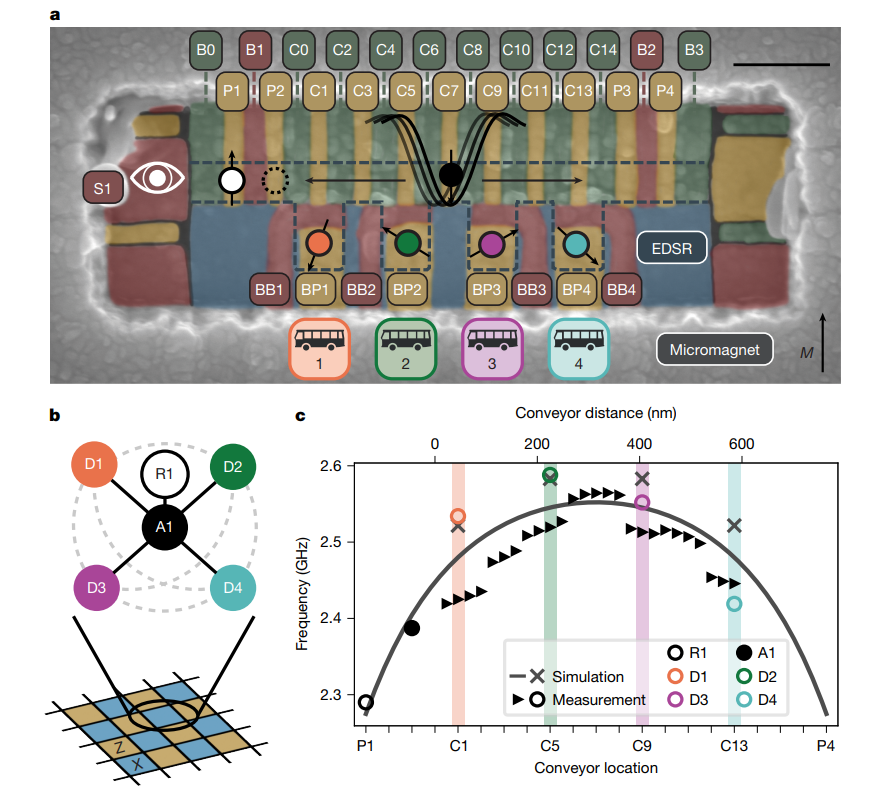
The processor is built on an isotopically purified ^28Si/SiGe heterostructure with a four‑layer Ti:Pd gate stack and an on‑chip cobalt micromagnet, eliminating the need for an external magnetic field. The layout comprises:
- A readout zone with a single‑electron transistor sensor.
- A 15‑gate “shuttling bus” that moves a mobile ancilla spin (A1) across a 1.2 µm round‑trip path at 1.8 m s⁻¹.
- Four stationary data qubits (D1‑D4) that serve as bus stops.
- A dedicated readout ancilla (R1).
Electron shuttling achieves a single‑qubit transport fidelity of 97.7 % with negligible residual exchange crosstalk (<10 kHz). This architecture enables remote calibration of many qubits from a single sensor, a key scalability advantage.
Benchmark performance
| Metric | Result | |---|---| | Single‑qubit X‑90 gate fidelity (EDSR) | 99.958 % – 99.978 % | | Decoupled CZ two‑qubit exchange fidelity | 90.1 % – 95.4 % | | Weight‑four parity‑check circuit time | 4.84 µs | | ZZZZ parity‑check accuracy | 72.2 % | | XXXX parity‑check accuracy | 67.0 % | | Post‑selected logical‑state preparation fidelity (⟦4,1,2⟧) | 62.9 % | | 4‑qubit GHZ fidelity | up to 76.6 % | | Genuine 5‑qubit GHZ entanglement | >50 % threshold |
Repeated stabilizer cycles were run for up to 35 rounds, with >93 % retention per round for weight‑two checks, demonstrating that the shuttling bus does not dominate the error budget. The dominant error source is incoherent noise in the two‑qubit exchange pulses.
Implications for fault‑tolerant modules
The ability to perform weight‑four stabilizer checks is a prerequisite for surface‑code error correction. By showing that a sparse shuttling channel can support remote calibration of roughly 100 qubits per sensor, the work suggests a pathway toward near‑term fault‑tolerant modules that combine high‑fidelity gates with scalable interconnects. The demonstrated GHZ entanglement across five qubits further validates coherent multi‑qubit operations in this platform.
Closing thoughts
QuTech’s silicon spin‑shuttling processor marks a concrete step toward scalable, fault‑tolerant quantum computing on a semiconductor platform. The combination of high‑fidelity gates, reliable electron transport, and weight‑four stabilizer capability positions silicon spin qubits as a strong contender for future large‑scale quantum processors.
Hype check
RealThe Nature paper provides concrete experimental data on weight‑four parity checks and multi‑qubit entanglement, backed by peer‑reviewed results; no external replication is reported but the claim matches the evidence.
- Peer-reviewed paper, or press release only?Paper — Nature publication mentioned
- Error-corrected (logical) qubits, or physical qubits only?Logical / not a qubit claim — Claim is not about qubit‑count
- A new milestone, or a rebrand / restatement?New — First demonstration of weight‑four checks in silicon
- Independent confirmation?Not yet — No external confirmation cited
- Does the headline claim match what the source shows?Matches — Headline accurately reflects the reported experiment
An editorial assessment of the claim as reported, not a judgment of the company or researchers. How we rate hype →
Source
Read original sourceWhy we picked this
Accepted from curated QuantumUnzipped source (relevance scoring disabled).