Reading superconducting qubits while suppressing unwanted state transitions
A millimeter‑wave readout resonator enables superconducting qubit measurement with 99.2% fidelity while suppressing unwanted state transitions.
High‑Fidelity Qubit Readout Using Millimeter‑Wave Resonators
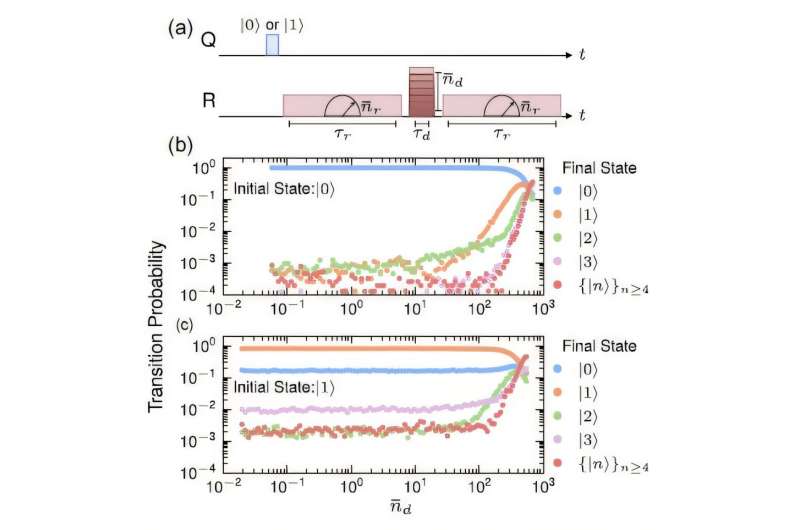
Superconducting transmon qubits are the workhorse of today’s quantum processors, but reading their state without disturbing it remains a technical bottleneck. A team led by Akash V. Dixit at NIST Boulder has demonstrated a novel approach: coupling a standard 3.083 GHz transmon to a 34.670 GHz aluminum cavity, pushing the readout frequency into the millimeter‑wave regime. The result is a qubit‑state measurement that retains the original state with 99.2 % fidelity using just 109 readout photons, and completes in 780 ns.
---
Why Frequency Matters
Conventional circuit‑QED readout resonators sit at 6–10 GHz, only a few times higher than the qubit frequency. In that range, the drive field can inadvertently excite the qubit, causing state‑flip errors during measurement. By increasing the readout‑to‑qubit frequency ratio to >10, the researchers effectively decouple the measurement photons from the qubit’s anharmonic potential well. The high‑frequency cavity responds to the qubit’s dispersive shift, allowing a clean frequency‑based readout while the qubit itself stays in its original eigenstate.
---
Suppressing Unwanted Transitions with Floquet Theory
The team employed Floquet simulations to model the periodic drive of the millimeter‑wave cavity. Floquet theory predicts that at such high drive frequencies the system’s effective Hamiltonian minimizes resonant transitions between the transmon’s energy levels. The simulations confirmed that the probability of a drive‑induced transition remains negligible even when more than 100 photons populate the cavity, explaining the observed high fidelity.
---
Practical Implications
- Faster, Cleaner Readout – The 780 ns measurement window is comparable to, or faster than, many existing readout schemes, but with far fewer error‑inducing photons.
- Compatibility with Existing Qubits – Because the transmon frequency is left unchanged, existing gate‑pulse calibrations and coherence times are preserved.
- Path to Hybrid Systems – The authors suggest that millimeter‑wave coupling could bridge superconducting circuits with other platforms (optomechanics, Rydberg atoms) and even aid dark‑matter detection experiments that require ultra‑low‑noise microwave readout.
---
Outlook
While the result is a clear step forward for circuit‑QED, broader adoption will require integration of millimeter‑wave components (waveguides, amplifiers) into cryogenic environments. Nonetheless, the work shows that moving the readout frequency upward—rather than lowering the qubit frequency—offers a viable route to high‑fidelity, low‑back‑action measurement, a key ingredient for scaling quantum processors.
---
The study, “Millimeter Wave Readout of a Superconducting Qubit,” appears in Physical Review Letters (2026) and is available on arXiv (arXiv:2603.13837).
Hype check
RealThe paper in Physical Review Letters provides concrete data on 99.2% fidelity readout using a millimeter‑wave cavity; the claim matches the reported evidence.
- Peer-reviewed paper, or press release only?Paper — Published in Physical Review Letters, a peer‑reviewed journal
- Error-corrected (logical) qubits, or physical qubits only?Logical / not a qubit claim — Claim is about readout fidelity, not qubit count
- A new milestone, or a rebrand / restatement?New — First demonstration of >99% fidelity using >10× frequency ratio
- Independent confirmation?Not yet — No external replication mentioned in the input
- Does the headline claim match what the source shows?Matches — Headline accurately reflects the paper’s result
An editorial assessment of the claim as reported, not a judgment of the company or researchers. Checked against: phys.org. How we rate hype →
Source
Read original sourceWhy we picked this
Accepted from curated QuantumUnzipped source (relevance scoring disabled).