Recursive Clifford noise reduction
A new recursive Clifford noise reduction scheme promises lower logical error rates for large Clifford circuits with modest overhead.
Recursive Clifford Noise Reduction: A Practical Path to Lower Logical Errors
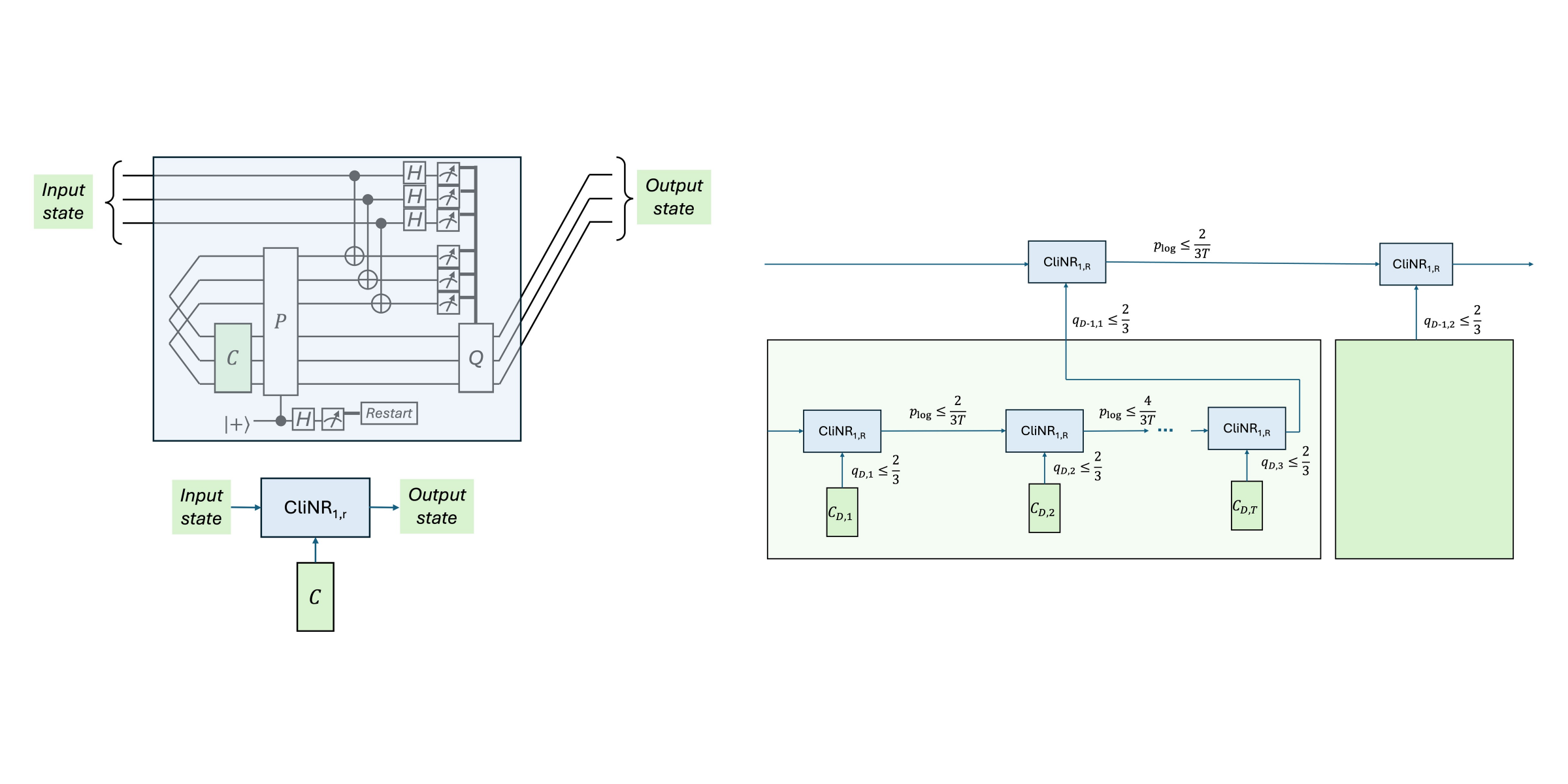
Clifford circuits form the backbone of many quantum error‑correction and simulation protocols. Reducing their logical error rates without exploding resource demands is a central challenge for near‑term quantum processors. In a recent paper published in Quantum (2026), Aharon Brodutch, Gregory Baimetov, Edwin Tham, and Nicolas Delfosse introduce Recursive Clifford Noise Reduction (CliNR), a partial error‑correction technique that extends the original CliNR scheme to larger circuits while keeping qubit and gate overhead modest.
---
How Recursive CliNR Works
The original CliNR method adds a small number of ancilla qubits and a set of Clifford‑preserving checks to suppress errors in a given circuit. Its logical error rate scales favorably when the product of circuit size \(s\), qubit count \(n\), and the square of the physical error rate \(p\) satisfies \(snp^2 \to 0\). The new recursive version builds on this insight by applying the same reduction step hierarchically:
- For a circuit of size \(s\) and \(n\) qubits, the recursion depth is set by \(\lceil\log(sp)\rceil\).
- Each recursion adds only \(2\lceil\log(sp)\rceil+1\) ancilla qubits per logical qubit, plus a single global ancilla.
- The total gate count grows as \(24 s \lceil(sp)^{3.6}\rceil\), still polynomial in the original circuit size.
When the product \(np \to 0\) the logical error rate can become vanishingly small, even for circuits where the original CliNR would no longer be effective. For the regime \(sp \le 2\) the method reduces to the original scheme, ensuring backward compatibility.
---
Numerical Evidence and Near‑Term Viability
The authors back their theoretical analysis with extensive stabilizer‑circuit simulations using the Stim simulator. Their results show:
- In realistic parameter regimes (e.g., \(p \approx 10^{-3}\), \(n \sim 50\), \(s \sim 10^4\)), recursive CliNR achieves a logical error rate up to an order of magnitude lower than the non‑recursive version for comparable gate overhead.
- The overhead in qubits remains linear in \(n\) and logarithmic in \(sp\), making the approach compatible with current trapped‑ion and superconducting platforms that can allocate a few hundred ancilla qubits.
- The gate count, while larger than the original method, stays within the coherence windows of near‑term devices, especially when combined with mid‑circuit measurement techniques.
These findings suggest that recursive CliNR could be deployed on existing hardware to improve the fidelity of Clifford‑dominant algorithms such as stabilizer‑based error‑correction, Hamiltonian simulation, and certain variational quantum eigensolvers.
---
Practical Takeaways for Quantum Engineers
- Resource Planning – Allocate roughly \((2\lceil\log(sp)\rceil+1)n+1\) ancilla qubits. For a 100‑qubit circuit with \(sp=5\), this translates to about 300 extra qubits, a figure within reach of emerging modular architectures.
- Gate Scheduling – The recursive checks can be interleaved with the original circuit layers, allowing reuse of existing control electronics and minimizing idle time.
- Error‑Rate Targets – The scheme shines when the physical error rate is below a few × 10⁻³. Improving two‑qubit gate fidelity to the 99.9 % level unlocks the full advantage of recursion.
- Software Integration – Because the method relies only on Clifford operations, it can be incorporated into existing stabilizer simulators and compilation pipelines with modest code changes.
---
Outlook
Recursive Clifford noise reduction adds a valuable tool to the quantum engineer’s toolbox, bridging the gap between modest error‑mitigation techniques and full fault tolerance. While the paper provides solid simulation evidence, experimental validation on a real processor will be the next crucial step. If confirmed, the approach could become a standard pre‑processing layer for any Clifford‑heavy workload, extending the useful lifetime of near‑term quantum devices.
---
The work is openly available via the journal DOI and the arXiv pre‑print, encouraging community scrutiny and rapid adoption.
Hype check
RealThe paper presents a peer‑reviewed, theoretically grounded method with simulation data; the claim matches the evidence and is not overstated.
- Peer-reviewed paper, or press release only?Paper — Published in Quantum, a peer‑reviewed journal
- Error-corrected (logical) qubits, or physical qubits only?Logical / not a qubit claim — Not a qubit‑count claim; focuses on error reduction
- A new milestone, or a rebrand / restatement?New — Introduces a novel recursive scheme, not a roadmap
- Independent confirmation?Unclear — No external replication mentioned in the input
- Does the headline claim match what the source shows?Matches — Headline accurately reflects the paper’s content
An editorial assessment of the claim as reported, not a judgment of the company or researchers. Checked against: doi.org. How we rate hype →
Source
Read original sourceWhy we picked this
Accepted from curated QuantumUnzipped source (relevance scoring disabled).