Researchers Demonstrate Fully Integrated Continuous-Variable QKD Over 100 km with Composable Finite-Size Security
A Chinese research team has demonstrated a fully integrated continuous‑variable QKD system that can distribute secret keys over 100 km of fiber with composable finite‑size security.
Integrated CV‑QKD Reaches 100 km with Composable Security
A collaboration led by Shanghai Jiao Tong University, together with the Shanghai Research Center for Quantum Sciences, Hefei National Laboratory and Donghua University, has reported the longest‑range, chip‑based continuous‑variable quantum key distribution (CV‑QKD) link to date. The system operates over 100 km of standard optical fiber and delivers composable finite‑size security, a stringent security notion that accounts for realistic data block sizes.
End‑to‑end photonic integration
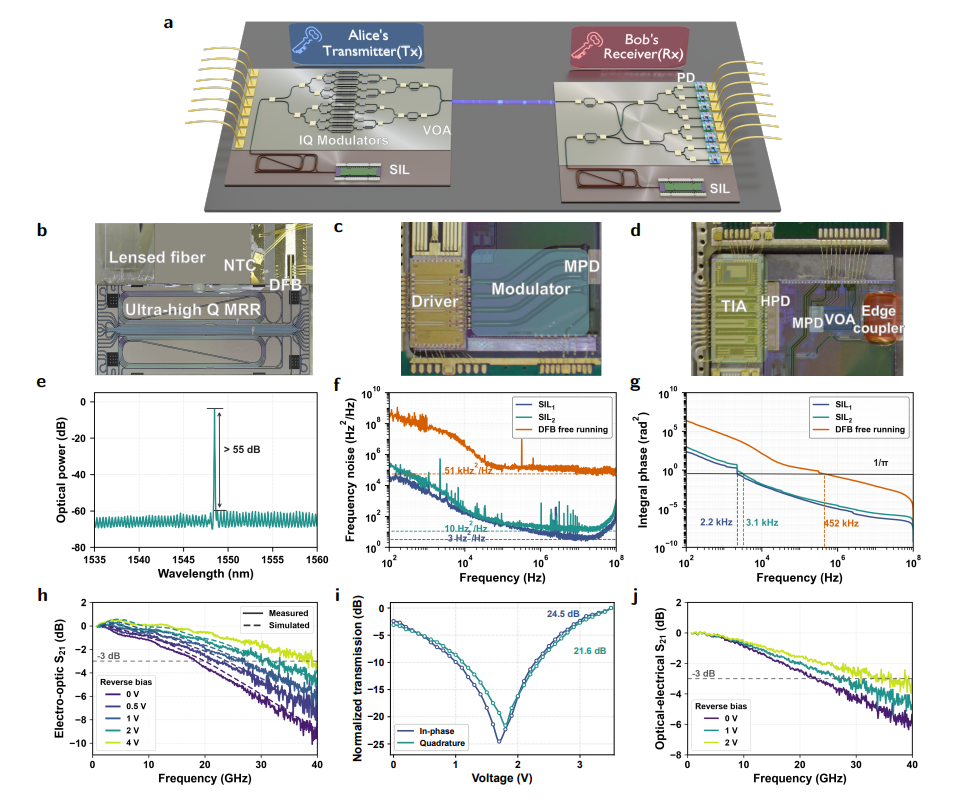
The researchers integrated three key photonic components on a silicon platform:
- Hybrid III‑V/silicon‑nitride lasers that are self‑injection‑locked to achieve sub‑30 Hz linewidths.
- A silicon transmitter built on silicon‑on‑insulator (SOI) PICs, providing high‑speed modulation (>30 GHz).
- A room‑temperature silicon coherent receiver with transimpedance amplifiers, reaching detection efficiencies of 40.8 % without cryogenic cooling.
By using a local‑local‑oscillator (LLO) architecture, the design avoids the bulky, cryogenic single‑photon detectors required by discrete‑variable QKD, simplifying deployment in telecom environments.
Signal processing breakthroughs
To keep phase noise within the tight excess‑noise budget over long spans, the team replaced conventional forward‑only Kalman filtering with a Bayesian unscented Rauch‑Tung‑Striebel smoother. This bidirectional estimator reduces worst‑case residual phase‑noise mean‑square error by up to 32.5 %, preserving the noise margin needed for finite‑size key extraction at 100 km.
The post‑processing also employs SNR‑adaptive multidimensional reverse reconciliation using multi‑edge‑type low‑density parity‑check (MET‑LDPC) codes, which maximizes the per‑symbol secret‑key rate.
Experimental benchmarks
| Fiber distance (km) | Channel loss (dB) | Block size (symbols) | Asymptotic key rate | Finite‑size composable key rate | |---------------------|-------------------|----------------------|---------------------|--------------------------------| | 25.25 | 4.1 | 1.0 × 10⁸ | 7.86 Mbps | 6.81 Mbps | | 50.40 | 8.1 | 1.0 × 10⁸ | 2.13 Mbps | 1.26 Mbps | | 75.65 | 12.2 | 1.0 × 10⁹ | 785 kbps | 501 kbps | | 100.80 | 16.2 | 1.4 × 10¹¹ | 111 kbps | 29.3 kbps |
The 100 km point delivers a composable secret‑key rate of 29.3 kbps, an order of magnitude higher than previous chip‑based CV‑QKD demonstrations.
Significance and next steps
This work pushes integrated CV‑QKD toward practical deployment by combining long reach, room‑temperature operation, and rigorous security analysis. The authors note that further improvements in detector efficiency and error‑correction overhead could extend the distance beyond 150 km while maintaining usable key rates.
The full technical preprint is available on arXiv, where the detailed security proofs and hardware schematics are described.
---
The result represents a notable milestone for photonic‑integrated quantum communications, but independent verification and peer‑review are still pending.
Hype check
PartlyThe preprint provides detailed data and security analysis, but it has not undergone peer review or independent replication.
- Peer-reviewed paper, or press release only?Press release only — Only a preprint on arXiv is mentioned
- Error-corrected (logical) qubits, or physical qubits only?Logical / not a qubit claim — Claim is about QKD, not qubit counts
- A new milestone, or a rebrand / restatement?New — Longest reported integrated CV‑QKD reach
- Independent confirmation?Not yet — No external confirmation cited
- Does the headline claim match what the source shows?Matches — Headline accurately reflects the reported experiment
An editorial assessment of the claim as reported, not a judgment of the company or researchers. How we rate hype →
Source
Read original sourceWhy we picked this
Accepted from curated QuantumUnzipped source (relevance scoring disabled).