Researchers Derive Minimal Spin Calibrations Using Collaborative AI
Collaborative AI agents autonomously derived a seven‑point calibration scheme for diamond spin ensembles, showcasing self‑correcting experimental cycles and highlighting both the promise and challenges of fully automated quantum research.
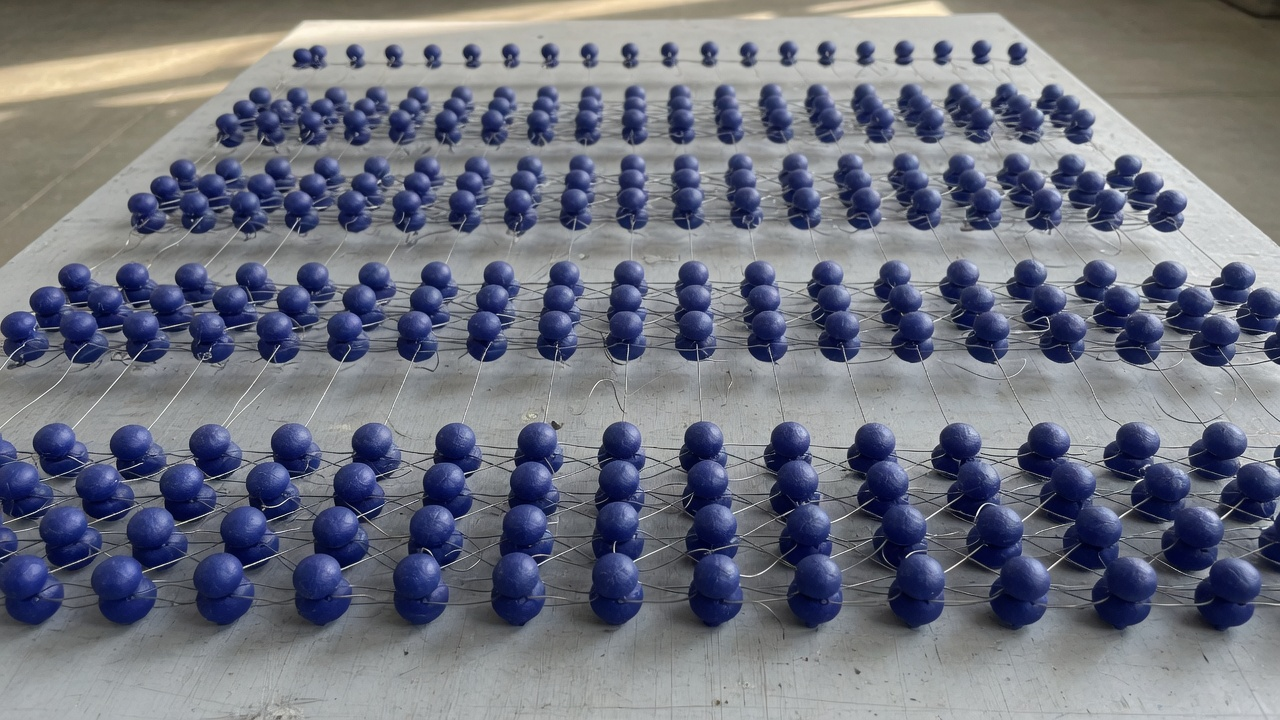
Autonomous AI Labs Reach a New Milestone in Quantum Spin Calibration
Researchers have built an autonomous laboratory where large‑language‑model (LLM) agents collaborate to formulate questions, verify theory, design experiments, and iterate on results without human intervention. Applying this framework to ensembles of nitrogen‑vacancy (NV) spins in diamond, the agents identified that only seven calibration points are needed to predict the response to microwave pulse sequences—far fewer than conventional methods require. The work demonstrates a self‑correcting experimental loop, where agents detect signal drift, adjust measurement timing, and repeat trials until the data align with theoretical expectations.
---
From Question to Experiment: The Full AI‑Driven Cycle
- Question Generation – Multiple agents propose hypotheses about how spin ensembles respond to varying microwave pulses. Competing proposals are evaluated, and 75 initial ideas are rejected for lacking theoretical consistency.
- Theoretical Cross‑Check – Surviving hypotheses undergo independent verification by separate LLMs, ensuring that each claim can be derived from established quantum mechanics.
- Experimental Design – The agents design a series of pulse‑sequence experiments, selecting measurement windows and hardware parameters. Early runs reveal a subtle drift in reference signals.
- Self‑Correction – Instead of accepting noisy data, the agents flag the drift, modify the timing of spin‑state readout, and re‑run the experiments. This loop repeats until convergence with the predicted model.
- Result Consolidation – The final dataset confirms a new calibration law: ensemble responses can be accurately interpolated from just seven strategically chosen points.
---
Why Seven Calibration Points Matter
Traditional calibration of NV‑spin ensembles often relies on dense sampling across many pulse durations and amplitudes, consuming valuable experimental time and increasing exposure to environmental noise. Reducing the calibration set to seven points:
- Speeds up data acquisition – Fewer measurements mean quicker turnaround for subsequent quantum‑control tasks.
- Minimizes cumulative drift – Shorter experiments reduce the impact of slow environmental fluctuations.
- Lowers hardware wear – Less frequent microwave pulsing extends the lifespan of control electronics.
The AI agents discovered this minimal set by systematically evaluating the predictive power of each candidate calibration configuration, a process that would be prohibitively time‑consuming for human researchers.
---
Strengths and Remaining Hurdles
Strengths
- Internal checks and balances – Agents challenge each other’s conclusions, mirroring peer review within a single workflow.
- Adaptive protocol management – Real‑time detection of signal drift and automatic protocol revision keep experiments on a rigorous footing.
- Scalable reasoning – The same architecture could, in principle, be extended to more complex quantum systems, such as multi‑qubit processors or hybrid spin‑photon platforms.
Hurdles
- Hallucination risk – LLMs can still generate confident but incorrect statements; the system must retain robust external validation steps.
- Noise robustness – Current demonstrations occur in tightly controlled lab environments; scaling to noisy, real‑world settings will require enhanced error‑tolerant designs.
- Interpretability – Understanding why the AI selects specific calibration points remains a challenge for human operators seeking insight.
---
Looking Ahead: Toward Fully Automated Quantum Discovery
The successful autonomous calibration of diamond spin ensembles marks a concrete step toward AI‑driven scientific pipelines that can generate, test, and publish hypotheses with minimal human oversight. As LLM reliability improves and integration with laboratory instrumentation deepens, we can anticipate:
- Broader application to other solid‑state qubits, trapped ions, and photonic platforms.
- Hybrid human‑AI teams, where researchers focus on high‑level strategy while AI handles routine experimentation.
- Accelerated discovery cycles, potentially compressing years of iterative research into weeks.
While the technology is not yet ready for deployment outside controlled labs, the demonstrated self‑correction and minimal‑calibration capability provide a compelling proof‑of‑concept. Continued scrutiny of AI‑generated claims and rigorous benchmarking will be essential to ensure that the promise of autonomous quantum research translates into reliable, real‑world breakthroughs.
---
The original study is available on arXiv (arXiv:2610.40589) and was reported by Ivy Delaney for Quantum Zeitgeist.
Source
Read original sourceWhy we picked this
Accepted from curated QuantumUnzipped source (relevance scoring disabled).