Researchers Detail Hurdles to Useful Quantum Computation
Hybrid quantum‑classical systems show promise, but coherence limits, data‑transfer bottlenecks, and architectural challenges must be solved before quantum computers become useful co‑processors.
Introduction
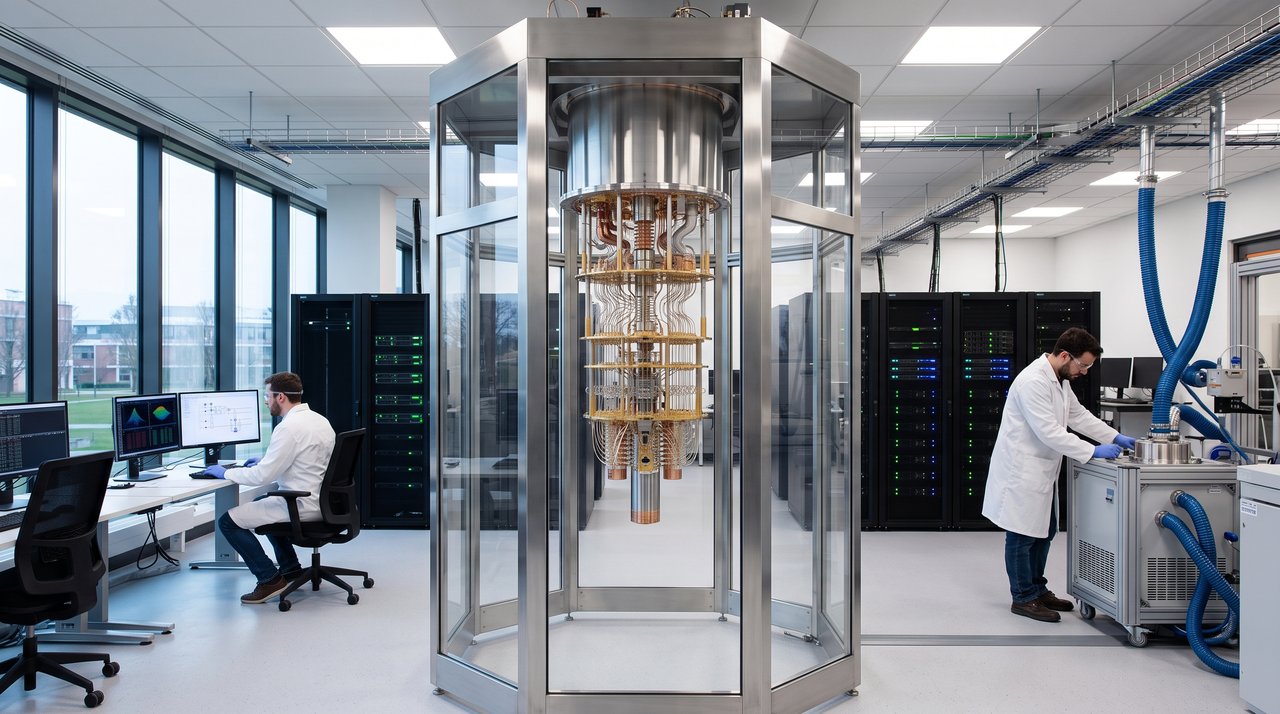
Quantum computing is often portrayed as a looming revolution that will soon replace classical computers. In reality, today’s noisy intermediate‑scale quantum (NISQ) devices are best viewed as specialised co‑processors that work alongside traditional hardware. Recent work from Newcastle University highlights both the progress—microsecond‑scale qubit coherence and long‑distance photon entanglement—and the practical hurdles that still stand in the way of a truly useful quantum advantage.
1. Why NISQ Devices Are Co‑Processors, Not Replacements
NISQ processors excel at a narrow set of tasks that exploit quantum superposition and entanglement, but they suffer from short coherence times and limited qubit counts. The most effective deployment model therefore mirrors a hybrid car: classical CPUs handle data preparation, error correction, and result analysis, while the quantum processing unit (QPU) tackles the tightly scoped sub‑routines where quantum parallelism offers a speed‑up. This division of labour preserves the strengths of each platform—precision arithmetic for classical machines and focused, high‑dimensional operations for quantum hardware.
2. Extending Coherence: From Nanoseconds to Microseconds
A key breakthrough reported by the Newcastle team is the achievement of microsecond‑scale qubit coherence using a hybrid workflow. By off‑loading pre‑ and post‑processing to a classical controller, the quantum circuit can execute more gate operations before decoherence erodes the computation. Longer coherence not only permits deeper circuits but also reduces the overhead of error‑mitigation techniques, bringing practical algorithms—such as variational quantum eigensolvers for chemistry—closer to feasibility.
3. Data‑Movement Bottlenecks in Hybrid Architectures
Even with improved coherence, the overall speed‑up of a hybrid system hinges on how quickly classical data can be shuttled to and from the QPU. Current interconnects introduce latency that can outweigh the quantum portion’s advantage, especially for algorithms that require frequent feedback loops. Optimising bandwidth, reducing protocol overhead, and co‑designing software stacks that batch operations are essential steps to prevent the classical‑quantum pipeline from becoming a performance choke point.
4. Architectural Lessons for the Future
The Newcastle study underscores several design principles for next‑generation quantum computers:
- Modular integration: Treat the QPU as a plug‑in accelerator with well‑defined APIs, allowing existing data‑centres to adopt quantum resources without wholesale redesign.
- Error‑aware orchestration: Use classical processors to monitor qubit error rates in real time and dynamically adjust circuit depth or apply error‑suppression techniques.
- Networked entanglement: Demonstrating photon entanglement over 25 km of fibre paves the way for distributed quantum networks, which could off‑load certain tasks to remote QPUs and improve scalability.
Conclusion
Hybrid quantum‑classical computing is moving from theory to practice, but useful quantum advantage remains contingent on solving three intertwined challenges: extending qubit coherence, eliminating data‑transfer bottlenecks, and building system‑level architectures that treat quantum processors as specialised co‑processors. Continued progress on these fronts will determine whether quantum computers become a routine part of the computing stack within the next decade.
Source
Read original sourceWhy we picked this
Accepted from curated QuantumUnzipped source (relevance scoring disabled).